
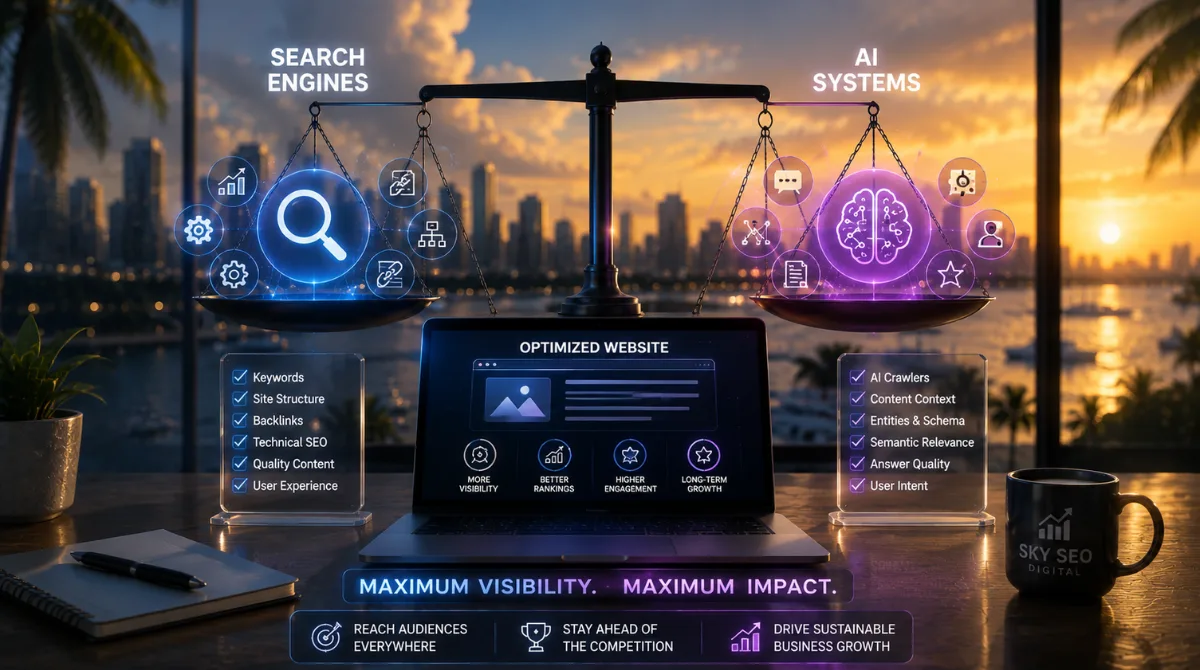
Relying on your website to perform only in traditional Google search is no longer enough. SEO and AI optimization work together to make your website easier to discover, understand, and trust across both search engines and AI-powered search platforms.
As Google expands AI-driven search features and tools such as ChatGPT increasingly help users find information online, businesses need a broader digital visibility strategy. Strong keyword targeting still matters, but it should be supported by helpful content, solid technical SEO, clear website structure, relevant entities, and credible authority signals that help both people and AI systems understand what your business offers.
Why Traditional SEO Still Matters
AI-powered search is changing how people discover information, but it does not replace traditional SEO. Search engines still need to crawl, render, understand, and index your website before they can determine where and when your content should appear.
That makes a strong SEO foundation essential. Technical SEO, useful and relevant content, descriptive page titles, logical internal linking, website performance, and authoritative backlinks all contribute to making your site accessible and understandable to search engines.
Google also emphasizes creating helpful, reliable, people-first content and using relevant language in clear, descriptive areas of a page. For businesses targeting customers in Miami and South Florida, effective SEO goes beyond adding location keywords. Your content should reflect local search intent, the services you provide, the areas you serve, and the questions your potential customers actually ask.
In other words, AI optimization works best when it is built on a solid SEO foundation. If you want to strengthen that foundation, explore Sky SEO Digital’s SEO services to learn how a comprehensive SEO strategy can improve your website’s visibility.
Why AI Search Changes the Optimization Equation
AI-powered search experiences interpret questions conversationally. Instead of searching only for “Miami SEO agency,” a user might ask:
“Which SEO agency in Miami is experienced with AI search for a local business?”
The underlying goal is different. The system has to identify entities, understand relationships, evaluate relevance, and potentially synthesize information from multiple sources.
That is where AEO, GEO, semantic SEO, and entity optimization become useful complements to traditional SEO.
Google’s current guidance for AI search emphasizes many of the same fundamentals as conventional Search: original, valuable content, strong page experience, and making content accessible to crawling and indexing systems.
SEO vs. AI Optimization: What’s the Difference?
| Traditional SEO | AI Search Optimization |
| Targets search queries and rankings | Targets understanding, retrieval, and answers |
| Focuses heavily on keywords and pages | Focuses on entities, context, meaning, and clear answers |
| Builds organic visibility | Builds visibility across AI-assisted search experiences |
| Uses technical SEO and links | Adds structured content, entity clarity, and answer-focused information |
The important point is that these approaches overlap rather than compete.
A technically strong, authoritative website with useful content gives both search engines and AI systems better material to interpret.
What Should You Optimize?
1. Make Your Content Clear and Comprehensive
Write pages that directly answer the questions your customers actually have.
Instead of creating separate thin pages for every keyword variation, build useful resources around topics and related questions. Include definitions, examples, limitations, comparisons, and practical next steps where appropriate.
Google recommends people-first content that demonstrates expertise and provides substantial value rather than content created primarily to manipulate rankings.
2. Strengthen E-E-A-T Signals
AI systems and search engines need trustworthy information.
Show who created your content, demonstrate relevant experience, cite credible sources when appropriate, maintain accurate business information, and make your organization easy to understand.
E-E-A-T stands for experience, expertise, authoritativeness, and trustworthiness. Google notes that E-E-A-T is not itself a single ranking factor, but its systems use signals associated with high-quality, trustworthy content. Developers
3. Use Structured Data and Entity Signals
Structured data can help Google understand the content and entities represented on a page and can make pages eligible for certain rich search features.
That does not mean schema markup guarantees an AI citation or rich result. It means you’re giving search systems clearer machine-readable context.
Your organization, people, services, locations, articles, and relationships should also be represented consistently across your website and reputable external sources.
4. Keep Technical SEO Strong
AI optimization cannot compensate for a website that search systems struggle to access.
Check:
- Crawlability and indexability
- Internal linking
- XML sitemaps
- Mobile usability
- Page performance
- Canonicalization
- Structured data
- Robots directives
- Clear site architecture
For ChatGPT Search specifically, OpenAI says websites should allow OAI-SearchBot to crawl their content if they want their site to be available for consideration in search results. There is no guaranteed placement.
5. Build Topical and Brand Authority
One excellent article rarely establishes authority.
Create a connected content ecosystem covering your core services, customer questions, industry terminology, use cases, and related topics. Link those resources together logically.
For example, a Miami business could connect pages about local SEO, technical SEO, AI search, AEO, content strategy, and conversion optimization rather than treating each subject as an isolated keyword.
Common Mistakes to Avoid
Keyword stuffing: Repeating phrases does not create topical authority.
Mass-producing AI content: Google warns that generating many pages with AI without adding value can violate its spam policies.
Ignoring technical SEO: Great content cannot help as much if important pages cannot be properly crawled or indexed.
Chasing AI citations: No legitimate strategy can guarantee that ChatGPT, Google AI Overviews, or another system will cite your website.
Writing for machines instead of people: The strongest approach is still useful, original content created primarily to satisfy the user’s need.
A Better Website Strategy for 2026
In 2026, your website should be more than a collection of pages designed to rank for individual keywords. Think of it as a trusted source of information that helps search engines, AI systems, and potential customers understand your business.
Start with a technically accessible website, then build useful, original content around the topics and questions that matter to your audience. Make your business, services, expertise, and relationships between related topics clear. At the same time, strengthen your authority through credible information, relevant mentions, and a consistent online presence.
Your measurement strategy should evolve, too. Look beyond traditional organic rankings and traffic to understand how your content performs across emerging AI-powered search experiences.
Google has also introduced reporting in Search Console to help eligible site owners understand performance from certain generative AI search features, giving businesses another way to evaluate their visibility as search continues to evolve.
Ultimately, successful search optimization starts with the right people and strategy behind it.
Building a Unified SEO and AI Search Strategy
The future of search is not SEO versus AI. It is a unified visibility strategy where technical SEO, helpful content, entity understanding, authority, and AI-search readiness reinforce one another.
If your website was built only to rank for keywords, now is a good time to evaluate whether it is also easy for AI-driven search systems to understand and trust.
For a practical assessment of your website’s organic and AI-search visibility, contact Sky SEO Digital for a strategy consultation.
FAQs
What is AI search optimization?
AI search optimization is the process of making website content easier for AI-powered search systems to discover, understand, evaluate, and use when answering user questions. It complements traditional SEO rather than replacing it.
Is traditional SEO still important for AI search?
Yes. Technical SEO, crawlability, indexability, relevant content, internal links, and authority remain important foundations. Google explicitly says its guidance for AI search builds on established Search fundamentals.
What is the difference between AEO and SEO?
SEO generally focuses on improving visibility in search engines, while Answer Engine Optimization focuses more specifically on making information useful and understandable for answer-oriented search experiences. In practice, the two strategies share many foundational techniques.
Does schema markup help with AI search?
Structured data can help search systems understand information on a page and can support eligibility for certain Google search features. However, schema markup does not guarantee rankings, AI citations, or inclusion in a particular search feature.
Can AI-generated content hurt SEO?
AI-assisted content is not automatically harmful. The risk comes from producing low-quality, unoriginal, or mass-generated pages without meaningful value; Google recommends prioritizing accuracy, quality, relevance, and people-first content.
How can I make my website more visible in ChatGPT Search?
Make your site accessible to OAI-SearchBot, publish reliable and useful information, maintain strong technical SEO, and establish clear authority around your subject. OpenAI states that there is no way to guarantee top placement in ChatGPT Search.