
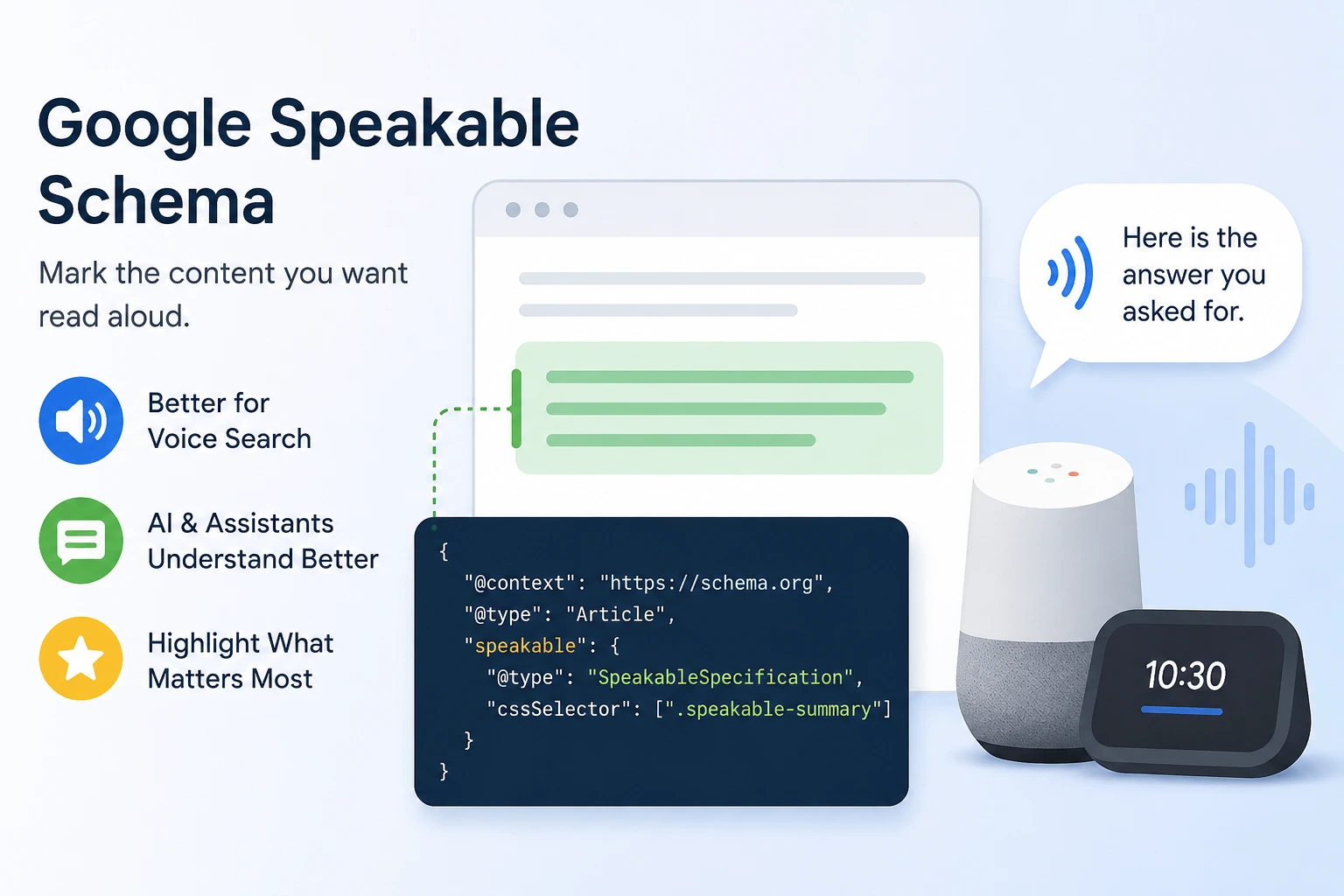
As search shifts from typing to talking, search engines and AI assistants are looking for content they can easily read aloud. That is where Google’s “Speakable” structured data comes in.
Google created Speakable schema to help identify sections of a webpage that are best suited for text-to-speech playback on devices like Google Assistant. Instead of reading an entire article, Google can choose a short section that directly answers a question.
For businesses focused on AEO (Answer Engine Optimization), Speakable schema is becoming increasingly relevant because it helps AI systems understand:
- Which content matters most
- Which section best answers a spoken query
- Which part of the page should be read aloud
What Is Speakable Schema?
Speakable schema is a type of structured data based on Schema.org vocabulary. It allows publishers to highlight specific parts of a page that are ideal for voice responses and audio playback.
In simple terms:
- Traditional SEO helps pages rank
- FAQ schema helps Google understand questions and answers
- Speakable schema helps AI assistants know what to read aloud
Google originally introduced Speakable schema for news content and Google Assistant devices, but its purpose aligns closely with modern AI search and voice search behavior.
Why Speakable Schema Matters for AEO
AEO focuses on becoming the direct answer inside:
- Google AI Overviews
- ChatGPT
- Gemini
- Perplexity
- Voice assistants
- Smart speakers
Speakable schema supports this goal because it encourages publishers to structure concise, conversational answers that machines can easily interpret.
This is important because AI systems increasingly prefer:
- Clear summaries
- Direct responses
- Conversational language
- Easily extractable content
Instead of forcing AI to guess which paragraph matters most, Speakable schema essentially says:
“Read this section first.”
How Speakable Schema Works
The markup identifies a specific section of content using:
- CSS selectors
- XPath references
Google then uses those highlighted sections for text-to-speech playback.
A simplified JSON-LD example looks like this:
<script type="application/ld+json">
{
  "@context": "https://schema.org",
  "@type": "Article",
  "speakable": {
    "@type": "SpeakableSpecification",
    "cssSelector": [
      ".speakable-summary"
    ]
  },
  "headline": "What Is Speakable Schema?"
}
</script>
The .speakable-summary class would contain the short section you want AI systems or voice assistants to prioritize.
Best Practices for Speakable Content
Google recommends using concise sections that sound natural when spoken aloud.
Good speakable content usually includes:
- 2–3 short sentences
- Conversational language
- Direct answers
- Simple wording
- Clear pronunciation
Example of Good Speakable Content
“Speakable schema helps Google identify parts of a webpage that are ideal for voice search and audio playback. It improves how AI assistants understand and read your content aloud.”
That works much better than:
- Long paragraphs
- Keyword stuffing
- Technical jargon
- Overly promotional language
Speakable Schema vs FAQ Schema
Many people confuse Speakable schema with FAQ schema, but they serve different purposes.
| Feature | Speakable Schema | FAQ Schema |
|---|---|---|
| Main Purpose | Audio playback and voice responses | Question-and-answer rich results |
| Focus | What should be read aloud | What questions are answered |
| Designed For | Voice search and AI assistants | Google Search rich snippets |
| Content Style | Short spoken summaries | Structured Q&A pairs |
| Output | Text-to-speech responses | Expandable FAQ results |
| Best Use Case | Conversational summaries | Supporting informational content |
FAQ schema organizes questions and answers.
Speakable schema identifies the exact section AI systems should vocalize.
They can work together on the same page.
Speakable Schema vs Traditional Structured Data
Older structured data types focused heavily on categorization:
- Article schema
- Product schema
- LocalBusiness schema
- FAQPage schema
Those schemas help search engines understand:
- What the page is about
- What type of content exists
- Who created it
- Associated metadata
Speakable schema is different because it focuses on usability for AI narration and voice delivery.
Instead of classifying content, it prioritizes:
- Readability
- Conversational flow
- Audio-friendly formatting
This aligns closely with modern AEO strategies where clarity often matters more than keyword density.
Is Speakable Schema Still Important?
Yes — especially as search becomes increasingly AI-driven.
Even though Speakable schema remains in beta and has historically been tied to Google Assistant news responses, the broader concept behind it is becoming more important:
- Structured answers
- Conversational formatting
- Machine-readable summaries
- Voice-ready content
Modern AI systems increasingly favor pages that:
- Provide quick answers early
- Use natural language
- Structure content clearly
- Include semantic markup
In many ways, Speakable schema predicted where search was heading years ago.
Does Speakable Schema Improve Rankings?
Not directly.
Google has never confirmed Speakable schema as a ranking factor.
However, it can indirectly help by:
- Improving content structure
- Supporting voice search visibility
- Making answers easier for AI systems to extract
- Increasing eligibility for spoken responses
For AEO, that matters because visibility is increasingly about:
- Being selected
- Being cited
- Being read aloud
- Being summarized by AI
Not just ranking #1.
Who Should Use Speakable Schema?
Speakable schema works best for:
- News publishers
- Educational sites
- Service businesses
- FAQ-heavy websites
- Local businesses
- Healthcare websites
- Legal websites
- Financial content
- Blogs answering common questions
It is especially useful when users are likely to ask voice-based questions such as:
- “What does a DUI lawyer do?”
- “How much does Botox cost?”
- “What is AEO?”
- “How does bankruptcy work?”
AEO Strategies That Pair Well With Speakable Schema
Speakable schema works best when combined with:
- FAQ schema
- Strong heading structure
- Short answer paragraphs
- Semantic keywords
- Authoritative citations
- Conversational writing
- Internal linking
- Entity optimization
This combination helps AI systems better understand:
- The topic
- The intent
- The answer hierarchy
- The most important information
Common Mistakes
Marking Entire Articles as Speakable
Only highlight the best summary sections.
Writing Robotic Content
Speakable content should sound natural aloud.
Using Long Paragraphs
Short, direct responses work best.
Ignoring User Intent
The marked section should directly answer a question.
Stuffing Keywords
AI systems increasingly prioritize clarity over repetition.
FAQs
What is Google Speakable schema?
Google Speakable schema is structured data that identifies sections of a webpage that are best suited for text-to-speech playback and voice assistant responses.
Is Speakable schema good for AEO?
Yes. Speakable schema supports Answer Engine Optimization by helping AI systems identify concise, conversational answers that can be read aloud or summarized.
Does Speakable schema replace FAQ schema?
No. FAQ schema organizes questions and answers, while Speakable schema identifies which content should be spoken aloud. They serve different purposes and can work together.
Can Speakable schema help with voice search?
Yes. Speakable schema was specifically designed to support voice search and Google Assistant playback.
Is Speakable schema still in beta?
Yes. Google still labels Speakable schema as a beta feature.
What type of content works best for Speakable schema?
Short summaries, direct answers, definitions, introductions, and conversational explanations work best.
Does Speakable schema guarantee AI visibility?
No. Structured data helps AI systems understand content better, but it does not guarantee rankings or citations.
Can local businesses use Speakable schema?
Yes. Local businesses can use Speakable schema on informational pages, FAQs, and service pages that answer common customer questions.
How long should speakable content be?
Google generally recommends short sections that take around 20–30 seconds to read aloud.
Is Speakable schema part of Schema.org?
Yes. Speakable schema uses the Schema.org SpeakableSpecification type.