
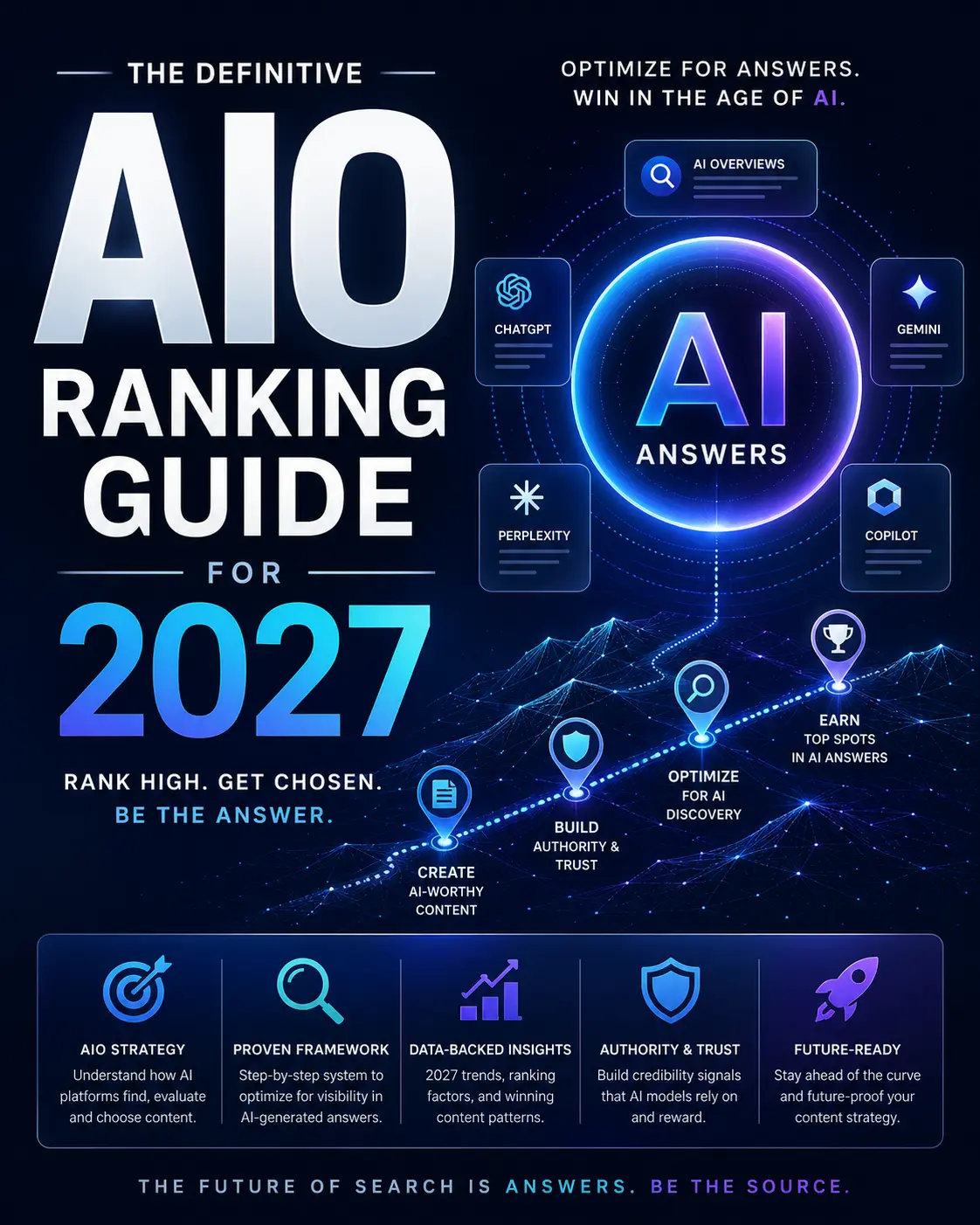
Ranking in AI Overviews is really about giving Google’s AI the best possible answer to a question—fast, clear, and trustworthy—then backing it up with strong SEO and brand signals.
Key Takeaways
- AI Overviews (AIO) are AI-generated summaries at the top of Google Search that pull from multiple sources and link out to websites.
- They still rely on Google’s core ranking systems—helpful content, links, freshness, spam filters—plus new AI systems designed for speed and relevance.
- Answer Engine Optimization (AEO) is your strategy for earning citations across all AI answer engines (ChatGPT, Gemini, Perplexity, Copilot), not just Google’s AIO.
- To rank in AIO, focus on:
- Clear, answer-first content
- Structured data (especially FAQ / HowTo)
- Strong topical authority and E-E-A-T
- Fast, mobile-friendly UX
- Think long-term: build an AIO/AEO content system, not one-off “AI overview bait” posts.
What Are AI Overviews, Really?
Google’s AI Overviews are AI-generated snapshots that answer a query using short paragraphs, bullets, and sometimes product cards or images, plus links so people can “dig deeper” on the open web.
Key points:
- They appear at the top of the results page (usually under ads but above most organic results).
- They’re powered by Google’s Gemini models and systems like FastSearch, which are tuned for speed and concise answers.
- When AIO shows up, it can divert a chunk of clicks away from classic blue links and toward whatever is cited in the overview.
So if you’re not in that AI snapshot—or at least in the links it highlights—you’re fighting over less real estate.
How AI Overviews Choose Which Sites to Show
Google has said that AI features like Overviews are grounded in the same ranking systems that power normal search (helpful content, PageRank, freshness, spam systems, etc.).
In plain English, that means:
- Relevance & intent match
- Does your content directly answer the question being asked, in the same language and context?
- Quality & helpfulness
- Is your content accurate, in-depth, and actually useful—not thin or generic?
- Authority & trust (E-E-A-T)
- Experience, Expertise, Authoritativeness, and Trustworthiness: Are you a recognized source in that niche?
- Freshness
- For fast-changing topics (AI, finance, health, regulations, etc.), newer content often wins.
- Technical & UX basics
- Fast loading, mobile-friendly, secure, and easy to read—especially on mobile.
- Structured context
- Schema markup and clean structure help Google’s systems understand where your best answer lives on the page.
Think of AIO as Google saying: “Out of all the content we already trust, who has the clearest, most useful, easy-to-summarize answer right now?”
AIO vs AEO: Same Game, Wider Field
You’ll see “AIO” (AI Overviews optimization) and “AEO” (Answer Engine Optimization) used almost interchangeably:
- AIO = specifically about Google’s AI Overviews and related AI experiences in Search.
- AEO = bigger umbrella: optimizing for all AI answer engines—ChatGPT, Copilot, Perplexity, Gemini, and Google’s AIO.
If you want a deeper dive into the broader AEO mindset, check out your own post “AEO: The Next Frontier of Search” once it’s live in full on the site (you’ve already got the teaser on the blog). Linking from this article to that one will reinforce the internal AEO cluster.
Chart: Classic SEO vs AI Overview Focus
Here’s a simple “at a glance” chart to help non-technical stakeholders understand the shift:
| Area | Classic SEO (Blue Links) | AI Overview / AIO Focus |
|---|---|---|
| Main goal | Rank a page in the top 10 | Be selected as the answer or a cited source |
| User behavior | Skim titles and meta descriptions | Read AI summary, then maybe click 1–3 links |
| Content style | Comprehensive pages, long-form guides | Clear answer up top, then depth and nuance below |
| Structure | H1/H2s, internal links | Q&A blocks, concise lists, schema-enhanced sections |
| Ranking signals | Links, on-page SEO, engagement | All of the above + answer clarity + semantic coverage |
| Platforms involved | Mostly Google Search | Google AIO, Gemini, ChatGPT, Perplexity, Copilot, etc. |
| Measurement | Clicks, rankings, conversions | Citations in AI answers, assisted traffic, brand mentions |
7 Practical Ways to Improve Your Chances of Ranking in AI Overviews
1. Start with the answer in the first 2–3 sentences
For any page targeting an AI-heavy query (e.g., “how to choose a Miami SEO agency” or “what is generative engine optimization”), open with a direct, plain-language answer:
- One or two short sentences that answer the question
- Then expand with context, examples, and nuance
AIO systems tend to pull content from the top or clearly labeled sections where the main question is answered succinctly.
2. Design pages for skimmable snippets
AI systems love well-structured content because it’s easy to parse and recombine into summaries.
On-page formatting tips:
- Use clear H2/H3 headings phrased as questions (“How does X work?”, “What is Y?”).
- Break key steps into short bulleted lists.
- Use short paragraphs (2–4 lines) for readability.
- Include Q&A blocks that look like FAQs (these often double as great snippet fodder).
3. Use structured data to label your best answers
Structured data (schema) doesn’t “force” you into AI Overviews, but it makes your content easier for AI to understand and trust.
Focus on:
- FAQPage schema for Q&A sections
- HowTo schema for step-by-step guides
- Product, Service, and LocalBusiness where relevant
Why it helps:
- Gives Google machine-readable context: questions, answers, steps, entities
- Increases your chance of being used in AI answers and rich results across devices
4. Build topical authority, not orphan posts
AI systems prefer sites that show depth in a subject, not one-off posts.
For example, on Sky SEO Digital you’re already building a strong AI/AEO hub with posts like:
- How to Rank on Google’s AI Overviews
- How to Get Cited by AI: SEO Strategies That Put Your Content in the Spotlight
- What is Generative Engine Optimization? (And How to Use It)
For a new client, think in terms of topic clusters:
- A pillar page (“Guide to AI Overviews for Law Firms”)
- Supporting posts (“Examples of AI Overview queries for law firms,” “Schema for legal services,” “How to measure AIO impact”)
- Internally link them heavily with descriptive anchor text
That’s AEO in action: turning your site into an obvious, go-to source for a specific topic.
5. Keep your content fresh and specific
AI Overviews are more likely to appear on complex, multi-part questions—and those queries often involve time-sensitive information.
Tactics:
- Add “Updated [Month Year]” near the top of important guides.
- Refresh key stats, screenshots, and examples at least once or twice a year (more for hot topics like Google updates).
- Add a short “What changed in 2025” section instead of rewriting the whole article.
This doesn’t just help AIO; it also boosts your regular ranking potential via Google’s “freshness” systems.
6. Fix UX basics: speed, mobile, clarity
Even though this sounds like old-school SEO, it matters for AIO because:
- Poor UX → lower engagement → weaker signals → less chance to be selected.
- Mobile is the default device for most searches where AIO shows up.
Checklist:
- Aim for Core Web Vitals in the green (especially LCP and CLS).
- Make sure text is readable on mobile without pinch-zoom.
- Avoid aggressive pop-ups over the main content.
- Use simple navigation and clear breadcrumb trails.
7. Strengthen your brand and backlinks
Google’s AI experiences lean heavily on trusted sources each time they summarize and cite.
That means:
- Earning editorial backlinks from respected sites in your niche
- Getting brand mentions (even unlinked) across the web
- Building a consistent brand footprint: same name, logo, messaging across your site, social, and profiles
This is where your existing thought leadership content and eBooks (like “How to Rank in ChatGPT”) become powerful AEO assets—other sites reference them, and AI models see those signals when picking answers.
AIO Optimization Checklist (What to Fix on Every Page)
| Element | What Google’s AI Wants | What to Do |
|---|---|---|
| Opening Paragraph | Immediate answer to the query | Answer the question in 1–2 sentences at the top |
| Headings (H2/H3) | Clear semantic structure | Use question-based headings (What, How, Why) |
| Paragraph Length | Easy-to-scan content | Keep paragraphs 2–4 lines max |
| Lists & Bullets | Extractable snippets | Turn steps, tips, and benefits into bullets |
| Internal Linking | Topic relationships | Link to supporting posts in your cluster |
| Schema Markup | Machine-readable context | Add FAQ, HowTo, Service schema where relevant |
| Content Depth | Complete coverage | Include examples, use cases, and edge cases |
| Freshness Signals | Up-to-date info | Add “Updated 2027” and refresh stats regularly |
| Brand Mentions | Trust and authority | Mention your brand naturally across content |
| UX & Speed | Clean user experience | Fast load times and mobile-friendly layout |
A Simple AIO Content Template You Can Reuse
When you write your next AIO-targeted post, you can follow a simple structure:
- Hook + direct answer
- 2–3 sentences answering the main question in plain language.
- Key Takeaways
- 3–5 bullets summarizing what the reader (and AI engine) should remember.
- Short explainer section
- “What is X?” or “How does X work?” with a clean H2.
- Chart or comparison
- A small table (like the one above) to show differences, steps, or trade-offs.
- Deep-dive sections (H2/H3)
- Each focused on a sub-question: “How do I implement this?”, “What are the risks?”, “How long does it take?”
- FAQ section
- 5–10 question/answer pairs at the end that mirror real queries.
- Soft CTA
- Clear next step (“Book a strategy call,” “Download the eBook,” “Contact our team”).
This layout is basically AEO in page form—you’re giving AI engines multiple ways to grab useful, self-contained chunks.
FAQs About Ranking in AI Overviews
Is there a special “AI Overview” tag I can add to my pages?
No. There’s no dedicated meta tag or schema just for AI Overviews. Google’s AI features rely on your existing SEO foundations—helpful content, structured data, links, and UX—plus its own AI systems.
Does keyword stuffing help me show up in AI Overviews?
No—and it can hurt you. Over-optimized, spammy copy is more likely to be ignored or demoted by Google’s core ranking and spam systems. Focus on natural language that directly answers real questions.
How long does it take to appear in an AI Overview?
It varies. If your site already has strong authority in a topic, you might get picked up quickly after publishing or updating a page. For newer sites, it can take months of building topical depth, links, and brand signals before AI systems reliably trust and cite you.
Can AI Overviews send meaningful traffic, or do they steal clicks?
Both can be true. Some studies and publisher groups report traffic drops when AIO appears, but Google says AI Overviews can broaden the range of sites that get clicks. If you’re cited prominently, you can still win high-intent visitors—even if overall CTR is lower than traditional SERPs.
Do I need schema on every page to rank in AI Overviews?
Not necessarily, but it helps on key pages. Prioritize schema on your main guides, FAQs, and how-to content. Those are the kinds of pages AI systems frequently draw from when constructing summaries.
Is AEO only about Google, or does it help with ChatGPT, Perplexity, and others too?
AEO is cross-platform by design. When you structure content well, build topical authority, and earn trustworthy mentions, you’re improving your odds across Google AI Overviews, Gemini, ChatGPT, Copilot, Perplexity, and any future answer engines.
How to Make AI
Ranking in AI Overviews isn’t about chasing a shiny new trick. It’s about:
- Taking everything you know about good SEO
- Combining it with answer-first content and structured data
- And committing to topical authority + brand-building over time
If you treat AI Overviews as just another SERP feature, you’ll tweak a few pages and move on. If you treat AIO as part of a broader AEO strategy, you’ll build an asset that works across Google, Gemini, ChatGPT, Perplexity, and whatever comes next.
Sources & Further Reading
Google Search Central – “AI features and your website” (2025). (Google for Developers)
Google Search Central Blog – “Top ways to ensure your content performs well in Google’s AI-powered experiences” (May 2025). (Google for Developers)
BrightEdge – “Ultimate Guide to AI Overviews” (2024/2025). (BrightEdge)
SEO.com / Sarah Berry – Guides to Answer Engine Optimization (AEO) (2025). (SEO.com)