
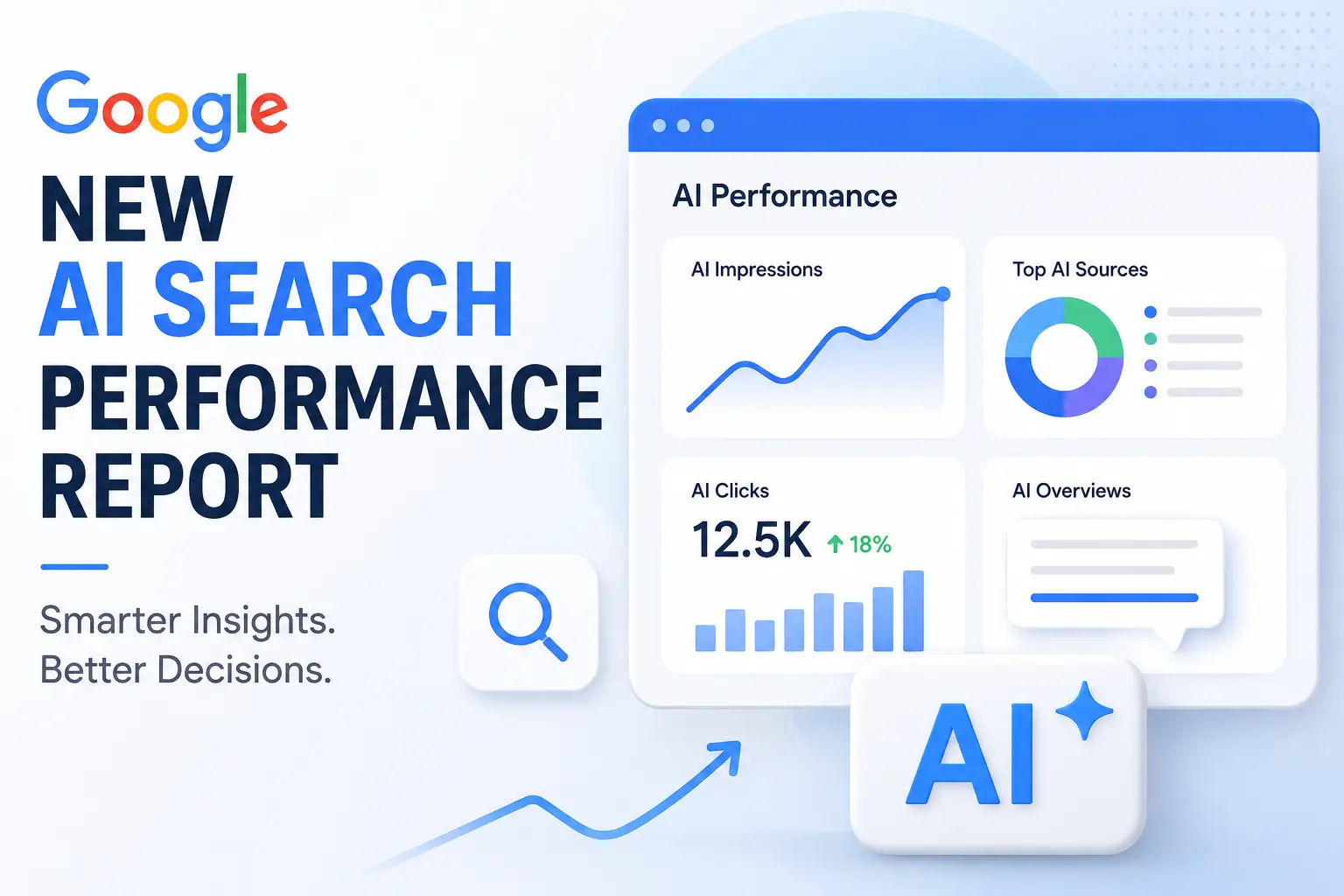
Google has officially taken another major step into the AI search era.
In June 2026, Google announced new reporting capabilities that allow website owners to better understand how their content performs within AI-powered search experiences, including AI Overviews and AI Mode. For the first time, businesses can view AI-generated search visibility separately from traditional organic search performance.
For marketers, business owners, and SEO professionals, this is one of the most significant search updates of the year.
Why This Matters
For years, website owners have been asking:
- How much traffic comes from AI search?
- Which pages are being cited by AI?
- Are AI Overviews helping or hurting my website?
- How do I measure AEO performance?
Until now, most of the answers involved educated guesses.
Google’s new reporting provides greater visibility into how content performs across AI-powered search experiences, helping businesses measure a growing source of impressions and engagement.
The Background: Search Is Changing Fast
Traditional Google Search was relatively straightforward:
- User searches.
- Google displays links.
- User clicks a result.
- Website receives traffic.
AI search changes that model.
Today, users increasingly receive:
- AI-generated summaries
- Direct answers
- Multi-step responses
- Conversational search experiences
Google’s AI Overviews and AI Mode often answer questions before users ever visit a website.
This has created concerns across industries because traditional metrics such as clicks and rankings no longer tell the whole story.
A website may influence an AI-generated answer without receiving a click.
Why Tracking AI Performance Has Been So Difficult
One of the biggest challenges for marketers has been attribution.
Unlike traditional search results, AI systems:
- Aggregate information from multiple sources
- Generate new summaries
- Reference multiple pages
- May not always send traffic
This creates several measurement challenges:
| Traditional SEO | AI Search |
| Rankings are visible | Citations may not be visible |
| Clicks are measurable | Influence may not generate clicks |
| Search results are consistent | Responses vary by user |
| Position tracking is straightforward | AI answers constantly evolve |
Because of this, many SEO tools have struggled to accurately measure AI visibility.
Google’s new reporting helps close that gap.
SEO vs AEO: What’s the Difference?
Many business owners are hearing the term “AEO” for the first time.
SEO (Search Engine Optimization)
Traditional SEO focuses on:
- Rankings
- Organic traffic
- Backlinks
- Technical optimization
- Keyword visibility
The goal is to get users to click your website.
AEO (Answer Engine Optimization)
AEO focuses on:
- Being cited by AI systems
- Answering questions clearly
- Building topical authority
- Structured content
- Trustworthiness and expertise
The goal is to become the source behind the answer.
The Good News: SEO Still Matters
One of the biggest misconceptions is that SEO is dead.
In reality, strong SEO remains the foundation of strong AEO.
Studies consistently show that websites already performing well in organic search are more likely to appear in AI-generated responses and citations.
That means:
- Technical SEO still matters
- Content quality still matters
- Authority still matters
- User experience still matters
AEO is not replacing SEO.
AEO is becoming an extension of SEO.
What Google’s New Reports Could Reveal
As adoption grows, business owners may begin discovering:
Which Content AI Uses Most
Some pages may receive little traffic but frequently appear in AI-generated answers.
These pages could become valuable authority assets.
Which Topics Generate AI Visibility
Businesses may identify content categories that perform exceptionally well in AI search environments.
New Content Opportunities
Questions frequently answered by AI can reveal gaps in existing content strategies.
Differences Between Click Performance and Citation Performance
Pages that perform poorly in traditional SEO may still perform well in AI search.
This creates entirely new optimization opportunities.
What Business Owners Should Do Next
1. Continue Investing in SEO
Do not abandon traditional SEO.
Organic rankings remain one of the strongest indicators of future AI visibility.
2. Build More Question-Based Content
Create content that directly answers:
- Who
- What
- When
- Where
- Why
- How
This aligns with both AI search and traditional search behavior.
3. Focus on Topical Authority
Publish clusters of related content instead of isolated articles.
AI systems increasingly reward comprehensive expertise.
4. Add Structured Data
Schema markup helps search engines understand content more effectively.
5. Monitor AI Reporting
As Google expands AI reporting, regularly review:
- AI impressions
- AI clicks
- Citation trends
- Top-performing content
6. Optimize for Entities
Brands, people, products, services, and locations are becoming increasingly important signals for AI systems.
What This Means for Agencies and Marketing Teams
Expect reporting conversations to change.
Instead of only discussing:
- Rankings
- Organic traffic
- Click-through rates
Marketing teams will increasingly discuss:
- AI visibility
- AI citations
- AI impressions
- Answer engine performance
- Brand mentions in AI responses
Businesses that adapt early may gain a significant advantage as AI-powered search continues to grow.
Frequently Asked Questions
Does this mean SEO is dead?
No. Strong SEO remains one of the best predictors of visibility in AI search experiences.
What is AEO?
AEO stands for Answer Engine Optimization. It focuses on helping content become a trusted source for AI-generated answers.
Will AI search reduce website traffic?
In some cases, yes. Users may get answers directly from AI-generated responses without clicking through to websites.
Can AI visibility be measured now?
Google’s new reporting is a major step toward providing more transparency into AI-generated search performance.
Should businesses create separate content for AI?
Generally no. The best strategy is to create high-quality content that serves both traditional search users and AI systems.
What types of content perform best in AI search?
Content that is authoritative, well-structured, factual, and directly answers user questions tends to perform well.
Will rankings still matter in 2026?
Absolutely. Traditional rankings remain a major signal and often correlate with AI visibility.
Key Takeaways
- Google has introduced new reporting for AI-powered search performance.
- Businesses can begin measuring AI visibility more effectively.
- AI search creates new challenges for attribution and tracking.
- AEO is becoming an important complement to traditional SEO.
- Strong SEO remains the foundation of strong AI visibility.
- Question-based content and topical authority are becoming increasingly important.
- Business owners should start monitoring AI performance alongside traditional search metrics.
- The future of search will likely involve a combination of rankings, clicks, citations, and AI-generated visibility.
The businesses that succeed over the next few years will not choose between SEO and AEO. They will build strategies that support both.