
TLDR
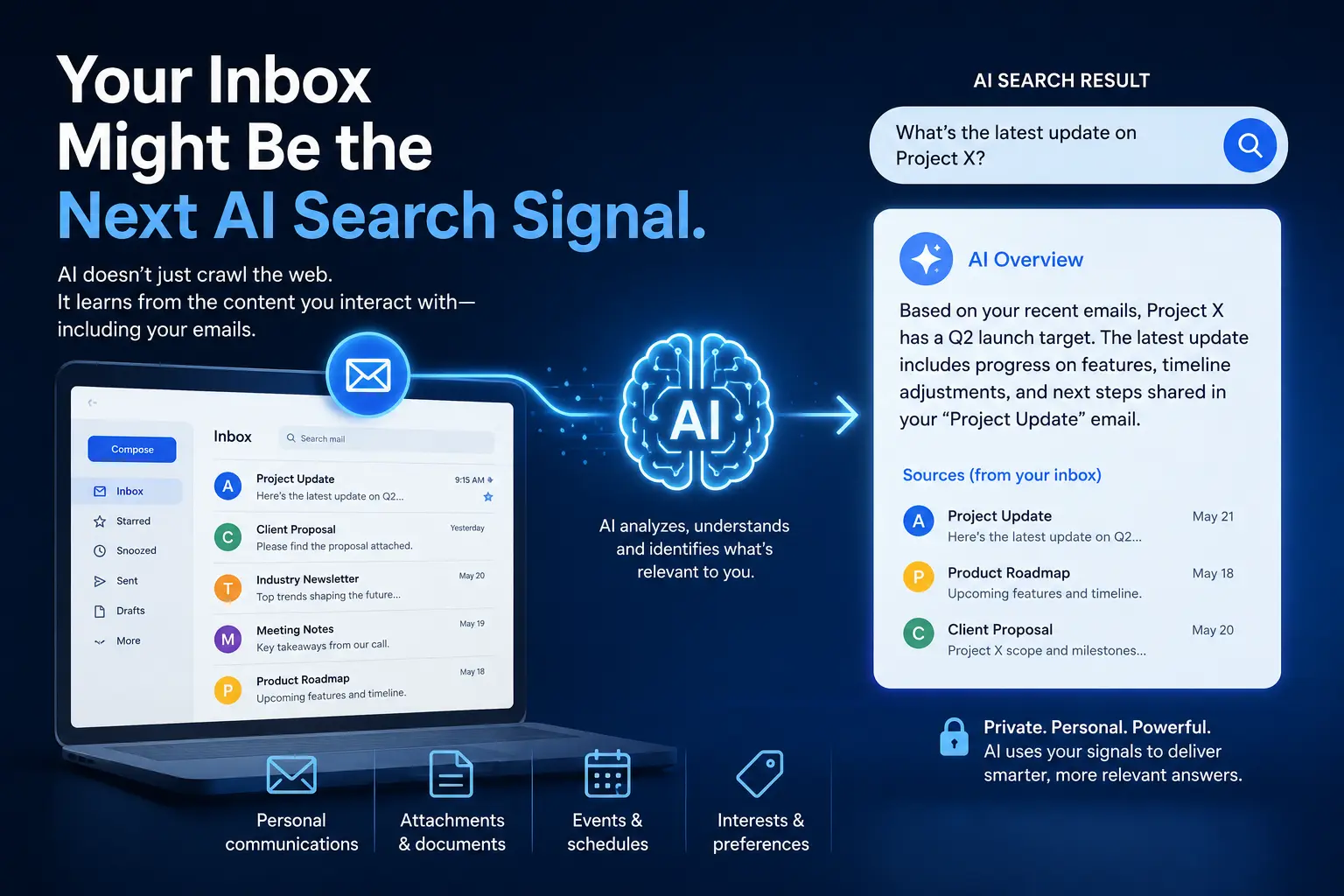
- Google’s Personal Intelligence may use opt-in data from Gmail and other Google apps to personalize AI Mode answers.
- An iPullRank experiment found that Gmail signals influenced which brands appeared in AI Mode recommendations.
- This could make email marketing, brand mentions, reviews, and owned audience touchpoints more important for AI search visibility.
- The big takeaway: SEO is no longer only about public web rankings. AI answers may also be shaped by personal context.
Overview
Google Search is becoming more personal. With AI Mode and Personal Intelligence, Google is testing how connected data from tools like Gmail and Photos can help shape search results and recommendations. That means the future of search may not be based only on websites, backlinks, and public content. It may also be influenced by what users receive, save, open, and interact with inside their personal Google ecosystem.
According to iPullRank’s original article, Gmail-based brand signals changed AI Mode recommendations in a controlled experiment. That is a major development for SEO, AEO, email marketing, and brand strategy.
What Is Google Personal Intelligence?
Google Personal Intelligence is an opt-in feature that allows Google’s AI systems to use personal context from connected apps. For example, if a user connects Gmail or Google Photos, AI Mode may be able to use that information to deliver more personalized answers.
Instead of giving every user the same answer, Google may tailor responses based on what it knows about that person’s preferences, history, emails, files, photos, and activity.
Why This Matters for AI Search
Traditional SEO focuses on ranking public web pages. AEO, or Answer Engine Optimization, focuses on helping brands appear inside AI-generated answers. Personal Intelligence adds another layer: private user context.
If AI search engines begin using personal data to shape recommendations, then brand visibility may depend on more than your website. It may also depend on your emails, customer relationships, receipts, newsletters, product education, reviews, and how often people interact with your brand across platforms.
The Key Finding: Gmail Signals Can Influence AI Recommendations
The most important finding from the experiment was that brands mentioned in Gmail appeared more often in AI Mode recommendations. This suggests that email content may become part of the personal context layer AI systems use when deciding what brands to recommend.
For businesses, this is a big shift. Email marketing may no longer be only a retention or sales channel. It may also help reinforce brand familiarity inside AI-powered search experiences.
What Brands Should Take Away
1. Email Marketing May Become an AI Search Signal
Well-written emails, newsletters, onboarding sequences, receipts, product guides, and follow-up messages may help AI systems understand how a user relates to a brand.
2. Brand Mentions Matter More Than Ever
AI systems need context. The more clearly your brand is connected to services, products, locations, use cases, and customer needs, the easier it is for AI to understand when to mention you.
3. Public Web Authority Still Matters
Personal context may help a brand enter the conversation, but public proof still matters. Websites, reviews, citations, product pages, third-party mentions, and trusted content help AI systems validate the recommendation.
4. AEO and SEO Need to Work Together
This experiment shows why brands should not separate SEO from AEO. Your website still needs to be optimized, but your broader digital presence also needs to be structured in a way AI can understand and trust.
How Businesses Can Prepare
- Create clear, helpful, answer-focused content on your website.
- Use email marketing to educate customers, not just sell to them.
- Build strong brand associations around your services, products, and locations.
- Improve reviews, testimonials, and third-party credibility signals.
- Use schema markup to help search engines understand your business.
- Publish comparison pages, FAQs, guides, and service-specific content.
- Make your brand easy for AI systems to identify, summarize, and recommend.
What This Means for SEO and AEO
Search is moving from rankings to recommendations. In the past, the goal was to rank on page one. Now, the goal is to be selected by AI as a trusted answer.
That means businesses need to optimize for visibility across multiple layers: traditional search, AI Overviews, AI Mode, ChatGPT, Gemini, Perplexity, email touchpoints, reviews, and brand mentions.
The companies that win in AI search will be the ones that are clearly understood, frequently mentioned, well-reviewed, and supported by strong digital trust signals.
FAQs
What is Google Personal Intelligence?
Google Personal Intelligence is an opt-in feature that allows Google’s AI tools to use personal context from connected apps like Gmail and Photos to create more personalized responses.
Can Gmail affect AI search results?
Based on iPullRank’s experiment, Gmail signals appeared to influence which brands showed up in Google AI Mode recommendations when Personal Intelligence was enabled.
Does this mean email marketing helps SEO?
Not in the traditional ranking sense. However, email marketing may help reinforce brand signals that AI systems can use in personalized search environments.
Is this the same as Google AI Overviews?
No. The experiment focused on AI Mode with Personal Intelligence enabled, not standard AI Overviews.
Should businesses change their SEO strategy?
Yes. Businesses should continue traditional SEO, but they should also invest in AEO, brand authority, email marketing, reviews, and structured content that helps AI understand and recommend them.
What is the biggest takeaway?
AI search is becoming more personalized. Your website matters, but your broader brand presence may also influence whether AI systems recommend your business.