
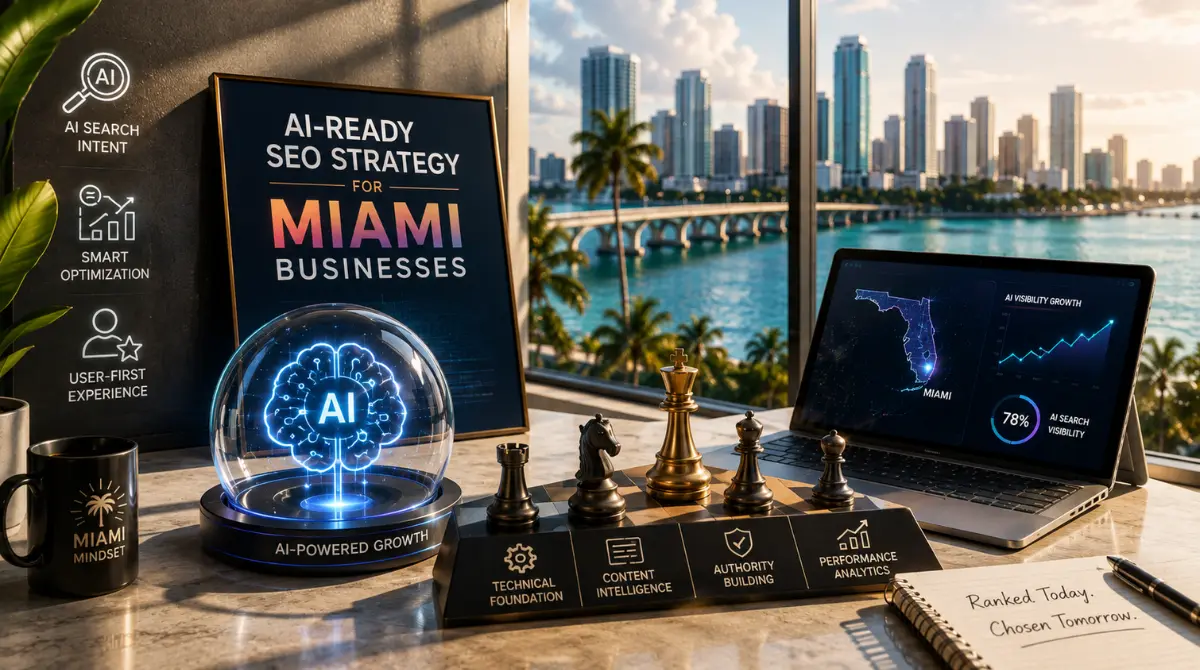
Traditional Google rankings alone may no longer be enough for Miami businesses navigating today’s evolving search landscape.
An AI-ready SEO strategy helps your website stay discoverable as customers increasingly turn to AI-powered search experiences to research businesses, compare options, and find answers. Google has stated that its AI features continue to rely on core Search systems and established SEO fundamentals rather than a separate set of secret ranking requirements.
For Miami companies, the opportunity extends beyond ranking for individual keywords. Your brand needs to be clear, credible, locally relevant, technically accessible, and genuinely useful so it can be surfaced across a wider range of search experiences.
What Does “AI-Ready SEO” Actually Mean?
AI-ready SEO is not simply adding AI-generated blog posts to your website. It combines traditional SEO with content, technical, entity, and local signals that help search systems understand your business and its expertise.
A strong strategy typically includes Technical SEO, covering crawlability, indexation, site structure, internal linking, and page experience. Entity SEO provides clear information about your business, services, locations, people, and areas of expertise, while Semantic SEO organizes content around topics, relationships, entities, and user needs rather than isolated keywords.
AEO focuses on clear, useful answers designed for conversational search experiences, while Local SEO strengthens business information, location relevance, reviews, and local authority. Content Marketing supports original content built around first-hand expertise and information that adds something beyond generic summaries.
Google specifically recommends valuable, non-commodity content and warns against creating large volumes of low-value pages primarily to manipulate AI search visibility.
Why Miami Businesses Have More to Gain
Miami isn’t a single, uniform search market. Someone looking for a service in Brickell may have very different needs from a customer in Coral Gables, Miami Beach, Doral, or elsewhere in Miami-Dade County. That makes local context a critical part of an effective SEO strategy.
Google says local search results are primarily influenced by relevance, distance, and prominence. Keeping your Google Business Profile accurate and complete also helps Google better understand your business and determine when it is relevant to local searches.
For an AI-ready local SEO strategy, the connection should be clear:
Business → Service → Expertise → Location → Customer Need
Consider a Miami real estate company. Instead of creating a generic page targeting “real estate services,” it could publish genuinely useful content addressing local buyer questions, neighborhood differences, property types, financing considerations, and the company’s first-hand market expertise.
This approach gives customers more useful information while giving search engines and AI-powered search systems stronger context about what the business does, where it operates, and why it is relevant.
Traditional SEO vs. AI-Ready SEO
| Traditional approach | AI-ready approach |
| Targets individual keywords | Builds topical and entity relevance |
| Focuses heavily on rankings | Focuses on visibility, relevance, and conversions |
| Creates generic informational content | Demonstrates first-hand expertise and useful context |
| Treats local SEO separately | Connects services, locations, entities, and reputation |
| Measures organic traffic | Also evaluates qualified leads and visibility across search experiences |
AI-ready SEO does not replace traditional SEO. It makes the underlying strategy more useful across evolving search interfaces. Google explicitly states that existing SEO best practices remain relevant to its generative AI experiences.
The Core Components of an AI-Ready Strategy
1. Build Content Around Real Customer Questions
Start with the questions prospects actually ask before contacting you.
For a Miami law firm, dentist, contractor, realtor, or ecommerce brand, that might mean answering questions about pricing factors, timelines, services, locations, qualifications, processes, and common problems.
The goal is not to manufacture hundreds of pages. It is to create authoritative resources that genuinely help someone make a decision.
2. Strengthen Your Local Entity
Your website, Google Business Profile, directories, reviews, and other reputable references should communicate consistent business information.
Include clear details about:
- What you do
- Who you serve
- Where you operate
- Your relevant expertise
- Your team and credentials
- How customers can contact you
Local SEO remains foundational because AI search does not eliminate the need for reliable business information.
3. Make Your Website Easy to Understand
AI systems still need accessible information.
Review your site’s crawlability, internal links, headings, navigation, structured data, and indexation. Google recommends ensuring important content is available in textual form and that structured data accurately matches visible content.
4. Demonstrate Experience and Trust
E-E-A-T matters because generic information is easy to reproduce.
Show the people behind the business. Explain processes. Reference genuine experience. Publish original insights, case studies, examples, and evidence where appropriate.
Google’s guidance emphasizes original, helpful, reliable, people-first content rather than content produced primarily for search manipulation.
5. Measure More Than Rankings
A modern SEO dashboard should connect search visibility with business outcomes.
Track relevant organic queries, qualified traffic, conversions, local visibility, leads, and engagement. Search Console can also help monitor performance from Google’s AI search experiences within the overall Web search reporting.
Common AI SEO Mistakes to Avoid
Publishing AI-generated content at scale: AI can assist research and drafting, but low-value automated pages can create quality and spam risks.
Chasing “AI hacks”: Google says there are no special technical requirements or secret schema types required specifically for AI Overviews or AI Mode.
Ignoring local SEO: A Miami business still needs accurate local information, relevant service pages, and a credible local presence.
Writing for algorithms instead of customers: If the page does not answer the visitor’s question clearly, adding more keywords will not fix the underlying problem.
Why Miami Businesses Need Both SEO and AI Search
Miami businesses should treat AI search as an evolution of SEO, not a replacement for it. The strongest approach combines technical SEO, local relevance, semantic content, entity clarity, genuine expertise, and useful answers.
If your website performs reasonably well in traditional search but your brand is difficult for AI systems to understand, an audit can reveal where the gaps are.
Ready to build an AI-ready search strategy for your Miami business? Contact Sky SEO Digital for a strategy conversation focused on your market, customers, and growth goals.
FAQs
What is an AI-ready SEO strategy?
An AI-ready SEO strategy combines traditional SEO with semantic content, entity optimization, local SEO, technical accessibility, and authoritative information. The goal is to make a business easier for both people and modern search systems to understand.
Does AI SEO replace traditional SEO?
No. Google says its AI search experiences continue to rely on core Search systems and established SEO best practices. AI-ready SEO extends those fundamentals to evolving search experiences.
Why is local SEO important for Miami businesses?
Local SEO helps search systems understand where a business operates and how relevant it is to local customers. Accurate business information, local relevance, and prominence remain important factors in Google’s local results.
Can AI-generated content improve SEO?
AI can assist with research, organization, and drafting, but simply publishing large amounts of AI-generated content does not create an SEO advantage. Content still needs to be accurate, original, useful, and created primarily for people.
What is the difference between AEO and traditional SEO?
Traditional SEO focuses broadly on improving visibility in search engines, while Answer Engine Optimization focuses on making information clear and useful for systems that provide direct answers. The two approaches overlap heavily because both depend on strong content and technical foundations.
How can a Miami business prepare for AI search?
Start by auditing technical SEO, local SEO, content quality, internal linking, business information, and customer questions. Then improve the areas that make your expertise, services, locations, and value clearer to both customers and search systems.