How to Conduct a Comprehensive SEO Audit for Your Website

Conducting a comprehensive SEO audit for your website is an essential part of any successful digital marketing strategy. A website audit involves evaluating all aspects of your website’s online presence and identifying opportunities to improve your search engine visibility. Here are some key steps to help you conduct a thorough SEO audit for your website:

Technical SEO Audit

The technical aspects of your website play a crucial role in determining its search engine visibility. Conduct a technical SEO audit of your website to evaluate factors such as page speed, mobile responsiveness, website architecture, URL structure, and more. Use tools like Google PageSpeed Insights, GTmetrix, and SEMrush to evaluate your website’s technical SEO performance.

On-Page SEO Audit

On-page optimization refers to optimizing individual web pages to rank higher in search engines and attract more relevant traffic. Evaluate your website’s on-page elements such as title tags, meta descriptions, header tags, keyword usage, content quality, and internal linking structure. Use tools like Screaming Frog, SEMrush, or Ahrefs to crawl your website and evaluate on-page elements.

Off-Page SEO Audit

Off-page SEO includes all the activities that you do outside of your website to improve your search engine rankings, such as link building, social media marketing, and influencer outreach. Review your backlink profile, social media presence, and other off-page factors that impact your website’s search engine visibility.

Keyword Analysis

A thorough keyword analysis is a critical component of an SEO audit. This involves identifying the relevant keywords and phrases for your business and evaluating your website’s ranking for those keywords. Use tools like SEMrush, Ahrefs, or Google Keyword Planner to perform a keyword analysis.

Analytics Data Analysis

Analyzing your website’s analytics data is crucial to identify areas of improvement and track your progress. Review your website’s traffic sources, bounce rate, conversion rate, and other metrics that impact your website’s SEO performance. Use tools like Google Analytics, SEMrush, or Ahrefs to analyze your website’s data.

Action Plan Development

Once you have identified areas for improvement, develop an action plan to address these issues. This may involve technical fixes, content optimization, link building, or other SEO tactics. Create a timeline and prioritize the tasks to ensure that you make progress towards your SEO goals.

By following these steps, you can conduct a comprehensive SEO audit for your website and optimize your site for search engines, leading to more relevant traffic and higher search engine rankings. Remember that SEO is an ongoing process, and you need to regularly monitor your website’s performance and adapt your strategy to stay ahead of your competitors.

Posted in SEO

17 Free SEO Tools You Need Now

Search engine optimization (SEO) is a critical aspect of any digital marketing strategy. SEO involves optimizing your website and content to rank higher in search engine results pages (SERPs), thereby increasing your organic traffic and, ultimately, your revenue. Fortunately, there are many free SEO tools available that can help you optimize your website and content. Here are 17 of the best free SEO tools:

Google Search Console

Google Search Console is a free tool provided by Google that allows you to monitor and improve your website’s presence in Google search results. With this tool, you can see which keywords your site is ranking for, monitor your backlinks, check for crawl errors, and more.

Google Analytics

Google Analytics is another free tool from Google that allows you to track your website’s traffic and user behavior. With this tool, you can see how many people are visiting your site, where they are coming from, which pages they are visiting, and how long they are staying on your site.

SEMrush

SEMrush is a popular SEO tool that offers both free and paid versions. With the free version, you can perform keyword research, track your keyword rankings, and analyze your competitors’ websites.

MozBar

MozBar is a free Chrome extension that provides valuable SEO metrics and insights for any website. With this tool, you can see a website’s domain authority, page authority, and backlinks.

Ahrefs Backlink Checker

Ahrefs Backlink Checker is a free tool that allows you to analyze any website’s backlink profile. With this tool, you can see the number of backlinks a website has, the domains that are linking to it, and the anchor text used in those links.

Ubersuggest

Ubersuggest is a free keyword research tool that provides keyword ideas and data on search volume, competition, and CPC (cost per click). With this tool, you can find new keywords to target and optimize your content for.

Answer the Public

Answer the Public is a free keyword research tool that helps you discover the questions people are asking about a particular topic. With this tool, you can find new content ideas and optimize your existing content to answer those questions.

Google Keyword Planner

Google Keyword Planner is a free tool from Google that allows you to research keywords for your PPC (pay-per-click) campaigns. With this tool, you can see keyword ideas, search volume, and competition level.

Yoast SEO

Yoast SEO is a free WordPress plugin that helps you optimize your content for SEO. With this plugin, you can set a focus keyword for each page, analyze your content for readability and SEO, and create XML sitemaps.

Google My Business

Google My Business is a free tool that allows you to manage your business’s online presence on Google. With this tool, you can create a business listing, manage your reviews, and see how your business is performing in local search results.

Screaming Frog SEO Spider

Screaming Frog SEO Spider is a free desktop tool that allows you to crawl and analyze your website’s pages and links. With this tool, you can identify crawl errors, duplicate content, and broken links.

GTmetrix

GTmetrix is a free tool that allows you to test your website’s speed and performance. With this tool, you can see how long it takes for your website to load and identify any issues that may be slowing it down.

Pingdom Website Speed Test

Pingdom Website Speed Test is another free tool that allows you to test your website’s speed and performance. With this tool, you can see how long it takes for your website to load and identify any issues that may be slowing it down.

Moz Local Listing Score

Moz Local Listing Score is a free tool that allows you to see how your business appears in local search results. With this tool, you can identify any inconsistencies in your business information across different directories and take steps to correct them.

Google Trends

Google Trends is a free tool that allows you to see how search interest for a particular keyword has changed over time. With this tool, you can identify trending topics and keywords and optimize your content accordingly.

Canva

Canva is a free graphic design tool that allows you to create images and graphics for your website and social media channels. With this tool, you can create visually appealing images that can help to attract more traffic to your site.

Buzzsumo

Buzzsumo is a free tool that allows you to find popular content in your niche. With this tool, you can see which content is being shared the most on social media and identify popular topics to create content around.

Free SEO Tools Abound

In conclusion, SEO is critical for the success of any digital marketing strategy, and there are many free SEO tools available to help you optimize your website and content. The above-listed tools can help you improve your website’s visibility, increase organic traffic, and ultimately drive revenue. While some of these tools have premium versions that offer more advanced features, the free versions can be a great starting point for businesses looking to optimize their website and improve their SEO performance.

Posted in SEO

What’s the Difference Between Bard and ChatGPT

[et_pb_section fb_built=”1″ admin_label=”section” _builder_version=”4.16″ global_colors_info=”{}” theme_builder_area=”post_content”][et_pb_row admin_label=”row” _builder_version=”4.27.5″ background_size=”initial” background_position=”top_left” background_repeat=”repeat” hover_enabled=”0″ global_colors_info=”{}” theme_builder_area=”post_content” width=”100%” max_width=”2560px” sticky_enabled=”0″][et_pb_column type=”4_4″ _builder_version=”4.16″ custom_padding=”|||” global_colors_info=”{}” custom_padding__hover=”|||” theme_builder_area=”post_content”][et_pb_text admin_label=”Text” _builder_version=”4.27.5″ background_size=”initial” background_position=”top_left” background_repeat=”repeat” hover_enabled=”0″ global_colors_info=”{}” theme_builder_area=”post_content” sticky_enabled=”0″]

Introduction

Bard and ChatGPT are both large language models, but they are trained on different datasets. Bard is trained on a massive dataset of text and code, while ChatGPT is trained on a dataset of text and code that is smaller but more specific. This means that Bard is able to generate more natural-sounding text and is better at understanding complex prompts. Bard’s larger dataset gives it a better understanding of the English language and how it is used. This allows it to generate more natural-sounding text that is more likely to be understood by humans. ChatGPT’s smaller dataset makes it more specialized in a particular field, such as technology or business. This allows it to generate more detailed and accurate text about specific topics.

Training

Bard is trained on a massive dataset of text and code, while ChatGPT is trained on a dataset of text and code that is smaller but more specific. This means that Bard is able to generate more natural-sounding text and is better at understanding complex prompts.

Integration with Google Search

Bard is more closely integrated with Google Search because it is a large language model chatbot that is designed to help users find information on the web. When you ask Bard a question, it can access information from Google’s search results to provide more accurate and up-to-date answers. ChatGPT, on the other hand, is a chatbot that is designed to have conversations with users. It does not have access to Google’s search results, so it can only provide information that it has been trained on. This means that Bard is better suited for tasks that require accuracy and up-to-date information, such as answering questions about factual topics or providing instructions on how to do something. ChatGPT is better suited for tasks that require creativity and entertainment, such as generating poems or telling jokes.

Available Languages

Bard is currently only available in English, while ChatGPT is available in a wider range of languages, including Spanish, French, Arabic, Mandarin, Italian, Japanese and Korean. This is because ChatGPT was first released in 2021, and has had more time to be trained on a wider range of data. Bard, on the other hand, was only released in 2023, and is still under development. However, Google has said that they are working to make Bard available in more languages in the future. They have also said that they are working to improve Bard’s ability to understand and respond to questions in different languages. In the meantime, if you are looking for a chatbot that can understand and respond to questions in a wider range of languages, then ChatGPT may be a better option for you. However, if you are looking for a chatbot that is still under development and is being continuously improved, then Bard may be a better option for you.

Performance

In a recent study, Bard and ChatGPT were compared on their ability to answer questions about factual topics and generate text. Bard was found to be more accurate than ChatGPT in answering questions about factual topics, while ChatGPT was found to be more creative in generating text. Bard’s accuracy may be due to the fact that it is trained on a larger dataset of factual information. ChatGPT’s creativity may be due to the fact that it is trained on a larger dataset of creative text. The study’s findings suggest that Bard and ChatGPT may be better suited for different tasks. Bard may be better suited for tasks that require accuracy, while ChatGPT may be better suited for tasks that require creativity. However, it is important to note that the study was conducted with a limited sample size. Further research is needed to confirm these findings.

Bard Vs. ChatGPT

Here are some specific examples of how Bard and ChatGPT differ in their capabilities:
    • Bard is able to generate more natural-sounding text than ChatGPT. For example, Bard can generate a news article that sounds like it was written by a human journalist, while ChatGPT’s news articles may sound more robotic.
    • Bard is better at understanding complex prompts than ChatGPT. For example, Bard can understand a prompt like “Write a poem about the beauty of nature,” while ChatGPT may not be able to understand this prompt.
    • Bard is more closely integrated with Google Search than ChatGPT. This means that when you ask Bard a question, it can access information from Google’s search results to provide more accurate and up-to-date answers. For example, if you ask Bard “What is the capital of France?”, it will be able to access Google’s search results to tell you that the capital of France is Paris. ChatGPT, on the other hand, does not have access to Google’s search results, so it would not be able to tell you the answer to this question.
    • Bard is currently only available in English, while ChatGPT is available in a wider range of languages. This means that if you are not fluent in English, you may not be able to use Bard. ChatGPT, on the other hand, is available in a wider range of languages, so you may be able to use it even if you are not fluent in English.

Final Thoughts

Bard and ChatGPT are both powerful AI chatbots that can be used for a variety of tasks. However, there are some key differences between the two chatbots. Bard is powered by a newer language model that is trained on a wider range of data, and it is more closely integrated with Google’s search engine. ChatGPT, on the other hand, is powered by a language model that is trained on a smaller range of data, and it is not integrated with Google’s search engine. Overall, Bard is a more general-purpose language model, while ChatGPT is a more specialized language model. Bard is better at generating natural-sounding text and understanding complex prompts, while ChatGPT is better at generating detailed and accurate text about specific topics. Ultimately, the best chatbot for you will depend on your specific needs and preferences. Sign-up for Bard here. [/et_pb_text][/et_pb_column][/et_pb_row][/et_pb_section]
Posted in AI

How to Avoid Wasting Money on Google Ads

Google Ads is an excellent platform for businesses of all sizes to drive traffic and generate leads. However, without a clear strategy, it’s easy to waste money on ineffective campaigns. To maximize your return on ad spend (ROAS), you need to focus on effective keyword research, compelling ad copy, and custom landing pages optimized for conversions. In this post, we’ll discuss each of these strategies in detail, including examples and best practices.

Conduct Thorough Keyword Research 

Keyword research is the foundation of any successful Google Ads campaign. The right keywords can help you reach your target audience and drive conversions. However, it’s essential to choose relevant keywords that have high search volume and are not too competitive.

There are many keyword research tools available to help you identify effective keywords for your campaign. Google Keyword Planner is a free tool that provides a list of relevant keywords and their estimated search volume. Third-party tools like SEMrush and Ahrefs provide more detailed insights into keyword performance and competition.

For example, if you own a pet store, you might use the keyword “dog food” to target customers searching for pet food. However, this keyword is highly competitive, and you might need to use more specific keywords like “organic dog food” or “grain-free dog food” to stand out from the competition.

Create Compelling Ad Copy

Once you’ve identified your target keywords, the next step is to create compelling ad copy. Your ad copy should be tailored to your target audience and include a clear call to action. Including your target keyword in your ad copy can improve its relevance and click-through rate.

One effective strategy for creating ad copy is to highlight your unique value proposition. This could be a specific product or service that sets you apart from your competitors. For example, if you own a coffee shop, you might highlight your artisanal roasts or your eco-friendly packaging.

Another strategy is to create urgency by offering a limited-time discount or promotion. This can motivate potential customers to take action and make a purchase. For example, a clothing store might offer a 20% discount on all items for a limited time.

Create Custom Landing Pages

One common mistake businesses make is sending all their Google Ads traffic to their homepage. However, this can be ineffective since your homepage may not be optimized for conversions. Instead, you should create custom landing pages that are specifically designed to convert visitors into customers.

Your landing page should be visually appealing and easy to navigate. It should include a clear call to action, such as a contact form or a button to purchase your product or service. You should also ensure that your landing page is optimized for mobile devices, as a significant percentage of Google Ads traffic comes from mobile devices.

For example, if you’re running a Google Ads campaign for a fitness class, your landing page should provide detailed information about the class schedule, pricing, and benefits. You could also include customer testimonials and before-and-after photos to demonstrate the effectiveness of your class.

Continuously Monitor and Optimize Your Campaigns

The final step to maximize your ROAS is to continuously monitor and optimize your campaigns. Regularly review your campaign performance and adjust your bidding and targeting strategies as needed. Use A/B testing to compare different ad variations and landing pages to see which ones are most effective at driving conversions.

For example, you might test different headlines, ad copy, and landing page layouts to see which ones generate the highest click-through and conversion rates. Use the data from your tests to optimize your campaigns and maximize your ROI.

Final Thoughts 

Remember to continuously monitor and optimize your campaigns to ensure that you’re getting the best possible results and staying ahead of your competition. By following these strategies and staying up-to-date with the latest trends and tools in Google Ads, you can create successful campaigns that drive significant traffic and conversions for your business.

Posted in SEM

The Minimum SEO You Need for Your Website

[et_pb_section fb_built=”1″ admin_label=”section” _builder_version=”4.16″ global_colors_info=”{}” theme_builder_area=”post_content”][et_pb_row admin_label=”row” _builder_version=”4.27.5″ background_size=”initial” background_position=”top_left” background_repeat=”repeat” width=”100%” max_width=”2560px” hover_enabled=”0″ global_colors_info=”{}” theme_builder_area=”post_content” sticky_enabled=”0″][et_pb_column type=”4_4″ _builder_version=”4.16″ custom_padding=”|||” global_colors_info=”{}” custom_padding__hover=”|||” theme_builder_area=”post_content”][et_pb_text admin_label=”Text” _builder_version=”4.27.4″ background_size=”initial” background_position=”top_left” background_repeat=”repeat” global_colors_info=”{}” theme_builder_area=”post_content”]Search engine optimization (SEO) is a critical aspect of any website’s success. Without proper SEO techniques, a website may not rank well in search engine results pages (SERPs) and consequently, fail to attract relevant traffic. Fortunately, implementing the minimum SEO requirements for a website is not a complex process. Here are some essential SEO techniques to consider:

Keyword Research

Keyword research is the foundation of any successful SEO strategy. It involves identifying the terms and phrases that people use to search for products or services that your website offers. To conduct keyword research, use tools such as Google Keyword Planner, Ahrefs, or SEMrush. Once you have identified relevant keywords, incorporate them into your website’s content, meta tags, and URLs. Example 1: A local bakery Suppose you run a bakery in a particular location. Conducting keyword research will help you identify the search terms that people use to find bakeries in your area. For instance, you might discover that people search for keywords such as ‘best bakery in [location],’ ‘freshly baked bread,’ or ‘custom cakes [location].’ You can then incorporate these keywords into your website’s content, such as blog posts, product descriptions, or even page titles. Example 2: An online clothing store An online clothing store that sells women’s dresses can conduct keyword research to identify relevant search terms. In this case, keywords such as ‘women’s dresses,’ ‘evening gowns,’ or ‘formal wear’ can be incorporated into the website’s product descriptions, category titles, and meta tags.

On-page optimization

On-page optimization refers to optimizing individual web pages to rank higher and earn more relevant traffic in search engines. On-page SEO techniques include using header tags, optimizing images, writing high-quality content, and internal linking. Example 1: A food blog Suppose you run a food blog that features recipes and cooking tips. To optimize your website’s pages, you can use header tags to organize your content, include relevant images, and write high-quality recipes that feature keywords. Additionally, you can interlink your recipes and cooking tips pages to enhance your website’s user experience and help search engines understand your content’s structure. Example 2: A tech review website A tech review website that publishes reviews of new gadgets and electronics can optimize its pages by including header tags, incorporating relevant images, and writing high-quality reviews that feature relevant keywords. The website can also interlink its reviews to improve the user experience and help search engines understand the website’s structure.

Off-page optimization

Off-page optimization refers to techniques that are outside the website’s domain but can impact its ranking in search engines. Off-page SEO techniques include link building, social media marketing, and guest blogging. Example 1: A travel agency Suppose you run a travel agency that offers tour packages to exotic destinations. To improve your website’s ranking, you can engage in off-page optimization by building links from other relevant websites. You can also promote your business on social media platforms such as Facebook and Instagram, and publish guest posts on popular travel blogs. Example 2: A pet store An online pet store that offers pet products and services can engage in off-page optimization by building links from other pet-related websites, promoting its products on social media, and publishing guest posts on popular pet blogs. The website can also participate in online pet communities and forums to build relationships and attract relevant traffic.

Mobile optimization

Mobile optimization is an essential SEO technique as mobile usage continues to increase worldwide. It involves ensuring that a website is mobile-friendly, loads quickly, and has a responsive design. To optimize a website for mobile, ensure that the website’s design adapts to various screen sizes, compress images to reduce loading time, and enable browser caching. Example 1: A fitness website Suppose you run a fitness website that offers workout videos and nutrition tips. Mobile optimization is critical for your website since fitness enthusiasts often use their mobile devices to access such content while at the gym. To optimize your website for mobile, ensure that the videos are playable on mobile devices, the website’s design adapts to various screen sizes, and the website loads quickly. Example 2: A restaurant website A restaurant website that offers an online menu and reservation system can optimize its website for mobile by ensuring that the website’s design is responsive, the images of food and ambiance load quickly, and the reservation system is easy to use on mobile devices.

Local SEO

Local SEO is a type of SEO that helps businesses optimize their websites for local search results. Local SEO techniques include optimizing the website for local keywords, creating Google My Business listings, and acquiring backlinks from local directories. Example 1: A dental clinic Suppose you run a dental clinic in a particular location. Local SEO is crucial for your website since potential clients are likely to search for dental services in their area. To optimize your website for local search results, incorporate local keywords into your website’s content, create a Google My Business listing, and acquire backlinks from local directories. Example 2: A home cleaning service A home cleaning service that offers cleaning services in a particular location can optimize its website for local search results by incorporating local keywords, creating a Google My Business listing, and acquiring backlinks from local directories. The website can also publish customer reviews to increase its credibility and attract more clients.

Essential to Your Website’s Success

In conclusion, implementing these minimum SEO requirements can help a website attract relevant traffic, improve its user experience, and increase its conversion rates. Keyword research, on-page optimization, off-page optimization, mobile optimization, and local SEO are all essential techniques that businesses should consider when optimizing their websites. By incorporating these techniques, businesses can improve their online visibility and attract more customers. [/et_pb_text][/et_pb_column][/et_pb_row][et_pb_row admin_label=”row” _builder_version=”4.27.4″ background_size=”initial” background_position=”top_left” background_repeat=”repeat” width=”100%” max_width=”2560px” global_colors_info=”{}” theme_builder_area=”post_content”][et_pb_column type=”4_4″ _builder_version=”4.16″ custom_padding=”|||” global_colors_info=”{}” custom_padding__hover=”|||” theme_builder_area=”post_content”][et_pb_text admin_label=”Text” _builder_version=”4.27.4″ background_size=”initial” background_position=”top_left” background_repeat=”repeat” global_colors_info=”{}” theme_builder_area=”post_content”]Search engine optimization (SEO) is a critical aspect of any website’s success. Without proper SEO techniques, a website may not rank well in search engine results pages (SERPs) and consequently, fail to attract relevant traffic. Fortunately, implementing the minimum SEO requirements for a website is not a complex process. Here are some essential SEO techniques to consider:

Keyword Research

Keyword research is the foundation of any successful SEO strategy. It involves identifying the terms and phrases that people use to search for products or services that your website offers. To conduct keyword research, use tools such as Google Keyword Planner, Ahrefs, or SEMrush. Once you have identified relevant keywords, incorporate them into your website’s content, meta tags, and URLs. Example 1: A local bakery Suppose you run a bakery in a particular location. Conducting keyword research will help you identify the search terms that people use to find bakeries in your area. For instance, you might discover that people search for keywords such as ‘best bakery in [location],’ ‘freshly baked bread,’ or ‘custom cakes [location].’ You can then incorporate these keywords into your website’s content, such as blog posts, product descriptions, or even page titles. Example 2: An online clothing store An online clothing store that sells women’s dresses can conduct keyword research to identify relevant search terms. In this case, keywords such as ‘women’s dresses,’ ‘evening gowns,’ or ‘formal wear’ can be incorporated into the website’s product descriptions, category titles, and meta tags.

On-page optimization

On-page optimization refers to optimizing individual web pages to rank higher and earn more relevant traffic in search engines. On-page SEO techniques include using header tags, optimizing images, writing high-quality content, and internal linking. Example 1: A food blog Suppose you run a food blog that features recipes and cooking tips. To optimize your website’s pages, you can use header tags to organize your content, include relevant images, and write high-quality recipes that feature keywords. Additionally, you can interlink your recipes and cooking tips pages to enhance your website’s user experience and help search engines understand your content’s structure. Example 2: A tech review website A tech review website that publishes reviews of new gadgets and electronics can optimize its pages by including header tags, incorporating relevant images, and writing high-quality reviews that feature relevant keywords. The website can also interlink its reviews to improve the user experience and help search engines understand the website’s structure.

Off-page optimization

Off-page optimization refers to techniques that are outside the website’s domain but can impact its ranking in search engines. Off-page SEO techniques include link building, social media marketing, and guest blogging. Example 1: A travel agency Suppose you run a travel agency that offers tour packages to exotic destinations. To improve your website’s ranking, you can engage in off-page optimization by building links from other relevant websites. You can also promote your business on social media platforms such as Facebook and Instagram, and publish guest posts on popular travel blogs. Example 2: A pet store An online pet store that offers pet products and services can engage in off-page optimization by building links from other pet-related websites, promoting its products on social media, and publishing guest posts on popular pet blogs. The website can also participate in online pet communities and forums to build relationships and attract relevant traffic.

Mobile optimization

Mobile optimization is an essential SEO technique as mobile usage continues to increase worldwide. It involves ensuring that a website is mobile-friendly, loads quickly, and has a responsive design. To optimize a website for mobile, ensure that the website’s design adapts to various screen sizes, compress images to reduce loading time, and enable browser caching. Example 1: A fitness website Suppose you run a fitness website that offers workout videos and nutrition tips. Mobile optimization is critical for your website since fitness enthusiasts often use their mobile devices to access such content while at the gym. To optimize your website for mobile, ensure that the videos are playable on mobile devices, the website’s design adapts to various screen sizes, and the website loads quickly. Example 2: A restaurant website A restaurant website that offers an online menu and reservation system can optimize its website for mobile by ensuring that the website’s design is responsive, the images of food and ambiance load quickly, and the reservation system is easy to use on mobile devices.

Local SEO

Local SEO is a type of SEO that helps businesses optimize their websites for local search results. Local SEO techniques include optimizing the website for local keywords, creating Google My Business listings, and acquiring backlinks from local directories. Example 1: A dental clinic Suppose you run a dental clinic in a particular location. Local SEO is crucial for your website since potential clients are likely to search for dental services in their area. To optimize your website for local search results, incorporate local keywords into your website’s content, create a Google My Business listing, and acquire backlinks from local directories. Example 2: A home cleaning service A home cleaning service that offers cleaning services in a particular location can optimize its website for local search results by incorporating local keywords, creating a Google My Business listing, and acquiring backlinks from local directories. The website can also publish customer reviews to increase its credibility and attract more clients.

Essential to Your Website’s Success

In conclusion, implementing these minimum SEO requirements can help a website attract relevant traffic, improve its user experience, and increase its conversion rates. Keyword research, on-page optimization, off-page optimization, mobile optimization, and local SEO are all essential techniques that businesses should consider when optimizing their websites. By incorporating these techniques, businesses can improve their online visibility and attract more customers. [/et_pb_text][/et_pb_column][/et_pb_row][/et_pb_section]

Posted in SEO

How to Create Google Featured Snippet Bait

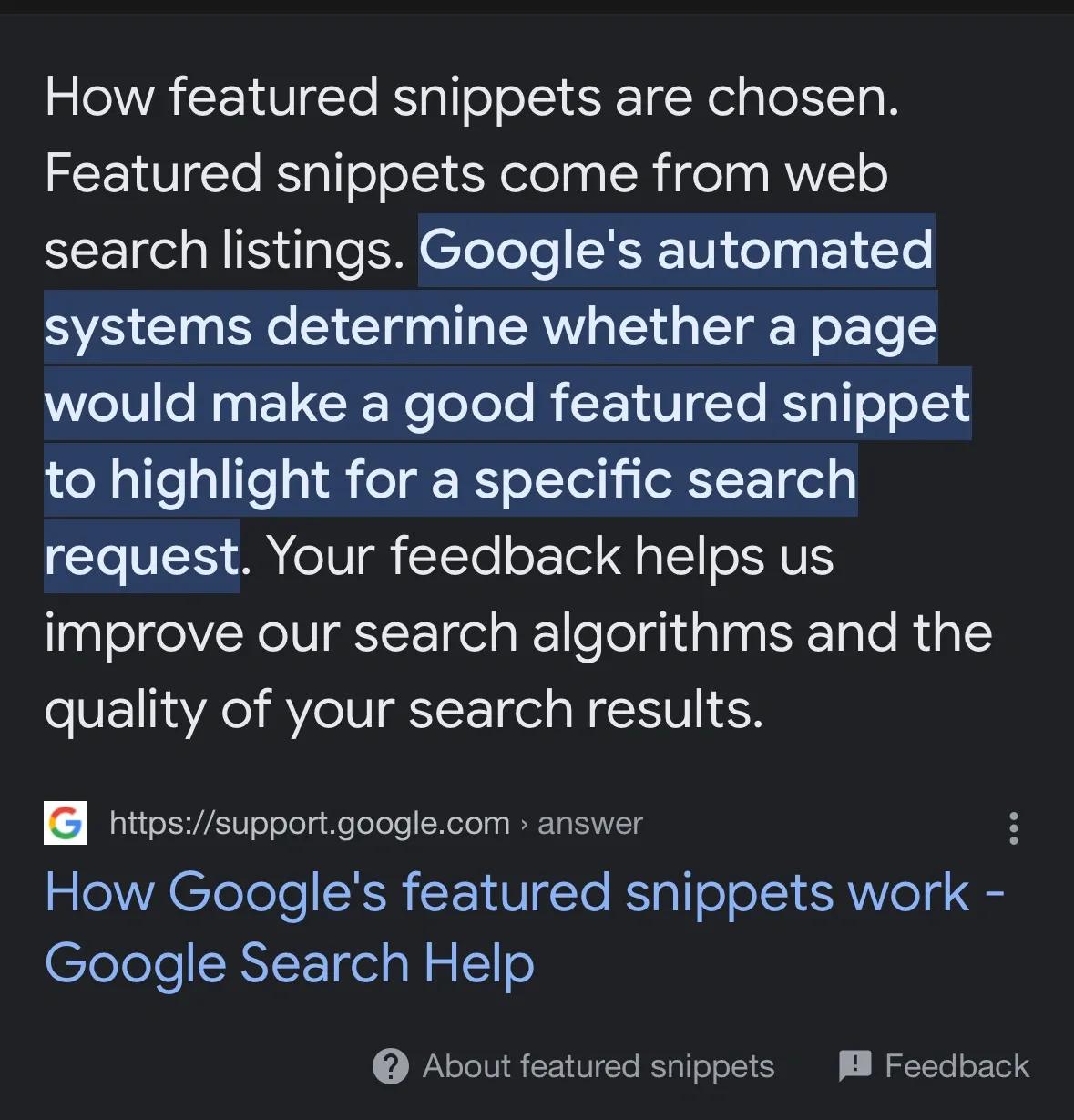
Featured snippets are concise answers to search queries that are displayed at the top of Google’s search results, providing a quick and easy way for users to get the information they need. As a result, featured snippets can be a valuable source of organic traffic for websites that manage to get their content featured in them.

Featured snippets typically include a link, page title, and URL, as well as a concise description that relates to the search query. The description is usually about 40-60 words in length, as per SEMrush.

One effective strategy for getting featured snippets is by creating “featured snippet bait” – content designed specifically to entice Google’s algorithms to feature it in a snippet. In this article, we’ll explore what featured snippet bait is, why it’s important, and how to create content that’s more likely to get featured in a Google featured snippet.

What is Featured Snippet Bait?

Featured snippet bait is content that is crafted with the specific goal of getting featured in a Google featured snippet. The goal of featured snippet bait is to provide a concise and authoritative answer to a user’s search query in a way that Google’s algorithms can easily parse and present as a featured snippet. 

Featured snippet bait can take many forms, including:

  •  Lists (e.g., “10 ways to improve your productivity”)
  •  Tables (e.g., “Calories in common fruits and vegetables”)
  •  Charts or graphs (e.g., “Average temperatures by month in Los Angeles”)
  •  Definitions (e.g., “What is a keto diet?”)
  •  How-to instructions (e.g., “How to make homemade pasta”)
  •  Q&A format (e.g., “What is the capital of Spain?”)

By creating content that fits into one of these formats, websites can increase their chances of being featured in a Google featured snippet when a user searches for a related query.

Why is Featured Snippet Bait Important?

Getting featured in a Google featured snippet can have a significant impact on a website’s organic search traffic. According to a study by Ahrefs, content that is featured in a snippet can see a click-through rate (CTR) of up to 8.6%, compared to a CTR of just 2.6% for the first organic search result.

Additionally, featured snippets are often displayed above the first organic search result, which means that even if a website is not in the top position for a search query, it can still get valuable exposure by being featured in a snippet.

Finally, because featured snippets provide a quick and easy answer to a user’s search query, they tend to be more focused on satisfying the user’s needs than on driving traffic to a specific website. As a result, websites that provide high-quality featured snippet bait can build trust with users and establish themselves as authorities in their respective fields.

How to Create Featured Snippet Bait

Creating effective featured snippet bait requires a combination of technical know-how and creative content creation skills. Here are some tips for creating content that’s more likely to be featured in a Google featured snippet:

1. Identify Relevant Queries

The first step in creating featured snippet bait is to identify the queries that are most likely to result in a featured snippet. Tools like Ahrefs, SEMrush, and Moz can help you identify high-volume search queries and the featured snippets that are associated with them.

Once you’ve identified the queries you want to target, you can begin crafting content that provides a concise and authoritative answer to those queries.

2. Format Your Content for Snippets

As we mentioned earlier, featured snippets tend to be presented in specific formats, such as lists, tables, and definitions. When creating your content, it’s important to format it in a way that makes it easy for Google’s algorithms to parse and present as a snippet.

For example, if you’re creating a list, use numbered or bulleted lists and make sure each item is concise and easy to read. If you’re creating a table, make sure the data is well-structured and clearly labeled. If you’re creating a definition, make sure it’s clear and concise, with no extraneous information.

By formatting your content in a way that’s easy for Google to parse, you increase your chances of being featured in a snippet.

3. Provide High-Quality Content

While formatting is important, it’s not the only thing that matters when it comes to featured snippet bait. To increase your chances of being featured in a snippet, you also need to provide high-quality content that answers the user’s query in a comprehensive and authoritative way.

This means doing research, providing examples, and citing sources when appropriate. You want to create content that is not only easy to read and understand but also provides real value to the user.

4. Use Structured Data

Structured data is a way of organizing your content so that search engines can better understand it. By using structured data, you can provide additional context and information about your content, which can increase your chances of being featured in a snippet.

For example, if you’re creating a recipe, you can use structured data to provide information about the cooking time, the number of servings, and the ingredients. This can make it easier for Google to present your recipe as a featured snippet.

5. Optimize Your Meta Data

Finally, it’s important to optimize your meta data – the title, description, and URL – to increase your chances of being featured in a snippet. Your meta data should be clear, concise, and accurately reflect the content of your page.

In particular, your title should be formatted in a way that’s likely to be featured in a snippet. This means including the query you’re targeting and using a format that’s likely to be featured, such as a list or table.

Examples of Featured Snippet Bait

To illustrate how featured snippet bait works in practice, here are a few examples of content that is designed to be featured in a Google featured snippet:

Example 1: “How to make a cup of coffee”

This how-to article is designed to be featured in a snippet by providing a concise, step-by-step guide to making a cup of coffee. The article is formatted as a numbered list, with each step clearly labeled and easy to read.

The meta data is also optimized for a featured snippet, with a title that includes the query and a description that provides additional information about the content of the article.

Example 2: “Calories in common fruits and vegetables”

This table is designed to be featured in a snippet by providing a concise, easy-to-read list of the calories in common fruits and vegetables. The table is well-structured, with clear headings and accurate data.

The meta data is also optimized for a featured snippet, with a title that includes the query and a description that provides additional information about the content of the table.

Example 3: “What is the capital of Spain?”

This Q&A format is designed to be featured in a snippet by providing a concise, authoritative answer to a common question. The answer is well-written and easy to read, with no extraneous information.

The meta data is also optimized for a featured snippet, with a title that includes the query and a description that provides additional information about the content of the page.

Takeaways

Featured snippets can be a valuable source of organic traffic for websites that manage to get their content featured in them. By creating featured snippet bait – content designed specifically to entice Google’s algorithms to feature it in a snippet – websites can increase their chances of being featured in a Google featured snippet.

To create effective featured snippet bait, it’s important to identify relevant queries, format your content for snippets, provide high-quality content, use structured data, and optimize your meta data. By following these tips, you can create content that’s more likely to be featured in a snippet and increase your organic traffic.

It’s worth noting that while creating featured snippet bait can be an effective SEO strategy, it’s not a guarantee of success. Google’s algorithms are constantly evolving, and what works today may not work tomorrow. Additionally, featured snippets can sometimes decrease click-through rates for the organic search results below the snippet, so it’s important to keep an eye on your overall traffic and adjust your strategy accordingly.

Overall, featured snippet bait can be a powerful tool for increasing organic traffic and improving your SEO. By following the tips outlined in this article and creating content that’s designed to be featured in a Google featured snippet, you can increase your chances of being featured and reap the benefits of increased visibility and traffic.

Posted in SEO

ChatGPT 4: A New Era of Conversational AI

The latest addition to the family of large language models, ChatGPT 4, which was just launched March 14. Following in the footsteps of its predecessor, ChatGPT 3.5, it is expected to bring significant improvements and enhancements to the field of natural language processing. This article explores how ChatGPT 4 differs from ChatGPT 3.5 and how it has improved to deliver even more accurate and coherent responses.

Training Data

One of the significant differences between ChatGPT 4 and ChatGPT 3.5 is the amount of training data used to train the model. ChatGPT 4 has been trained on a much larger dataset than its predecessor, including billions of words from a diverse range of sources. This ensures that the model has a more comprehensive understanding of the nuances of language and can generate more accurate and coherent responses.

Fine-tuning

In addition to using more training data, ChatGPT 4 has been fine-tuned to perform better on specific tasks. Fine-tuning involves retraining the model on a smaller dataset that is specific to a particular task, such as question-answering or language translation. This process enables the model to improve its performance on these tasks significantly. ChatGPT 4 has been fine-tuned on a wide range of tasks, which means it can provide more accurate and relevant responses.

Memory Capacity

Another significant improvement in ChatGPT 4 is its memory capacity. ChatGPT 4 has a much larger memory than ChatGPT 3.5, which enables it to store more information and generate more coherent responses. This is particularly useful in conversational AI applications where the model needs to remember previous interactions to provide relevant and consistent responses.

Contextual Understanding

ChatGPT 4 has been designed to have a better understanding of the context in which language is used. This means that it can generate responses that take into account the broader context of a conversation, rather than just responding to individual sentences or phrases. This contextual understanding is achieved through the use of advanced neural network architectures and training techniques.

Multilingual Support

ChatGPT 4 has also been designed to support multiple languages. This means that it can generate responses in languages other than English, which makes it more useful for global applications. The model has been trained on a wide range of languages, including French, German, Spanish, Chinese, and Japanese, which means it can provide accurate and coherent responses in these languages.

Speed and Efficiency

One of the challenges with large language models is their speed and efficiency. ChatGPT 4 has been optimized for speed and efficiency, which means it can generate responses much faster than its predecessor. This optimization has been achieved through the use of advanced hardware and software optimizations, which enable the model to run more efficiently on a wide range of devices.

Accuracy and Coherence

Finally, the most significant improvement in ChatGPT 4 is its accuracy and coherence. The model has been designed to generate more accurate and coherent responses, which means it can provide more helpful and relevant information. This improvement has been achieved through a combination of the factors mentioned above, including larger training data, fine-tuning, improved memory, contextual understanding, and multilingual support.

Looking Ahead

ChatGPT 4 represents a significant improvement over its predecessor, ChatGPT 3.5. The model has been trained on a much larger dataset, fine-tuned on a wide range of tasks, and designed to have a better understanding of context, which enables it to generate more accurate and coherent responses. The model also has a larger memory capacity, supports multiple languages, and is optimized for speed and efficiency.

All of these improvements combine to make ChatGPT 4 a powerful tool for natural language processing and conversational AI applications. As the field of AI continues to evolve, it is likely that we will see even more improvements in the capabilities of large language models like ChatGPT 4. However, for now, ChatGPT 4 represents a significant milestone in the field of natural language processing, and its improved accuracy and coherence make it a valuable tool for a wide range of applications.

Revolutionary Technology

ChatGPT 4 has the potential to revolutionize the way we interact with technology and each other. Its ability to generate coherent and relevant responses in natural language makes it an ideal tool for customer service, education, and entertainment. As the technology continues to advance, we can expect to see even more innovative applications for large language models like ChatGPT 4.

Posted in AI

Is TikTok Going to be Banned in the US?

Update 3/14/24

The latest updates on the TikTok ban in the United States reflect significant legislative and political movements. A bipartisan group of U.S. lawmakers introduced legislation in early March 2024, urging ByteDance, the Chinese owner of TikTok, to divest the app within six months to avoid a ban. This legislative effort aims to address national security concerns related to TikTok’s Chinese ownership. The bill, spearheaded by key figures such as Mike Gallagher and Representative Raja Krishnamoorthi, seeks to make it illegal for app stores to offer TikTok if ByteDance does not comply with the divestiture. The White House has shown support for this legislation, viewing it as a step toward protecting Americans’ data and national security, though TikTok has criticized the move, arguing it infringes on the First Amendment rights of its users oai_citation:1,U.S. lawmakers push for ByteDance to divest TikTok or face ban | Reuters.

Further efforts to address concerns related to TikTok and its potential impact on U.S. national security include the RESTRICT Act. This bill, receiving endorsement from the Biden administration, would empower the Secretary of Commerce to ban apps like TikTok if deemed a risk to national security. The RESTRICT Act aims for a broader approach to tackle threats from technology associated with foreign adversaries oai_citation:2,TikTok ban: The latest developments in the US – 9to5Mac.

Despite these legislative attempts, challenges remain. For example, the popularity of TikTok and the significant lobbying efforts by the company have slowed down the momentum of bills aimed at either banning the app or forcing a divestiture. Senator Mark Warner highlighted the impact of TikTok’s lobbying, noting the need for a comprehensive, risk-based approach to address the potential dangers of foreign-controlled technology platforms oai_citation:3,TikTok crackdown bill may need changes, US senator says | Reuters.

Overall, the situation around TikTok’s future in the U.S. remains fluid, with legislative efforts reflecting the ongoing debate over balancing national security concerns with individual freedoms and the interests of businesses reliant on the platform.


Update 5/18/23

Montana has recently imposed restrictions on TikTok. The state government passed a law prohibiting the use of TikTok within its borders, citing concerns about data privacy and national security. This move comes in response to growing apprehension surrounding the popular social media platform, particularly its Chinese ownership.

Montana’s decision to ban TikTok stems from the broader debates surrounding data privacy and national security. Critics argue that TikTok, as a Chinese-owned app, may pose a risk to user data and potentially allow for unauthorized access by foreign entities. These concerns have gained traction in various parts of the world, leading to similar actions by other countries and regions.

The ban on TikTok in Montana is aimed at safeguarding the personal information of its residents and protecting national security interests. By prohibiting the use of TikTok, the state government hopes to mitigate any potential risks associated with the platform. It is important to note that the ban is specific to TikTok and does not extend to other social media platforms.

The decision to ban TikTok in Montana has sparked both support and criticism. Advocates of the ban argue that it is a necessary step to protect individuals’ privacy and national security. However, opponents argue that it infringes upon freedom of speech and expression, limiting access to a popular platform for sharing content and engaging with others.

The ban on TikTok in Montana represents a localized response to the broader global concerns regarding data privacy and national security. As the discussions around these issues continue to evolve, it remains to be seen if other states or regions will follow suit.

Update 3/25/23

On Thursday, Shou Zi Chew, TikTok’s CEO, testified in front of Congress amidst mounting pressure for a compulsory sale of its US operations or a nationwide ban. 

According to Insider’s Dan Whateley and Aaron Mok, the hearing swiftly deteriorated into a barrage of “yes or no” questions from both sides of the aisle, with several politicians seemingly uninterested in hearing the executive’s complete responses.

The aim of the hearing was to allow TikTok, an app with approximately 150 million monthly active users in the US, or nearly half the country’s population, to alleviate lawmakers’ concerns about the app’s data privacy policies and its connection to China via its parent company, Bytedance. However, instead of achieving this goal, the testimony was criticised by Wall Street.

According to Wedbush analyst Dan Ives, the testimony was a “disastrous” moment that will probably result in more calls from lawmakers and the White House to ban TikTok in the US if the company does not take steps to spin-off and force a sale from its Chinese parent company, ByteDance.

Bloomberg Intelligence’s Senior Litigation and Government Analyst, Matthew Schettenhelm, stated that “I don’t think he made any new friends today and changed any minds.” Nonetheless, segments from the testimony became popular on TikTok, with people ridiculing the proceedings and stating that lawmakers lacked sufficient knowledge of the app to litigate it. Eventually, Chew won over the internet.

Update 3/16/23

The Wall Street Journal reported that the Biden administration is urging ByteDance to sell off TikTok to sever ties with China. The Committee on Foreign Investments in the United States (CFIUS), responsible for overseeing national security risks, has recommended ByteDance’s divestment from TikTok in a unanimous decision.

A TikTok spokesperson confirmed that they were contacted by CFIUS and did not dispute the WSJ’s report. However, the spokesperson claimed that the report was exaggerated, and the practical implications of “divestiture” were unclear. They argued that a change in ownership would not impose new restrictions on data flows or access, and transparent protection of US user data and systems would be the best way to address national security concerns.

This development precedes the testimony of TikTok’s CEO, Shou Zi Chew, before Congress on March 23. It marks his first appearance before the legislative body, where he will be questioned extensively while under oath.

Original Post

TikTok, a social media app popular among teenagers and young adults, has faced intense scrutiny and controversy in the United States over the past year. The app, which allows users to create short videos set to music and share them with others, has been accused of a variety of issues, including censorship, data privacy concerns, and ties to the Chinese government. As a result, there have been numerous attempts to ban the app in the United States.

Background on Previous Attempts to Ban TikTok

The first major attempt to ban TikTok in the United States came in the summer of 2020, when then-President Donald Trump issued an executive order that would have required the app’s Chinese parent company, ByteDance, to divest from its US operations within 90 days. The order cited concerns about the app’s data collection practices and its potential to be used for espionage by the Chinese government. However, the ban was ultimately put on hold by a federal judge, who ruled that the Trump administration had not provided sufficient evidence to justify the ban.

Another attempt to ban TikTok came in August 2020, when the Committee on Foreign Investment in the United States (CFIUS) launched an investigation into ByteDance’s acquisition of the US-based app Musical.ly in 2017, which was later rebranded as TikTok. The investigation focused on whether the acquisition posed a threat to US national security. In September 2020, the Trump administration issued another executive order that would have banned TikTok from US app stores, but a federal judge issued a temporary injunction blocking the ban.

In November 2020, ByteDance announced that it had reached a deal with Oracle and Walmart to create a new company, TikTok Global, which would oversee the app’s US operations. However, the deal was never finalized, and the Biden administration has since taken a different approach to TikTok.

Current Attempts by the Biden Administration to Ban TikTok

Since taking office in January 2021, President Joe Biden has not taken any immediate action to ban TikTok in the United States. However, his administration has continued to review the app’s data privacy practices and potential national security risks. In June 2021, President Biden signed an executive order that revoked the previous administration’s executive orders targeting TikTok, but also called for a broader review of apps with ties to foreign adversaries.

In December 2021, the Biden administration suspended a Trump-era rule that would have forced US companies to remove Chinese-made apps, including TikTok, from their app stores. The rule had been scheduled to take effect on January 5, 2022, but was put on hold pending a review by the Biden administration.

As of March 2023, there are no immediate plans to ban TikTok in the United States, but the app remains under scrutiny by the Biden administration. In February 2022, the Federal Trade Commission launched an investigation into TikTok’s data privacy practices, focusing on how the app collects and uses data from its users, particularly children and teenagers. The investigation is ongoing, and it is unclear what actions, if any, the Biden administration will take against TikTok as a result.

Legislation in the Senate

This past Tuesday, March 7, a group of US senators put forward legislation that would extend President Joe Biden’s power to ban TikTok nationwide. The RESTRICT Act gives the US government the ability to act against foreign producers of electronics or software considered a risk to national security. It does not single out TikTok, but could be used against it. Fears have been raised that the Chinese government may use national security laws to access data on TikTok’s US users. TikTok is seeking an agreement with the Biden administration, and has put in place measures to protect US data.

The proposed law aims to address concerns that Chinese-affiliated companies may be compelled by the Chinese government to provide access to Americans’ sensitive personal information or communication records. In the case of TikTok, lawmakers believe China’s national security laws could force TikTok’s Chinese parent company, ByteDance, to provide access to US user data. TikTok CEO Shou Chew denies ever receiving such a request and has taken voluntary measures to isolate US user data, including hosting it on servers operated by Oracle. TikTok is in negotiations with the Biden administration to continue operating in the US. TikTok spokesperson Brooke Oberwetter stated that a US government ban would limit American speech and the export of American culture and values to the platform’s global user base.

Social Media Transactions 

Sen. Marco Rubio’s proposed legislation aims to prevent social media companies with ties to foreign adversaries from conducting transactions in the US. In contrast, a bill introduced on Tuesday by Senate Intelligence Committee Chairman Mark Warner and South Dakota Republican Sen. John Thune takes a more flexible approach, allowing the Commerce Department to exercise discretion in identifying and mitigating potential security risks associated with technology produced by companies with connections to foreign adversaries such as China, Russia, Iran, North Korea, Cuba, and Venezuela.

The bill instructs the Commerce Secretary to take action to identify, deter, disrupt, prevent, prohibit, investigate, or otherwise mitigate national security risks posed by technology linked to these countries. It also grants the Commerce Secretary the authority to negotiate, enforce, and impose any measures necessary to mitigate such risks.

Is TikTok’s Future at Risk?

TikTok’s future has faced some uncertainty in the past due to concerns about data privacy and security, and the potential influence of the Chinese government on the company. However, as of now, TikTok continues to operate in the United States and many other countries around the world. The company has taken steps to address these concerns, such as separating its US user data from the rest of its global organization and hosting that data on servers operated by the US tech giant Oracle. Additionally, TikTok is currently negotiating a possible agreement with the Biden administration that could allow it to continue operating in the United States under certain conditions. So while TikTok’s future may still face some challenges and uncertainties, it is not currently at immediate risk.

Continued Scrutiny

While there have been numerous attempts to ban TikTok in the United States, the app remains available and popular among millions of Americans. The controversy surrounding the app highlights the growing concern over data privacy and national security in an increasingly digital world. The Biden administration has taken a more cautious approach to TikTok than the previous administration, but the app’s fate in the United States remains uncertain. It is likely that the app will continue to face scrutiny and regulation in the coming years, but a complete ban seems unlikely at this time.

Does Google Penalize AI Content?

In recent years, the use of artificial intelligence (AI) in content creation has been gaining popularity among marketers and publishers. While some express concerns about the quality of AI-generated content, others see it as a valuable tool for improving efficiency and speeding up the content creation process. This article explores the benefits and concerns of using AI in content creation and how marketers and publishers can ensure that their AI-generated content meets Google’s quality guidelines.

Google Approves of Quality AI Content

Google, the world’s most popular search engine, has recently clarified its policies regarding the use of AI-generated content. According to the company’s quality guidelines, content should be “useful and informative” and provide “original, high-quality content.” AI-generated content that meets these standards is not prohibited.

This clarification comes as a relief to many marketers and publishers who were unsure about the use of AI in content creation. With Google’s stamp of approval, they can now use AI to create content without fear of penalties or removal from search results, as long as the content meets Google’s quality guidelines.

Avoid Low-Quality Content

However, it’s important to note that Google’s policies still prohibit the use of AI to generate low-quality content that is intended to manipulate search rankings or deceive users. This type of content is in violation of Google’s policies and could result in penalties or even removal from search results.

Rise of AI Content

The rise of AI in content creation has been driven by the desire for efficiency and speed. AI-powered tools can quickly generate blog posts, product descriptions, and other types of content, allowing marketers and publishers to produce more content in less time. Additionally, AI can help improve the quality of content by analyzing data and user behavior to identify trends and insights that can be used to create more targeted and effective content.

Benefits of Using AI in Content Creation

Using AI in content creation has several benefits that can help marketers and publishers produce content that is both high-quality and effective. Some of the benefits include:

  1. Improved Efficiency: AI-powered tools can create content faster than human writers, freeing up time for other tasks.
  2. Data-Driven Insights: AI can analyze data and user behavior to identify trends and insights that can be used to create more targeted and effective content.
  3. Improved Accuracy: AI can help reduce errors and improve the accuracy of content by identifying grammar and spelling mistakes.
  4. Scalability: AI-powered tools can create large volumes of content quickly and efficiently, making it easier to scale content production.

Concerns with Using AI in Content Creation

Despite the benefits of using AI in content creation, there are also concerns about its quality and impact on human writers. Some of the concerns include:

  1. Lack of Creativity: AI-generated content lacks the creativity and nuance of human-written content, leading to a bland and generic output.
  2. Decrease in Demand for Human Writers: The use of AI could lead to a decrease in the demand for human writers, as companies turn to AI-powered tools to create content.
  3. Over-Reliance on AI: Companies may become over-reliant on AI-powered tools, leading to a decrease in the quality of content.

Ensuring Quality Guidelines with AI-Generated Content

To address these concerns, it’s important for marketers and publishers to ensure that AI-generated content meets the standards of Google’s quality guidelines. This means creating content that is useful, informative, and provides value to users. It also means using AI as a tool to supplement, rather than replace, human writers. By combining the creativity and nuance of human writers with the efficiency and insights of AI-powered tools, companies can create content that is both high-quality and effective.

AI Usage Will Gain Momentum

In the future, we can expect the use of AI in content creation to continue to rise, as more and more companies seek to improve the efficiency and effectiveness of their content marketing efforts. However, it’s important to remember that AI-generated content is not a replacement for human writers, but rather a tool to supplement their work. By ensuring that the content meets high standards of quality and using AI in a responsible and ethical manner, we can harness the power of AI to create content that is both effective and engaging for users.

Posted in AI

How Will the Metaverse Affect Digital Marketing

The Metaverse is a virtual world where individuals can interact with each other and the environment through digital representations of themselves, known as avatars. It is an immersive experience where people can communicate, explore, and create content in a virtual space. The Metaverse is becoming increasingly popular, with many tech companies investing in creating their own Metaverse. As the Metaverse continues to grow, it presents opportunities for businesses to engage with their customers through digital marketing.

Digital Marketing + Metaverse

Digital marketing in the Metaverse involves promoting products and services through the virtual world. It can be done through various channels, such as virtual billboards, social media platforms, and experiential marketing. Here are some ways businesses can leverage digital marketing in the Metaverse:

  1. Virtual billboards – Businesses can advertise their products and services through virtual billboards in the Metaverse. These billboards can be placed in high-traffic areas of the virtual world, such as shopping centers, parks, or popular landmarks. Advertisements on virtual billboards can be targeted based on the user’s interests and behaviors, making them more effective than traditional billboards.
  2. Social media platforms – Businesses can also promote their products and services through social media platforms in the Metaverse. These platforms can be used to engage with customers and build brand awareness. For example, a business can create a virtual social media profile that allows customers to interact with the brand and its products. Social media platforms in the Metaverse can also be used for customer support and to receive feedback from customers.
  3. Experiential marketing – Experiential marketing is a type of marketing that creates an immersive experience for customers. In the Metaverse, experiential marketing can be done through virtual events and experiences. For example, a business can host a virtual concert or create a virtual showroom where customers can explore and interact with their products. Experiential marketing in the Metaverse can be an effective way to build brand awareness and create customer loyalty.
  4. In-game advertising – In-game advertising is a type of advertising that occurs within video games. In the Metaverse, in-game advertising can be done through virtual products and items. For example, a business can create a virtual product that can be used within a video game. This product can be promoted through virtual billboards and social media platforms, making it more visible to users.

New Opportunities 

Digital marketing in the Metaverse presents opportunities for businesses to engage with their customers in a new and innovative way. It allows businesses to create immersive experiences that can build brand awareness and create customer loyalty. However, it also presents challenges, such as the need to create virtual content that is engaging and relevant to users.

To succeed in digital marketing in the Metaverse, businesses need to understand the virtual world and its users. They need to create virtual content that is relevant and engaging to users and leverage virtual channels, such as social media platforms and virtual billboards, to promote their products and services. Businesses also need to be innovative and creative in their approach to digital marketing in the Metaverse, as the virtual world is constantly evolving and changing.

Looking Forward

In conclusion, digital marketing in the Metaverse presents both opportunities and challenges for businesses. It allows them to engage with customers in a new and innovative way, but also requires them to be creative and adaptable in their approach. As the Metaverse continues to grow, businesses that embrace digital marketing in this virtual world will be better positioned to succeed and thrive.

Posted in SEO

We use cookies to enhance your browsing experience, personalize content, and analyze our traffic. By clicking “Accept,” you consent to our use of cookies. View our Privacy Policy for more information.