

SEO Strategies for Realtors

If you’re a real estate agent, you already know how important it is to have a strong online presence. With so many people turning to the internet to find their next home or real estate agent, having a solid SEO strategy is crucial for success. In this blog post, we’ll explore some tips and best practices for SEO for realtors.

Optimize your website for local search

As a real estate agent, your business is primarily local. This means that optimizing your website for local search is essential. Start by making sure your website includes your business name, address, and phone number (NAP) on every page. This information should be consistent and up-to-date across your website and any online directories you’re listed in.

In addition to NAP, you should also include localized keywords on your website. For example, if you’re a real estate agent in Denver, include phrases like “Denver real estate agent” and “homes for sale in Denver” throughout your website. This will help Google understand where your business is located and what types of searches your website should appear for.

Build high-quality backlinks

Backlinks are one of the most important ranking factors in Google’s algorithm. A backlink is simply a link from another website to your website. The more high-quality backlinks you have, the more authoritative Google will view your website.

To build backlinks, start by creating high-quality content on your website. This could be anything from blog posts to videos to infographics. Once you’ve created your content, reach out to other websites in your industry and ask if they’d be willing to link to your content. You can also look for guest blogging opportunities on other websites to build links back to your website.

Use local business directories

Local business directories like Yelp and Google My Business can be a powerful tool for real estate agents. Not only do these directories help improve your local search rankings, but they also provide valuable information to potential clients who are searching for a real estate agent in your area.

Make sure your business is listed on all relevant directories, and keep your information up-to-date. This includes your business name, address, phone number, website, and hours of operation. Encourage happy clients to leave reviews on these directories, as positive reviews can help improve your visibility in search results.

Leverage social media

Social media can be a great way to connect with potential clients and promote your real estate business. But did you know that social media can also help improve your SEO?

When you share content on social media, it can help drive traffic back to your website. This increased traffic can help improve your search rankings. Additionally, social media signals (such as likes, shares, and comments) are a small but important part of Google’s algorithm. The more social signals your content receives, the more authoritative Google will view your website.

Create local content

Finally, creating local content is a great way to improve your local search rankings and connect with potential clients. This could include blog posts about local events or attractions, videos showcasing local neighborhoods, or social media posts highlighting local businesses.

When creating local content, be sure to include localized keywords and phrases. This will help Google understand the relevance of your content to your local area. Additionally, make sure your content is shareable and easy to find on your website and social media channels.

SEO is Essential for Your Business

SEO is essential for realtors in today’s digital age. By optimizing your website for local search, building high-quality backlinks, leveraging local business directories, using social media, and creating local content, you can improve your visibility in search results and connect with potential clients. With a strong SEO strategy, you can take your real estate business to the next level.

Posted in SEO

Is it Time for a Content Refresh?

[et_pb_section fb_built=”1″ admin_label=”section” _builder_version=”4.16″ hover_enabled=”0″ global_colors_info=”{}” theme_builder_area=”post_content” sticky_enabled=”0″][et_pb_row admin_label=”row” _builder_version=”4.27.4″ background_size=”initial” background_position=”top_left” background_repeat=”repeat” hover_enabled=”0″ global_colors_info=”{}” theme_builder_area=”post_content” width=”100%” max_width=”2560px” sticky_enabled=”0″][et_pb_column type=”4_4″ _builder_version=”4.16″ custom_padding=”|||” global_colors_info=”{}” custom_padding__hover=”|||” theme_builder_area=”post_content” admin_label=”Column”][et_pb_text admin_label=”Text” _builder_version=”4.27.4″ background_size=”initial” background_position=”top_left” background_repeat=”repeat” hover_enabled=”0″ global_colors_info=”{}” theme_builder_area=”post_content” sticky_enabled=”0″]In the contemporary, digitally-driven era, the internet is undeniably the primary conduit of information, and in this context, content reigns supreme. Content, the lifeblood of any online platform, has the power to attract traffic to your website and keep your audience absorbed, engaged, and continuously coming back for more. However, due to the relentless pace of technological advancement, search engine algorithms are continually evolving, and with the stratospheric rise of competition in the digital landscape, it has become of paramount importance to ensure your content is not just current but resonates with the zeitgeist. The focus of this article will be to delve into the heart of the matter — should you consider a content refresh and how can you utilize data from the Google Search Console to make informed decisions that would have a meaningful impact on your content strategy.

The Burning Question: Is your content growing stale?

Before we explore the nuances of leveraging Google Search Console data, it’s crucial to address an underlying question: Is it time to give your content a facelift? If you find yourself relating to any of the situations described below with regard to your website, then the answer is a resounding yes.

The Plight of Outdated Content

Should you discover that your website is riddled with outdated information or references that no longer hold water, it’s a clear signal that your content requires an immediate refresh. Outdated content is detrimental to your search engine rankings and can undermine your website’s credibility in the eyes of your audience. However, there’s no need to completely discard outdated content; you can give it a new lease on life by revising it to make it more germane. It’s commonplace for writers to add an update to an existing post or page, which signals to readers that the information has been brought up to speed.

The Struggles of Low Engagement

If your content isn’t sparking a substantial level of engagement in terms of comments, shares, or likes, it’s a glaring indication that your audience finds your content neither interesting nor relevant. This calls for an urgent re-evaluation of your content strategy.

The Dilemma of Decreasing Traffi

A downward trend in your website’s traffic could be attributed to outdated or irrelevant content. Given that Google’s algorithm has a penchant for fresh, topical content, if you’re not regularly updating your content, you’re likely to witness a dip in traffic.

Harnessing Google Search Console Data

Google Search Console is a powerful, cost-free tool provided by Google, allowing website owners to monitor and maintain their website’s presence in search engine results. It provides an array of valuable data that can be used to make well-informed decisions about your content strategy. Let’s take a closer look at how you can make the most of Google Search Console data:

Pinpointing Popular Pages

With the aid of the Search Analytics report in Google Search Console, you can pinpoint the pages on your website that are reaping the most clicks and impressions. These pages are likely your star performers when it comes to content, so you can harness this data to generate more content that echoes a similar style or subject matter.

Analyzing Search Queries

The Search Analytics report also serves up insights into the search queries driving traffic to your website. By delving into this data, you can gain an understanding of what piques your audience’s interest and the topics that resonate with them. Armed with this information, you can tailor your content to align more closely with your audience’s interests.

Monitoring Crawl Errors

Google Search Console also doubles up as your digital sentinel, alerting you to any crawl errors on your website, such as broken links or pages that are off-limits. Addressing these issues promptly is vital to ensure your content is readily accessible to both search engines and your audience.

Words of Wisdom

Having explored the dynamics of Google Search Console data, here are a few pearls of wisdom to help you navigate the path of content refresh with more confidence: Revitalize Old Content Make it a habit to periodically comb through your website to identify stale content, and rejuvenate it with fresh information, visuals, or videos. This strategy can provide a substantial boost to your search engine rankings and keep your audience continually engaged. Paying Heed to User Intent When crafting new content, it’s critical to pay more attention to user intent rather than just focusing on keywords. With the relentless advancements in AI, Google’s algorithm has grown adept at deciphering user intent. Therefore, creating content that aligns with your audience’s needs and expectations carries more weight than ever before. Experimentation is Key Don’t hesitate to try your hand at different formats, such as infographics, videos, or podcasts, to infuse a breath of fresh air into your content. Dabbling with different formats could open the doors to a new audience that may not have engaged with your traditional content.

Ensure Your Content Remains Engaging

It’s of paramount importance to regularly evaluate and revamp your content to ensure it remains relevant, engaging, and in sync with the pulse of the audience. While using Google Search Console data can guide you in making informed decisions about your content strategy, it’s equally important to maintain a laser-like focus on user intent, experiment with a diverse array of formats, and regularly monitor your website’s performance. [/et_pb_text][/et_pb_column][/et_pb_row][/et_pb_section]

8 Things You Need to Know About Google Ads

Google Ads, formerly known as Google AdWords, is an online advertising platform that allows businesses to display their ads on Google’s search engine results pages (SERPs), as well as on other websites within the Google Display Network. With over 246 million unique visitors per day, Google Ads is a powerful tool for businesses looking to reach a wide audience and drive conversions. In this blog post, we’ll cover 8 things you need to know about Google Ads, along with tips and tricks to help you get the most out of this platform.

1. Understand the Basics of Google Ads

Before you start advertising on Google, it’s important to understand the basics of the platform. Search Engine Land offers a great overview of the different components of a Google Ads campaign, including keywords, ad groups, ads, and bidding strategies. Knowing how these different elements work together will help you create effective ads and optimize your campaigns for maximum ROI.

2. Use Keyword Research Tools

One of the most important parts of creating a successful Google Ads campaign is choosing the right keywords. You want to choose keywords that are relevant to your business and have a high search volume but aren’t too competitive. Use keyword research tools like Google Keyword Planner or SEMrush to identify keywords that meet these criteria. Once you’ve identified your target keywords, create ad groups around them and write ads that are specifically tailored to those keywords.

3. Optimize Your Landing Pages

Your Google Ads campaign doesn’t end with your ad copy – it’s equally important to have effective landing pages that convert visitors into customers. Make sure your landing pages are optimized for the keywords you’re targeting and provide a clear call-to-action. Search Engine Journal recommends using tools like Unbounce or Instapage to create landing pages that are specifically designed for your Google Ads campaigns.

4. Use Ad Extensions

Ad extensions are additional pieces of information that can be included in your Google Ads, such as your business’s phone number or address. These extensions make your ads more informative and increase their visibility on the SERPs. Search Engine Land recommends using ad extensions like sitelinks and callout extensions to make your ads more compelling and encourage users to click through to your website.

5. Test Your Ads

Testing different ad copy and landing pages is a crucial part of optimizing your Google Ads campaigns. By testing different elements of your ads, you can identify what works best for your target audience and improve your conversion rates. Search Engine Journal recommends using A/B testing tools like Google Optimize to test different versions of your landing pages and ad copy.

6. Use Remarketing

Remarketing is a powerful tool for reaching users who have already visited your website or interacted with your brand in some way. By targeting these users with ads, you can increase the likelihood that they’ll convert into customers. Search Engine Land recommends using remarketing lists for search ads (RLSAs) to target users who have previously visited your website and are actively searching for relevant keywords on Google.

7. Monitor Your Metrics

Keeping track of your metrics is key to understanding how your Google Ads campaigns are performing and identifying areas for improvement. Important metrics to track include click-through rates (CTR), conversion rates, and cost per conversion. Search Engine Journal recommends using Google Analytics to track your metrics and gain insights into user behavior on your website.

8. Keep Up with Changes to the Platform

Google is constantly updating its algorithms and changing the way it displays ads, so it’s important to stay up-to-date with changes to the platform. Search Engine Land offers a comprehensive guide to the latest updates to Google Ads, including changes to ad formats, bidding strategies, and targeting options. By staying on top of these changes, you can ensure that your Google Ads campaigns remain effective and competitive.

Maintain the Course

Google Ads is a powerful tool for businesses looking to reach a wide audience and drive conversions. By following these 8 tips and tricks, you can create effective Google Ads campaigns that reach the right audience and drive results.

By understanding the basics of the platform, using keyword research tools, optimizing your landing pages, using ad extensions, testing your ads, using remarketing, monitoring your metrics, and staying up-to-date with changes to the platform, you can create campaigns that deliver a high return on investment and help grow your business. As with any marketing channel, it’s important to continually evaluate and refine your Google Ads campaigns to ensure that they remain effective and competitive. By implementing these best practices, you can get the most out of your Google Ads campaigns and achieve your business goals.

Posted in SEM

Google Search and Generative AI: A Game-Changer

[et_pb_section fb_built=”1″ admin_label=”section” _builder_version=”4.16″ global_colors_info=”{}” theme_builder_area=”post_content”][et_pb_row admin_label=”row” _builder_version=”4.27.5″ background_size=”initial” background_position=”top_left” background_repeat=”repeat” hover_enabled=”0″ global_colors_info=”{}” theme_builder_area=”post_content” width=”100%” max_width=”2560px” sticky_enabled=”0″][et_pb_column type=”4_4″ _builder_version=”4.16″ custom_padding=”|||” global_colors_info=”{}” custom_padding__hover=”|||” theme_builder_area=”post_content”][et_pb_text admin_label=”Text” _builder_version=”4.27.5″ background_size=”initial” background_position=”top_left” background_repeat=”repeat” hover_enabled=”0″ global_colors_info=”{}” theme_builder_area=”post_content” sticky_enabled=”0″]Google Search is undeniably the most widely used search engine worldwide, with over 92% of the global market share. The company has been striving to incorporate artificial intelligence (AI) into its search engine to enhance its conversational capabilities.

What’s Generative AI?

Generative AI is a form of AI that can create new data such as text, images, and other forms. Google has employed generative AI to develop new features for Google Search to improve user experience. One of the ways in which Google utilizes generative AI is by creating AI-generated summaries of websites. These summaries are generated by AI algorithms that understand website content and generate a brief summary of the site’s main points, making it easier for users to obtain the information they require without reading the entire website.
https://www.youtube.com/embed/dVsiusLQy5Q
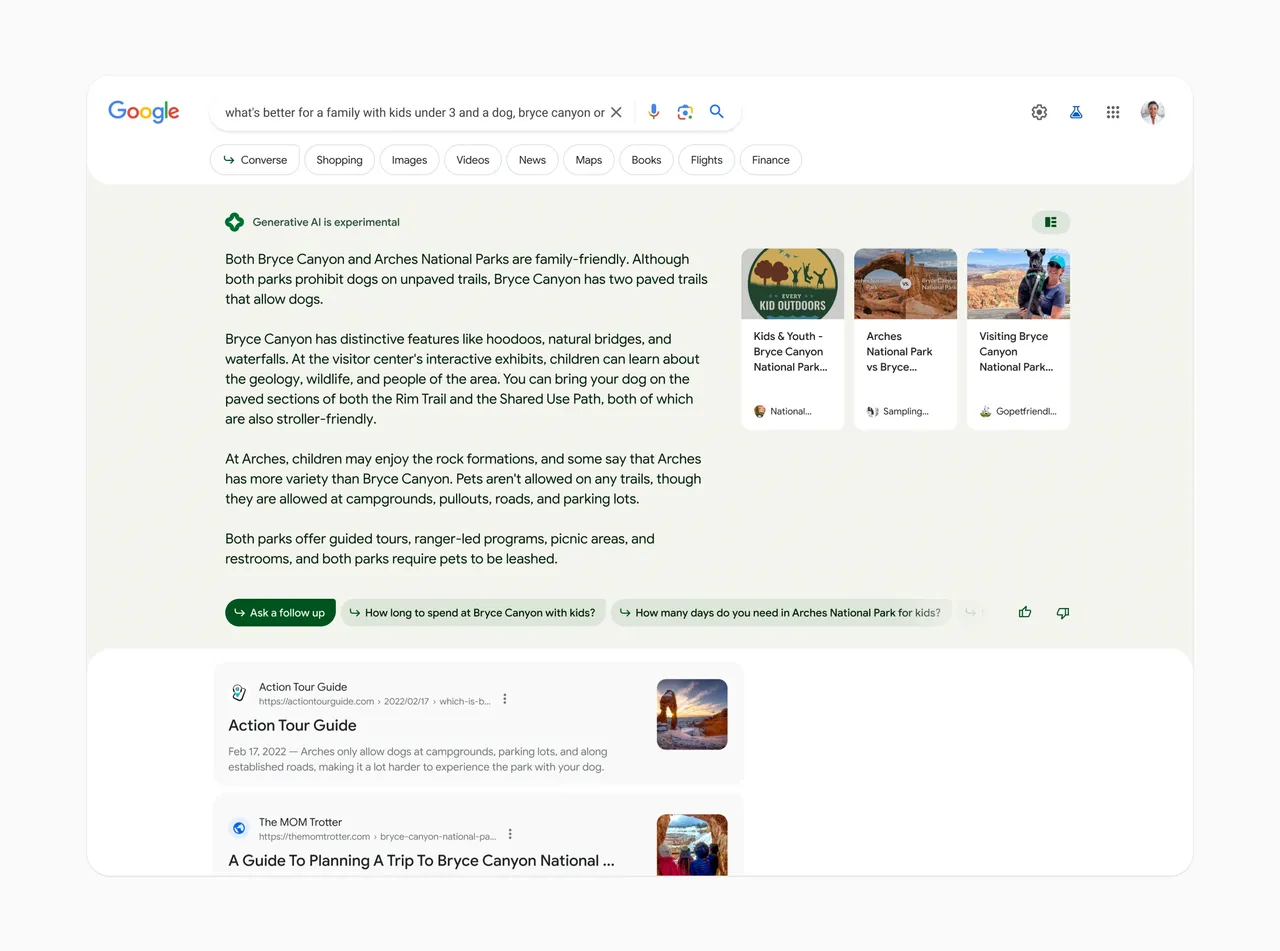
Google’s preview of Generative AI in Search

AI Chatbots + User Interaction

Google is also using generative AI to develop chatbots, which are computer programs that can simulate conversation with humans. These chatbots can assist users in various contexts, including customer service and marketing. For instance, Google’s chatbots can answer questions about its products and services, as well as aid users in finding information on the web. Additionally, Google is using generative AI to design new methods for users to interact with its search engine. For example, the company is developing a feature that allows users to ask their voice assistant questions, which the assistant can then search for answers on the web. Although this feature is still in development, it has the potential to make Google Search even more conversational. Incorporating generative AI into Google Search is a significant development that has the potential to transform the way people interact with the internet. By enhancing its conversational abilities, Google is making it easier for users to locate the information they require. This is a positive development that can benefit both users and businesses.

Benefits of Utilizing Generative AI in Google Search

There are several advantages to utilizing generative AI in Google Search, including:
    • Improved search results: Generative AI can enhance the quality of Google’s search results by providing users with more relevant and informative results.
    • Personalized search: Generative AI can personalize search results for each user by considering their previous search history, interests, and location.
    • Engaging search: Generative AI can make Google’s search engine more engaging by offering users more interactive and conversational experiences.
    • Accessible search: Generative AI can make Google’s search engine more accessible to people with disabilities by providing alternative methods for them to interact with the search engine, such as through voice commands.

Challenges of Utilizing Generative AI in Google Search

However, there are also several challenges to using generative AI in Google Search, including:
    • Bias: Generative AI algorithms can be biased, leading to the provision of inaccurate or misleading information.
    • Security: Generative AI algorithms can be employed to generate fake news and other forms of disinformation.
    • Privacy: Generative AI algorithms can collect and store personal data about users.

Significant Development 

Incorporating generative AI into Google Search is a significant development that has the potential to revolutionize the way people interact with the internet. By improving its conversational abilities, Google is simplifying the process of finding the necessary information for users. This is a positive step that can benefit both users and businesses. However, before generative AI can be utilized safely and effectively in Google Search, there are several challenges that need to be addressed, such as bias, security, and privacy. Google is dedicated to addressing these issues and ensuring that its search engine is utilized for the greater good. [/et_pb_text][/et_pb_column][/et_pb_row][/et_pb_section]
Posted in AI

5 Essential Steps for a Successful Content Migration

Content migration is the process of moving digital content from one system or platform to another. It’s a critical task that requires careful planning, execution, and monitoring. A successful content migration can improve website performance, enhance user experience, and increase engagement. In contrast, a poorly executed content migration can result in lost content, broken links, and a negative impact on SEO. In this post, we will discuss the five essential steps for a successful content migration.

Step 1: Conduct a Content Audit

The first step in any content migration process is to conduct a thorough content audit. This involves identifying all the content on your current website or platform, including pages, posts, images, and videos. You should also consider any metadata associated with your content, such as page titles, descriptions, and keywords.

The content audit serves two purposes. First, it helps you identify any redundant or outdated content that can be removed or consolidated. Second, it provides a clear picture of the scope and complexity of the migration, allowing you to plan and allocate resources accordingly.

Step 2: Develop a Migration Strategy

Once you have conducted a content audit, the next step is to develop a migration strategy. This involves identifying the goals of the migration, the target platform, and the timeline for completion. You should also consider any technical requirements, such as the need to map URLs or redirect traffic.

During this stage, it’s essential to involve key stakeholders in the planning process. This includes content creators, web developers, and SEO specialists. You should also consider the impact of the migration on your users and develop a communication plan to inform them of any changes or disruptions.

Step 3: Prepare Your Content for Migration

The third step in the content migration process is to prepare your content for migration. This involves ensuring that all content is compatible with the target platform and that any metadata is correctly formatted. You should also consider any technical requirements, such as the need to resize images or compress videos.

During this stage, it’s essential to maintain the integrity of your content. You should avoid making any significant changes to the content or structure of your pages, as this can negatively impact SEO and user experience. Instead, focus on optimizing your content for the target platform and ensuring that it’s easy to navigate and access.

Step 4: Execute the Migration

The fourth step in the content migration process is to execute the migration. This involves transferring your content to the target platform and ensuring that it’s functioning correctly. You should also monitor the migration process carefully, identifying and addressing any issues that arise.

During this stage, it’s essential to be patient and thorough. Content migration can be a complex and time-consuming process, so it’s crucial to take the time to ensure that everything is working correctly. You should also have a backup plan in case of any unexpected issues or disruptions.

Step 5: Monitor and Optimize

The final step in the content migration process is to monitor and optimize your content. This involves tracking your website performance, identifying any issues or errors, and making improvements where necessary. You should also consider the impact of the migration on your SEO and adjust your strategy accordingly.

During this stage, it’s essential to be proactive and responsive. You should continually monitor your website performance, identify any areas for improvement, and make changes where necessary. You should also solicit feedback from your users and make adjustments based on their needs and preferences.

Ensure Success

Content migration is a critical process that can have a significant impact on your website performance, user experience, and SEO. By following these five essential steps, you can ensure a successful and efficient migration, minimizing the risk of errors or disruptions. Remember to involve key stakeholders in the planning process, maintain the integrity of your content, and monitor your website performance carefully. With the right strategy and approach, content migration can be a smooth and seamless process that enhances your online presence and delivers a better experience for your users.

How to Use Local SEO to Increase Bookings for Your Resort

[et_pb_section fb_built=”1″ admin_label=”section” _builder_version=”4.16″ global_colors_info=”{}” theme_builder_area=”post_content”][et_pb_row admin_label=”row” _builder_version=”4.27.5″ background_size=”initial” background_position=”top_left” background_repeat=”repeat” hover_enabled=”0″ global_colors_info=”{}” theme_builder_area=”post_content” width=”100%” max_width=”2560px” sticky_enabled=”0″][et_pb_column type=”4_4″ _builder_version=”4.16″ custom_padding=”|||” global_colors_info=”{}” custom_padding__hover=”|||” theme_builder_area=”post_content”][et_pb_text admin_label=”Text” _builder_version=”4.27.5″ background_size=”initial” background_position=”top_left” background_repeat=”repeat” global_colors_info=”{}” theme_builder_area=”post_content”]If you own or manage a resort, you may already be aware of the importance of local search engine optimization (SEO) to attract more guests and increase bookings. OTA’s such as Hotels.com and Booking.com take large commissions from each booking. That’s why direct bookings are so important. Here are some tips to help you use local SEO to increase bookings for your resort:

Optimize your website for local search

Make sure your website is optimized for local search by including your resort’s name, address, and phone number (NAP) on every page of your website. This will help search engines like Google to understand that your business is local and help potential guests find you. It’s important to also use local business schema to help your site rank for local searches such as “St. Lucia resort” or “resorts in Nassau”.

Claim and optimize your Google My Business listing

Claiming and optimizing your Google My Business (GMB) listing is critical to your local SEO strategy. Make sure your GMB listing is complete, accurate, and up-to-date. Include your resort’s name, address, phone number, website, hours of operation, photos, and reviews. This can help your business show up in local searches in Google.

Get listed in local directories

Get your resort listed in local directories like Yelp, TripAdvisor, and other travel review websites. Make sure your listings are accurate, up-to-date, and include all the necessary information, such as your resort’s address, phone number, and website. Google will begin to learn and understand that your business is local as a result. This can be a tedious task, which is why services such Moz Local can assist, as they aggregate your business information to multiple sites.

Use local keywords

Use local keywords in your website content, blog posts, and other online marketing materials. This will help potential guests find your resort when they search for specific keywords related to your location. The meta data should make reference to your locale, which will help with SEO and click through rates. But make sure to do this in a natural, non-spammy way.

Generate local backlinks

Backlinks are links from other websites to your resort’s website. Getting high-quality backlinks from local websites can improve your local SEO and help potential guests find your resort. Consider partnering with local businesses, such as restaurants, attractions, and other businesses in your area, to generate local backlinks. Also, look at where your competitors have backlinks, and see which ones you might want to obtain.

Create local content

Create blog posts, videos, and other content that is focused on your local area. This can also include long form guides as well as practical info about your area. This will help potential guests learn more about your location and increase the chances that they will book a stay at your resort. Over time, this content will help your site rank for local searches in Google such as “Miami resort” or “hotel on South Beach”.

Encourage guest reviews

Encourage your guests to leave reviews on your Google My Business listing, TripAdvisor, and other travel review websites. Positive reviews can help improve your local SEO and attract more guests to your resort. Using email marketing, having a QR code to scan, or incentivizing guests can help increase the frequency and quantity of your reviews

Local SEO Strategies

By implementing these local SEO strategies, you can increase the visibility of your resort to potential guests and ultimately increase your bookings. It takes time, and effort, but these are proven tactics that will work for your resort. [/et_pb_text][/et_pb_column][/et_pb_row][/et_pb_section]

What Exactly is SEO?

[et_pb_section fb_built=”1″ admin_label=”section” _builder_version=”4.16″ global_colors_info=”{}” theme_builder_area=”post_content”][et_pb_row admin_label=”row” _builder_version=”4.27.5″ background_size=”initial” background_position=”top_left” background_repeat=”repeat” hover_enabled=”0″ global_colors_info=”{}” theme_builder_area=”post_content” width=”100%” max_width=”2560px” sticky_enabled=”0″][et_pb_column type=”4_4″ _builder_version=”4.16″ custom_padding=”|||” global_colors_info=”{}” custom_padding__hover=”|||” theme_builder_area=”post_content”][et_pb_text admin_label=”Text” _builder_version=”4.27.5″ background_size=”initial” background_position=”top_left” background_repeat=”repeat” global_colors_info=”{}” theme_builder_area=”post_content”]Search Engine Optimization, or SEO, is a tool that businesses use to improve their online visibility and attract more customers. It’s important because it helps businesses rank higher in Google’s search results, which means more people are likely to visit their website. There are four key factors that influence a website’s SEO: keywords, content, backlinks, and user experience. Let’s take a closer look at each of these factors.

Keywords

Keywords are the words and phrases that people use to search for something on Google. For example, if someone is looking for a sushi restaurant in their area, they might search for “sushi near me” or “best sushi restaurant.” By including these keywords in your website’s content, you can signal to Google that your website is relevant to those search queries. However, it’s important to use keywords in a natural way. Don’t just stuff them into your content because you think it will help your SEO. Google’s algorithms are smart enough to recognize when a website is trying to manipulate its search results. Instead, focus on creating high-quality content that includes relevant keywords in a natural way. For example, if you run a pizza restaurant, you could create content that highlights your menu, your location, and your hours of operation. You could also create blog posts that discuss topics related to pizza, such as the history of pizza or different pizza toppings.

Content

High-quality content is crucial for SEO. Your website should have content that is relevant, informative, and engaging. This includes things like blog posts, product descriptions, videos, and images. When you create content that is valuable to your visitors, they are more likely to share it with others and link to it from their own websites, which can help boost your website’s SEO. For example, if you run a wedding planning business, you could create a blog post that highlights the history of wedding dresses or shares tips for planning the perfect wedding. This kind of content is relevant to your business and your customers, and it can help establish your website as a valuable resource in your industry.

Backlinks

Backlinks are links from other websites that point to your website. When other websites link to your website, it signals to Google that your website is valuable and relevant. However, not all backlinks are created equal. High-quality backlinks from reputable websites are more valuable than low-quality backlinks from spammy websites. For example, if you run a pizza restaurant, you could reach out to local food bloggers and ask them to review your restaurant. If they include a link to your website in their review, it can help boost your website’s SEO.

User Experience

User experience refers to how easy and enjoyable it is for visitors to use your website. If your website is slow, difficult to navigate, or hard to read, visitors are more likely to leave and go to a different website. This can hurt your website’s SEO because Google wants to show websites that provide a good user experience. To improve your website’s user experience, focus on things like website speed, mobile responsiveness, and clear navigation. For example, if you run an accounting firm, your website should include a menu that is easy to read and navigate, as well as clear information about your location, hours, and contact information.

Leave it to the Experts

As you can see, SEO is an important tool for businesses that want to improve their online visibility and attract more customers. By focusing on factors like keywords, content, backlinks, and user experience, you can improve your website’s SEO and attract more visitors to your website. And if you need help with your SEO, consider working with a company like Sky SEO Digital. They can help you create a customized SEO strategy that is tailored to your business goals and can help you rank higher in Google’s search results. With their expertise and experience, you can improve your online presence and attract more customers to your business. So, if you’re looking to improve your SEO, consider working with Sky SEO Digital and take your business to the next level. [/et_pb_text][/et_pb_column][/et_pb_row][/et_pb_section]
Posted in SEO

10 Ways to Build Free Backlinks

In the expansive and often complex realm of search engine optimization (SEO), one element that stands out in its significant influence over the positioning of your website on search engines such as Google is backlinks. Essentially, backlinks are links that are embedded within one website and point towards another. While this might seem like a relatively simple concept, the truth is that these links carry substantial weight in the world of SEO. The more quality backlinks a website boasts, the higher it tends to rank on search engines. This is because backlinks act as endorsements, signaling to search engines that other sites find your content useful and worth linking to.

However, the task of acquiring these precious backlinks can seem rather overwhelming, especially for startups and small businesses that are often operating with a limited budget and resources. Even in such circumstances, would you believe that it’s entirely possible to construct high-quality backlinks without spending a single penny? Indeed, it is. In this comprehensive and in-depth guide, we’ll explore ten effective strategies that can be used to build valuable backlinks free of charge.

1. The Power of Guest Blogging

Guest blogging stands as an excellent, cost-free strategy for creating quality backlinks. This method involves writing and publishing a blog post on a website that operates within the same niche as your own, while embedding a link that leads back to your website within that post. The process requires you to identify websites in your field that accept guest posts and then reach out to them with a proposal for a unique, insightful post that would provide value to their audience. It’s important to remember that your guest post should deliver tangible value to the host website’s audience, while subtly promoting your own site by including a link back in the author’s bio or within the content where relevant.

2. Harnessing Broken Link Building

Another innovative and free approach to backlink construction is broken link building. This method requires you to identify broken or dead links on other websites that share your niche. The idea is to replace these broken links with a link to your own website, specifically to a piece of content that is related to the topic of the page where the broken link was found. Tools such as Check My Links or Broken Link Checker can be extremely handy for finding these non-functioning links. After locating a broken link, you can reach out to the website owner, inform them about the issue, and kindly suggest replacing it with a link to your site if you have relevant and valuable content.

3. Utilizing the Skyscraper Technique

The skyscraper technique is an ambitious yet effective method for building high-quality backlinks. This technique involves creating content that is substantially better, more comprehensive, and more valuable than your competitors’ existing content, and then reaching out to websites that currently link to your competitors’ inferior content. Tools such as Moz or Ahrefs can be used to identify these linking sites. Once you have identified them, reach out and present them with your superior content. Propose that they replace the link to your competitor’s content with a link to your more informative and beneficial content.

4. The Magic of Infographics

Infographics provide a visually engaging and easy-to-digest method for presenting data, making them a hit among internet users and a fantastic means to generate quality backlinks. Start by designing an infographic on a topic that’s relevant to your niche. This visual should be both informative and attractive. Once complete, share it on your website and across your social media platforms. Additionally, consider reaching out to other websites within your niche to offer them the opportunity to share your infographic with their audience, on the condition that they provide a link back to your site.

5. Promoting Content through Social Media

The realm of social media platforms offers a wealth of opportunities to promote your content and build backlinks for free. Platforms like Twitter, Facebook, LinkedIn, and Instagram are ideal for sharing your blog posts, infographics, and other content. If your content is well-constructed, offers genuine value, and is highly relevant to your audience, there’s a good chance that other users may choose to share it on their own social media profiles or websites. Each time they do so, a new backlink to your website is created.

6. Leveraging Q&A Sites

Question and answer sites such as Quora and Yahoo Answers can be utilized effectively to build free backlinks. On these platforms, you can search for questions that pertain to your niche and provide helpful, well-crafted answers. Within your response, subtly include a link back to a relevant post on your website that provides more in-depth information on the topic.

7. Submitting to Directories

Directories are websites that categorize and list other websites based on their niche or industry. You can submit your website to popular directories like DMOZ or Yahoo Directory without spending any money. When you submit your website to these directories, you’re creating a valuable backlink to your site, which can help increase its visibility and improve your ranking on search engines.

8. Engaging through Blog Commenting

Blog commenting, when done responsibly and constructively, can be a beneficial way to build free backlinks. Seek out popular blogs within your niche and contribute meaningful, insightful comments to the discussion. Within your comment, include a link back to a pertinent post on your website. Make sure your comment adds value to the discussion and isn’t just a thinly-veiled attempt at self-promotion; this will increase the chances of your comment (and your link) being approved by the site owner.

9. Tapping into Resource Pages

Resource pages are web pages specifically created to provide a curated list of resources or links that are valuable to a certain niche. You can locate these resource pages within your niche and contact the owner or webmaster of the site, requesting them to consider including a link to your website on their page.

10. Implementing the Right Backlinking Strategy

The task of building quality backlinks without incurring any costs is achievable with the right strategies and a good amount of patience and perseverance. By making the most of guest blogging, broken link building, the skyscraper technique, infographics, social media promotion, Q&A sites, directory submissions, blog commenting, and resource page outreach, you can significantly boost your website’s ranking on search engines. However, always remember that the focus should remain on creating valuable, informative, and relevant content. This is because high-quality content is what other websites and users will be interested in linking to, thus organically enhancing your website’s visibility, credibility, and search engine ranking.

Use the Right Strategy

Building quality backlinks for free is possible with the right strategies. By utilizing guest blogging, broken link building, the skyscraper technique, infographics, social media, Q&A sites, directories, blog commenting, and resource pages, you can improve your website’s ranking on search engines without spending a dime. Remember to focus on creating valuable and relevant content that other websites and users would want to link to organically.

Posted in SEO

We use cookies to enhance your browsing experience, personalize content, and analyze our traffic. By clicking “Accept,” you consent to our use of cookies. View our Privacy Policy for more information.