
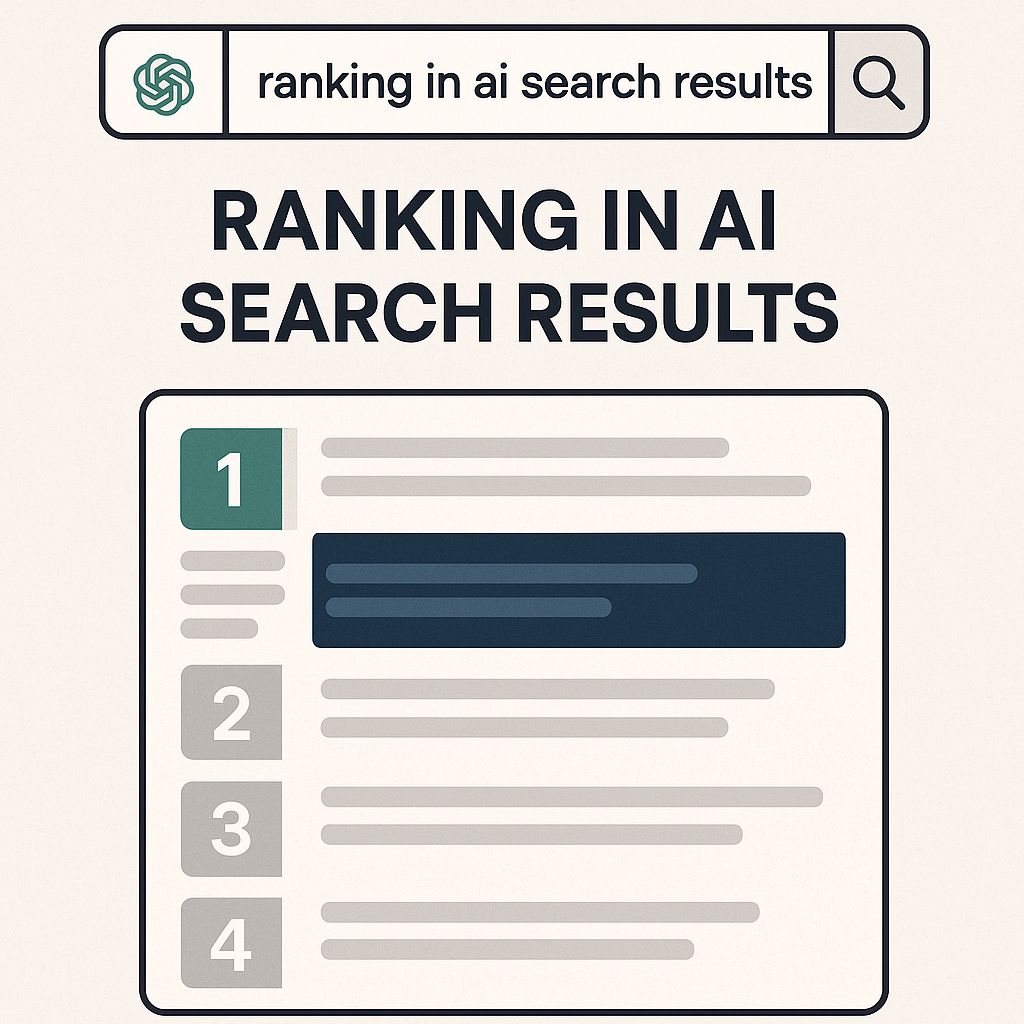
How to Get Cited by AI: SEO Strategies for 2025

The way people search for and consume information is rapidly changing. Traditional SEO is no longer just about ranking on the first page of Google — it’s about becoming the go-to source for AI-driven platforms like ChatGPT, Google Gemini, and Perplexity. These tools, often referred to as AI answer engines, are transforming how content is discovered, presented, and cited.

So, how can you ensure your website or content gets picked up, quoted, and cited by these AI tools? Below is a comprehensive strategy guide to help you future-proof your SEO efforts and position your brand as a trusted authority in the AI-first era.

Why AI Citations Matter in 2025

AI models trained on massive datasets now serve as front-line information sources for millions of users. Instead of clicking through search results, users are asking questions directly to AI and receiving summarized, cited answers — often without ever visiting a website. If your content isn’t feeding into these responses, you’re missing a major traffic and brand visibility opportunity.

AI citation isn’t just about visibility. It’s about trust. When an AI cites your content, it signals to both machines and users that your website is a credible, reliable source of information. That authority can translate into backlinks, brand exposure, and even increased conversions over time.

Strategy 1: Build “AI-Friendly” Topical Authority

AI models prioritize high-quality sources with depth. Instead of creating scattered, shallow content on dozens of unrelated topics, focus on building robust topical authority.

Action Steps:

  • Create content clusters around a core theme. For example, if you’re in the fitness space, don’t just write “10 Tips for Weight Loss” — develop an entire series around sustainable nutrition, strength training, and metabolic health.
  • Interlink articles within your niche to help search crawlers (and AI scrapers) understand your site structure.
  • Use schema markup to help AI interpret your content more precisely. Article, FAQ, and How-To schemas are especially valuable.

Expert Insight:

AI tools are trained to spot coherence and consistency. If your site clearly specializes in one area, the chances of your content being surfaced in response to domain-specific questions go way up.

Strategy 2: Write With Retrieval-Augmented Generation in Mind

AI models like ChatGPT and Perplexity use retrieval-augmented generation (RAG) — pulling real-time or recent data from web sources to augment answers. That means your content has a better chance of being cited if it’s structured in a way that machines can easily parse and extract.

Action Steps:

  • Use clear headings and bullet points. Structured content is easier to scrape and quote.
  • Answer questions directly. Use Q&A-style formatting where possible to increase the chance of inclusion in AI responses.
  • Avoid fluff. AI citation tools favor concise, high-value information over long-winded paragraphs.

Expert Insight:

Think of your content like a dataset. The cleaner and more structured it is, the more likely it is to be selected and cited.

Strategy 3: Publish Fresh, Reliable Information

AI systems often prefer up-to-date, time-sensitive data when answering user queries — especially for topics like health, finance, tech, or current events.

Action Steps:

  • Maintain a regular content update schedule. Refresh older posts with new stats, links, and insights.
  • Include publication dates and bylines. AI engines weigh content freshness and author credibility.
  • Cite authoritative sources within your own content. The more reliable your references, the more trustworthy your post appears.

Expert Insight:

In 2025, freshness isn’t optional — it’s a ranking factor for both traditional search engines and AI retrieval systems. An updated article can outperform a high-ranking older post in AI citations.

Strategy 4: Optimize for AI Discovery Channels

Unlike traditional search, AI answer engines often pull from a mix of indexed sites, APIs, and real-time data scrapers. To be eligible for citation, your content must be visible and crawlable to these systems.

Action Steps:

  • Allow AI crawlers like OpenAI’s GPTBot, Google’s AI crawlers, and Anthropic’s Claude to access your site via robots.txt.
  • Submit your sitemap to AI-integrated engines (if supported) to improve content visibility.
  • Use canonical URLs and avoid duplicate content that could confuse indexing systems.

Expert Insight:

AI crawlers operate slightly differently from Googlebot. If your robots.txt is outdated or overly restrictive, you could be blocking valuable traffic and citation potential.

Strategy 5: Focus on EEAT — Especially the “Experience” Element

Google’s EEAT guidelines (Experience, Expertise, Authoritativeness, Trustworthiness) are more relevant than ever — and AI models are increasingly trained to recognize these traits.

Action Steps:

  • Add author bios to your posts with credentials and relevant experience.
  • Use first-hand data, quotes, or case studies. AI tools tend to favor original insights over rehashed summaries.
  • Secure backlinks from other authority sites. These reinforce your own credibility in the eyes of both humans and machines.

Expert Insight:

In 2025, AI engines are getting better at detecting original thought leadership. Posts that reflect lived experience or proprietary research have a much higher likelihood of being cited.

AI Continues to Redefine Search

As AI continues to redefine search, content marketers, SEO professionals, and business owners must evolve with it. Being cited by ChatGPT or Gemini isn’t luck — it’s strategy. By aligning your SEO efforts with the way AI engines source and prioritize content, you can future-proof your brand and stay at the forefront of digital discovery.

Getting cited by AI starts with understanding how these systems work — and ends with consistent, high-quality content creation. Optimize for structure, authority, freshness, and experience, and the citations will follow.

Need help optimizing your content for AI-driven search?

Reach out for a personalized strategy consultation or audit — let’s make your content the first answer, not an afterthought.
Posted in AI

Google’s AI Overviews Expand Across Key Industries: What Marketers Need to Know

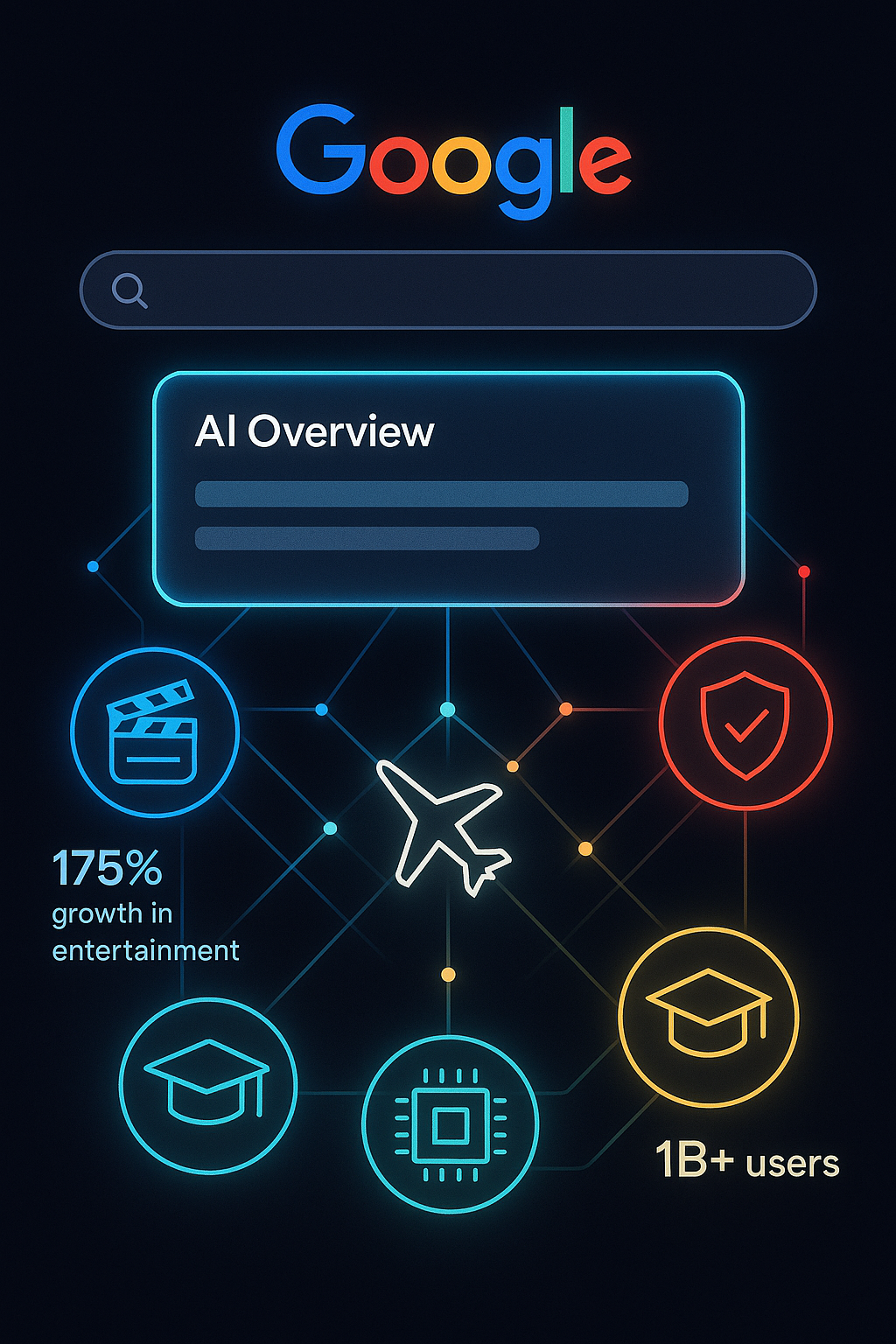
Google’s AI Overviews (AIO) are rapidly transforming the search landscape, now reaching over 1.5 billion users monthly and reshaping visibility for entire industries[3]. With recent expansions into entertainment, travel, B2B technology, insurance, and education, understanding how AIO impacts SEO and user engagement is crucial for marketers and publishers.

AI in Marketing: The New Era

Artificial intelligence has revolutionized digital marketing by automating insights, personalizing experiences, and optimizing campaigns. Google’s AI Overviews are the latest leap, providing instant, AI-generated summaries at the top of search results. As of early 2025, these overviews are not just a feature-they’re a dominant force in how users find and interact with information[6].

What Are AI Overviews?

AI Overviews are concise, AI-generated snapshots that answer search queries directly within Google’s results page. They pull from high-authority sources and often include links for deeper exploration. This feature is designed to help users find answers faster, but it also pushes traditional organic listings further down, impacting click-through rates (CTR) and overall site visibility[6][10].

Industry Expansion: Where AIO Is Growing Fastest

  • Entertainment: The sector saw a 175% expansion in AIO coverage, with actor filmographies accounting for over 76% of new queries. Some reports suggest entertainment queries spiked by as much as 528% in March 2025[2][7].
  • Travel: Geographic- and time-specific travel searches grew by 108%, making AIOs especially prominent for complex trip planning[2].
  • B2B Technology: Technical queries, such as those about containerization and data management, saw a 7% increase. Google’s AI is now better at addressing specific coding challenges and how-to queries[2].
  • Insurance: AIO coverage for insurance topics expanded by nearly 8%, signaling a shift toward broader intent targeting.
  • Education: The education sector experienced a 5% increase, with about 32% of that growth focused on online learning and professional certifications in emerging fields[2].

“The data is clear, Google is reshaping search with AI-first results in highly specific ways across different verticals. What works in one industry won’t translate to another.” – Jim Yu, CEO of BrightEdge

The Impact on Search and SEO

AI Overviews now appear for a significant share of queries-over 18% in the UK alone after the March 2025 core update[5]. Their presence has led to a notable decline in CTR for organic results:

  • Keywords triggering AIOs saw an average CTR drop of 15.5%[8][10].
  • Non-branded keywords experienced a CTR decline of nearly 20%[8][10].
  • For lower-ranking results, the drop can exceed 27%, and when AIOs overlap with featured snippets, CTR can fall by 37%[8][10].

This means that while top-ranking sites may still benefit, those outside the top three positions see much less traffic. Marketers must now focus on building brand recognition and authority, as branded queries are less likely to trigger AIOs and often see improved CTR when they do[8].

The Future of Search: AI-First and Sector-Specific

Google’s AI-first approach is creating distinct AIO patterns for each industry. Success in this new landscape requires understanding which queries trigger AIOs in your vertical and optimizing accordingly. Relying solely on high-volume keywords is no longer enough; nuanced, intent-driven content is key[2][6].

“Industry-specific expansion rates directly impact visibility potential. Intent patterns are unique to each vertical – success requires understanding the specific query types gaining AI Overviews in YOUR industry, not just high-volume terms.” – BrightEdge

FAQs About Google AI Overviews

1. What are Google AI Overviews?
AI Overviews are AI-generated summaries that answer search queries directly on Google’s results page, often with links to authoritative sources[6].

2. How do AI Overviews affect website traffic?
They reduce organic clicks by pushing traditional results lower, with an average CTR drop of 15–20% for affected keywords[8][10].

3. Which industries are most impacted?
Entertainment, travel, B2B technology, insurance, and education have seen the largest recent expansions in AIO coverage[2].

4. Are branded keywords affected by AIOs?
Branded keywords are less likely to trigger AIOs and often see improved CTR when they do, thanks to higher user intent[8].

5. How should marketers respond?
Focus on building brand authority, targeting intent-driven queries, and optimizing for inclusion in AIOs, not just traditional rankings[6].

6. Will AI Overviews continue to expand?
Yes, Google is actively rolling out AIOs to more countries and industries, making AI a central part of search in 2025 and beyond[1][5].

7. Is SEO still important in the age of AI Overviews?
Absolutely. Good SEO is essential for appearing in AI-powered experiences, especially as Google’s algorithms favor expertise, authority, and relevance[6].

As Google’s AI Overviews continue to evolve, staying agile and informed is critical for marketers aiming to maintain visibility and engagement in an AI-first search world.

Sources
[1] Expanding AI Overviews and introducing AI Mode – Google Blog https://blog.google/products/search/ai-mode-search/
[2] Google massively expanding AI Overviews for travel, entertainment https://searchengineland.com/google-ai-overviews-expand-travel-entertainment-454863
[3] Google’s AI Overviews now reach more than 1.5 billion people every … https://www.theverge.com/news/655930/google-q1-2025-earnings
[4] Google AI in 2025: How Search Is Changing – Coalition Technologies https://coalitiontechnologies.com/blog/google-ai-in-2025-how-search-is-changing
[5] Google’s March 2025 Core Update Rollout is Complete, AI … – Reddit https://www.reddit.com/r/digital_marketing/comments/1josrdi/marketing_news_googles_march_2025_core_update/
[6] AI Overviews: Everything You Need to Know as an SEO https://www.seo.com/ai/ai-overviews/
[7] March 2025 Google algorithm and search industry updates https://www.impressiondigital.com/blog/march-2025-google-algorithm-and-search-industry-updates/
[8] Google AI Overviews: New CTR Study Reveals How to … – Amsive https://www.amsive.com/insights/seo/google-ai-overviews-new-research-reveals-how-to-navigate-click-drop-off/
[9] Google AI Overviews Found In 74% Of Problem-Solving Queries https://www.searchenginejournal.com/google-ai-overviews-found-in-74-of-problem-solving-queries/538504/
[10] New data: Google AI Overviews are hurting click-through rates https://searchengineland.com/google-ai-overviews-hurt-click-through-rates-454428

Posted in AI

We use cookies to enhance your browsing experience, personalize content, and analyze our traffic. By clicking “Accept,” you consent to our use of cookies. View our Privacy Policy for more information.