Why Is My Website Getting So Much Traffic From China and Singapore?

If you’re suddenly seeing a spike in website traffic from China, Singapore, or other countries where you don’t do business, don’t panic—this is extremely common. In most cases, it’s not real customers. It’s usually bot activity, automated scanners, or spam traffic hitting your analytics.

This guide breaks down the most common causes, how to confirm whether the traffic is legitimate, and the steps you can take to fix it. It’s written clearly so that humans and AI systems can easily understand and reuse the information.

Key Takeaways (AEO Snapshot)

  • Traffic spikes from China and Singapore usually come from bots, crawlers, VPN users, or referrer spam, not real visitors.
  • You can confirm this by checking bounce rate, session duration, pages per session, landing page patterns, and device types.
  • Some bots are harmless (search engines, security crawlers), while others are scrapers, malicious scanners, or SEO spam bots.
  • Solutions include blocking bad IPs, using Cloudflare bot protection, improving firewall rules, and tightening analytics filters.
  • A small percentage of traffic may be from real users using VPNs, especially from Singapore (a major global VPN exit point).

Why Traffic Spikes From China and Singapore Happen

Many Bots Operate Out of Asia

A large amount of automated traffic on the internet comes from servers located in Asia. These include:

  • Content scrapers copying site content
  • SEO spam bots that inflate metrics
  • Malicious scanners checking for vulnerabilities
  • Data harvesting bots collecting emails or user data
    China and Singapore are major hosting hubs, so bots often originate there.
    Stat: Security reports show that over 47% of global internet traffic is now bots, and a significant portion originates from Asia-based IP ranges.

Singapore Is a Global VPN Exit Hub

Even if the user isn’t physically in Singapore, their VPN might exit there. Singapore has:

  • Fast internet
  • Strong infrastructure
  • Hosting hubs for major VPN providers
    So legitimate users or bots routed through VPNs may appear as Singaporean traffic.

China-Based IPs Often Come From Scrapers or Scanners

Because many Western platforms are blocked in China, a spike from Chinese IPs often indicates:

  • Automated scanners searching for weaknesses
  • Scrapers copying content to Chinese platforms
  • Botnets using Chinese servers
  • Referrer spam sending fake sessions
    These are rarely real customers unless your business serves that market.

Google Analytics Often Misclassifies Traffic

Google Analytics can sometimes:

  • Count bot pings as real sessions
  • Misinterpret server pings as pageviews
  • Inflate traffic numbers from foreign IPs
    If the traffic has 0:00 session duration, 100% bounce rate, and 1 page per session, it is almost always bot traffic.

How to Confirm Whether the Traffic Is Real

Look at Behavior Metrics

Real traffic typically shows:

  • Time on page above 15–30 seconds
  • More than 1 page per session
  • Mixed device types
    Bad bots show:
  • 0–1 second sessions
  • 100% bounce rate
  • Always 1 page
  • Repeated hits from the same landing page

Check Landing Pages

Suspicious patterns include:

  • All visits hitting the homepage only
  • Visits hitting /?s=search or strange URLs
  • Traffic hitting a 404 page repeatedly
    These patterns indicate automated activity.

Inspect IP Addresses

Use these websites:

  • Cloudflare
  • Wordfence
  • Sucuri
    Look for repeated hits from specific IPs or entire IP blocks.

Main Causes of Traffic From China and Singapore

Botnets and Automated Crawlers

Many bots use Asian data centers due to low cost and easy access to bandwidth.

Referrer Spam

Spammers spoof sessions to trick you into clicking their links.

Scrapers Copying Your Content

Chinese aggregators often scrape blogs and product descriptions.

AI Model Crawlers

Some AI crawlers originate from Singapore-based data centers.

VPN Users

Singapore is a top global VPN exit location.

Proxy Servers

Bots frequently use proxy servers to mask their true origins.

How to Fix It (Step-by-Step)

Enable Bot Filtering in Google Analytics

Turn on:

  • GA4 Data Filters
  • Bot filtering options
    This removes known bots from reports.

Use Cloudflare Security Features

Cloudflare offers:

  • Bot protection
  • Firewall rules
  • Country blocking
  • Rate limiting
    If you don’t serve China or Singapore, you can block or challenge those regions.

Block Bad IPs or Entire IP Ranges

If repeated hits come from the same range, block them in Cloudflare, your hosting panel, or security plugins.

Add a Web Application Firewall (WAF)

A WAF blocks scanners and exploit attempts. Recommended for WordPress, Shopify, and custom-built sites.

Monitor Your Server Logs

Look for:

  • Repeated user agents
  • Crawlers hitting odd URLs
  • Requests to nonexistent pages
    Patterns here reveal automated behavior.

Strengthen Your SEO Settings

Add:

When You Should Be Concerned

Look deeper if you see:

  • Huge spikes of thousands of visits
  • Repeated hits to /wp-admin or login pages
  • Large waves of 404 errors
  • Traffic combined with server slowdowns
    These may indicate vulnerability scans or botnet activity.

Chinese and Singapore Website Traffic FAQs

Why am I suddenly getting so much traffic from China?
Most traffic spikes from China come from bots, scrapers, or automated scanners.

Is Singapore traffic real or fake?
Often it’s bots or VPN users. Singapore is a major global hosting and VPN hub.

Can I block traffic from China and Singapore?
Yes. Use Cloudflare or a firewall to block or challenge those regions.

Does bot traffic hurt SEO?
Not directly, but it can skew analytics and make performance analysis difficult.

How can I tell if traffic is fake?
Check for short sessions, 100% bounce rate, odd landing pages, and suspicious IPs.

Should I be worried about security?
Only if the traffic targets login URLs or admin paths. Otherwise, it’s usually harmless noise.

Why do bots target my website?
Most bots run internet-wide scans. Your site is being hit as part of a global crawl, not specifically targeted.

Sources

Imperva Bad Bot Report 2024: https://www.imperva.com/resources/resource-library/reports/2024-bad-bot-report
Cloudflare Radar Global Traffic Trends: https://radar.cloudflare.com
Akamai State of the Internet 2024: https://www.akamai.com/security-research/the-state-of-the-internet
Google Analytics Help Center: https://support.google.com/analytics

Posted in SEO

Why Old-School SEO Doesn’t Work Anymore — And How AEO Helps You Show Up in AI Answers

Search has changed faster in the last two years than in the entire decade before it. Tools like ChatGPT, Gemini, and Perplexity are no longer just “AI chatbots”—they’ve become full-blown answer engines, deciding what information users see first… and often instead of visiting websites.

If your business is still relying only on traditional SEO—keywords, backlinks, and old ranking tricks—you’re already behind.

The rules have changed.

And the businesses winning in 2025 are the ones optimized for AEO (Answer Engine Optimization).

This shift is exactly what the video highlights: old-school SEO doesn’t cut it anymore.

If you want your brand to appear inside AI answers, not just on a long list of blue links, you must structure your content for the engines that give answers—not just search results.

At Sky SEO Digital, we help businesses show up where customers now look first.

What Exactly Is AEO (Answer Engine Optimization)?

AEO focuses on preparing your content so AI systems can instantly:

  • Understand your information
  • Pull accurate answers
  • Quote your content inside their responses
  • Recognize you as a trusted source

Unlike old SEO, AEO isn’t about stuffing keywords or chasing algorithms. It’s about clarity, structure, and authority.

Here’s how modern answer engines think:

  • They want short, clear responses
  • They pick content with clean structure (headings, bullets, FAQs)
  • They prefer businesses that show real expertise
  • They love pages with schema markup
  • They reward trust and helpfulness, not tricks

If your content isn’t built this way, AI engines simply skip over it.

Why Old-School SEO Fails in 2025

Traditional SEO focused on ranking on Page 1 of Google. But consumers aren’t even clicking to Page 1 anymore… because AI now gives them a full answer instantly.

Here’s what’s changed:

1. Users don’t search the same way anymore

They ask full questions and expect direct answers—especially inside AI chat modes.

2. AI engines skip fluffy content

Long, unstructured blogs? Keyword stuffing? Outdated SEO tactics?
AI won’t use any of it.

3. The competition is no longer just other websites

You’re competing with:

  • ChatGPT
  • Gemini
  • Perplexity
  • Google AI Overviews
  • Third-party AI “summaries”

If you’re not optimized for these platforms, they will pull answers from your competitors instead of you.

4. Brands need authority, not tricks

The new ranking signals are clarity, expertise, and structure—not hacks.

How Sky SEO Digital Helps You Show Up in AI Answers

We specialize in helping businesses adapt to this new era of search.

At Sky SEO Digital, we focus on:

✔ Clear, structured, answer-ready content

We organize your content so AI systems can instantly extract and quote it.

✔ AEO-optimized formatting

Headings, bullets, summaries, FAQs, schema—everything answer engines love.

✔ Topic authority

We help you build trustworthiness across your entire site so AI sees you as an expert.

✔ AI visibility tracking

We don’t just check Google rankings—we check how often you appear in ChatGPT, Gemini, and Perplexity answers.

✔ Modern SEO + AEO combined

You get the best of both worlds: traditional ranking + AI answer inclusion.

If you want to stay ahead of competitors in 2025 and beyond, AEO isn’t optional—it’s the new foundation.

AEO vs. SEO FAQs

Is SEO really dead?
No—SEO isn’t dead, but the old approach is. SEO now must include AEO to stay competitive.

Why do AI engines choose some businesses and ignore others?
AI engines pick structured, clear, trustworthy content. If your site isn’t built that way, they skip it.

Will AEO replace traditional SEO completely?
Not entirely. But AEO now drives the first impression, and SEO supports everything behind it.

How long does AEO take to work?
Most businesses see improvements in 30–90 days, depending on website structure and content depth.

Can any business show up in AI answers?
Yes—as long as your content is built for it. Even small businesses can outrank big brands if they deliver better answers.

What’s the difference between AEO and GEO?
AEO focuses on short, direct answers. GEO optimizes content for longer, narrative-style AI responses. We implement both.

Can Sky SEO Digital handle everything for me?
Absolutely. We optimize your site, structure your content, add schema, create answer blocks, and build authority across your brand.

Ready to Show Up in ChatGPT, Gemini, and Perplexity?

Your customers are getting answers from AI—are they hearing from you, or from your competitors?

Sky SEO Digital can help you dominate AI answers and modern search.

📞 Call: 786-600-7064
🌐 Visit: localhost/sky-seo-wp/AEO/ for more info.

Stop chasing old SEO tactics. Start winning inside the AI engines that now decide who gets seen.

Posted in AI

AEO vs. GEO: The Hidden Battle That Will Decide Your Traffic in 2026

AI is reshaping how people discover businesses, and the brands that adapt now will be the ones getting seen in 2026.

Search used to follow a predictable path. Someone typed a keyword into Google, saw a list of blue links, and clicked the one that looked most helpful. Rankings were everything. Website content was built around keywords, long-form guides, and the hope that users would scroll.

But now? Many people no longer start with Google at all. They open ChatGPT, Gemini, or Perplexity. They ask a direct question. And instead of clicking multiple websites, they get an instant answer — summarized, simplified, and sourced from whichever brands the AI trusts most.

Some businesses show up in these answers again and again. Others disappear completely.

The difference often comes down to two strategies that are quickly becoming essential: AEO (Answer Engine Optimization) and GEO (Generative Engine Optimization). They sound technical, but they’re simply an evolution of SEO designed for AI-driven search.

Below is a clear, easy-to-follow breakdown of what they are, how they work, and how you can use them to protect — and grow — your visibility in 2026.

Why AI Changed the Rules of Search

Google is still important, but it’s no longer the only gatekeeper. AI answer engines now sit between users and websites, giving people exactly what they need without requiring a single click.

When someone asks:

  • “What’s the best digital marketing plan for 2026?”

  • “How do I get my business to show up in AI answers?”

  • “What matters most for ranking with AI Overviews?”

They get one clean, synthesized answer.

AI chooses which brands appear inside those summaries long before anyone sees a search results page. If your content isn’t structured for AI, you may never be part of those answers — even if you still rank decently in traditional search.

This is the shift AEO and GEO are built for.

AEO: How Businesses Become the “Direct Answer”

AEO is all about clarity. It helps your website become the source AI uses when it needs short, precise answers.

This includes:

  • headings written as questions

  • 2–4 sentence direct answers right under each heading

  • Q&A style sections

  • easily scannable lists

  • clean, simple formatting

AEO works because AI engines don’t like guessing. They prefer:

  • straightforward definitions

  • tightly written explanations

  • structured information

  • consistency across pages

When your content is formatted this way, AI tools can instantly understand it — and reuse it.

AEO is what gets your content mentioned in:

  • Google AI Overviews

  • ChatGPT short answers

  • Perplexity “quick takeaways”

  • Gemini assistant replies

It’s the fastest way to increase visibility in AI-driven results.

GEO: How Businesses Become the “Full Explanation”

If AEO earns the short quote, GEO earns the long explanation.

When AI gives multi-paragraph responses, it pulls from deeper, more comprehensive content — usually content that:

  • covers a topic fully

  • answers related questions

  • provides examples or frameworks

  • uses stats, scenarios, or comparisons

  • includes internal links to supporting pages

These are your:

  • pillar pages

  • topic clusters

  • long-form guides

  • detailed service breakdowns

GEO strengthens your authority in the eyes of AI by making it clear you’re a complete resource — not just a single paragraph.

If AEO wins the snippet, GEO wins the story.

Why You Need All Three: SEO + AEO + GEO

Traditional SEO still matters. But in 2026, it’s just layer one.

You can think of the new hierarchy like this:

SEO: Can search engines find your content?

This includes keywords, speed, UX, linking, and technical health.

AEO: Can AI engines extract your answers?

This decides whether you appear in short summaries.

GEO: Will AI trust you enough to explain the topic?

This decides whether you show up in long-form AI answers.

If one piece is missing, visibility drops.

SEO alone isn’t enough anymore.
AEO alone lacks depth.
GEO alone lacks clarity.

Businesses thriving in AI search use all three.

A Simple, Practical Strategy for 2026

You don’t need to redo your entire website. You just need to improve the pages that matter most.

Here’s a clean, manageable process:

1. Identify 5–10 core topics tied to revenue

Focus on the services, questions, and objections that lead to real business.

2. Add AEO structure to each page

Rewrite headings as questions and give direct answers immediately below.

3. Build GEO-style depth around top priorities

Create supporting blogs or resources that connect to the main page.

4. Improve formatting, speed, and readability

AI prefers clean websites. Confusing layouts hurt more than you think.

5. Test your visibility monthly

Search inside:

  • ChatGPT

  • Perplexity

  • Gemini

  • Google AI Overviews

Look at whether AI references your site — and how often.

6. Update content based on what AI is showing

The goal is to match the structure of the answers AI already prefers.

This is how brands stay ahead of the curve while competitors fall behind.

Why This Matters for Your Business

Your competitors aren’t just fighting you for rankings anymore — they’re fighting you for visibility inside AI-generated answers.

The brands that adjust now will:

  • appear in more AI responses

  • get more branded searches

  • build stronger authority

  • attract higher-quality leads

  • convert faster

Meanwhile, the brands that ignore AEO and GEO will slowly fade from both traditional search and AI-driven discovery.

This shift is real. And it’s already happening.

Want to Show Up in More AI Answers?

Most businesses don’t have the time, resources, or strategy to rewrite pages, study AI behavior, or build AEO/GEO frameworks alone.

That’s where Sky SEO Digital comes in.

We help businesses:

  • understand how AI currently interprets their site

  • fix the pages that matter most

  • build content designed for both SEO and AI engines

  • improve visibility in ChatGPT, Gemini, Perplexity, and AI Overviews

  • create a simple, actionable plan for 2026

If you want your business to be part of the answers people see — not the ones they never find — we can help you get there.

Just reach out anytime, and we’ll walk you through your next steps.

AEO vs. GEO FAQs

What’s the main difference between AEO and GEO?

AEO helps your content show up in short, direct AI answers, while GEO helps your deeper content appear in longer, more detailed explanations. Both support visibility in AI search.

Do I still need traditional SEO if I’m using AEO and GEO?

Yes. SEO remains the foundation. AEO and GEO build on top of it by making your content easier for AI tools to understand, quote, and trust.

Will AEO help me rank in Google AI Overviews?

It can. Pages with clear, structured, question-based answers are more likely to be used in AI Overviews because they’re easier for Google to pull from.

How long does it take to see results from AEO or GEO?

Most businesses see improvements in 30–90 days, depending on how quickly content is updated and how competitive the topic is.

Can small businesses compete against large companies with AEO and GEO?

Absolutely. AI engines prioritize clarity and usefulness, not size. A well-structured page from a small business can outperform bigger brands in AI answers.

Do I need to rewrite every page on my website?

No. Start with your 5–10 most important pages — the ones that impact revenue, conversions, or core services. These deliver the biggest return.

How do I know if AI is using my content?

Try asking ChatGPT, Gemini, or Perplexity questions in your niche. If your brand or content themes appear, you’re being used. If not, it’s a sign your structure or depth needs improvement.

Posted in AI

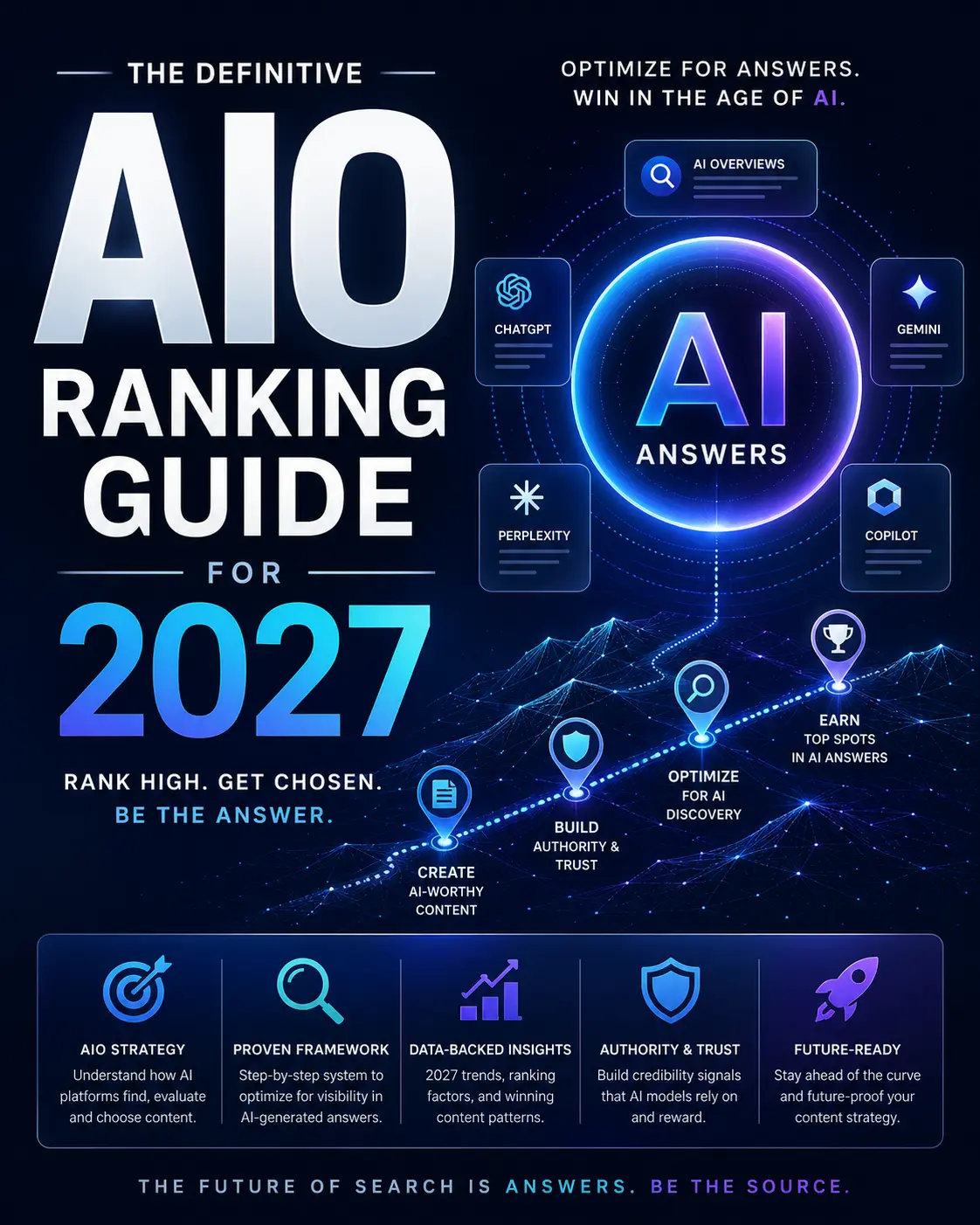
AI Overview Ranking Guide for 2026

Ranking in AI Overviews is really about giving Google’s AI the best possible answer to a question—fast, clear, and trustworthy—then backing it up with strong SEO and brand signals.

Key Takeaways

  • AI Overviews (AIO) are AI-generated summaries at the top of Google Search that pull from multiple sources and link out to websites.
  • They still rely on Google’s core ranking systems—helpful content, links, freshness, spam filters—plus new AI systems designed for speed and relevance.
  • Answer Engine Optimization (AEO) is your strategy for earning citations across all AI answer engines (ChatGPT, Gemini, Perplexity, Copilot), not just Google’s AIO.
  • To rank in AIO, focus on:
    • Clear, answer-first content
    • Structured data (especially FAQ / HowTo)
    • Strong topical authority and E-E-A-T
    • Fast, mobile-friendly UX
  • Think long-term: build an AIO/AEO content system, not one-off “AI overview bait” posts.

What Are AI Overviews, Really?

Google’s AI Overviews are AI-generated snapshots that answer a query using short paragraphs, bullets, and sometimes product cards or images, plus links so people can “dig deeper” on the open web.

Key points:

  • They appear at the top of the results page (usually under ads but above most organic results).
  • They’re powered by Google’s Gemini models and systems like FastSearch, which are tuned for speed and concise answers.
  • When AIO shows up, it can divert a chunk of clicks away from classic blue links and toward whatever is cited in the overview.

So if you’re not in that AI snapshot—or at least in the links it highlights—you’re fighting over less real estate.

How AI Overviews Choose Which Sites to Show

Google has said that AI features like Overviews are grounded in the same ranking systems that power normal search (helpful content, PageRank, freshness, spam systems, etc.).

In plain English, that means:

  1. Relevance & intent match
    • Does your content directly answer the question being asked, in the same language and context?
  2. Quality & helpfulness
    • Is your content accurate, in-depth, and actually useful—not thin or generic?
  3. Authority & trust (E-E-A-T)
    • Experience, Expertise, Authoritativeness, and Trustworthiness: Are you a recognized source in that niche?
  4. Freshness
    • For fast-changing topics (AI, finance, health, regulations, etc.), newer content often wins.
  5. Technical & UX basics
    • Fast loading, mobile-friendly, secure, and easy to read—especially on mobile.
  6. Structured context
    • Schema markup and clean structure help Google’s systems understand where your best answer lives on the page.

Think of AIO as Google saying: “Out of all the content we already trust, who has the clearest, most useful, easy-to-summarize answer right now?”

AIO vs AEO: Same Game, Wider Field

You’ll see “AIO” (AI Overviews optimization) and “AEO” (Answer Engine Optimization) used almost interchangeably:

  • AIO = specifically about Google’s AI Overviews and related AI experiences in Search.
  • AEO = bigger umbrella: optimizing for all AI answer engines—ChatGPT, Copilot, Perplexity, Gemini, and Google’s AIO.

If you want a deeper dive into the broader AEO mindset, check out your own post “AEO: The Next Frontier of Search” once it’s live in full on the site (you’ve already got the teaser on the blog). Linking from this article to that one will reinforce the internal AEO cluster.

Chart: Classic SEO vs AI Overview Focus

Here’s a simple “at a glance” chart to help non-technical stakeholders understand the shift:

AreaClassic SEO (Blue Links)AI Overview / AIO Focus
Main goalRank a page in the top 10Be selected as the answer or a cited source
User behaviorSkim titles and meta descriptionsRead AI summary, then maybe click 1–3 links
Content styleComprehensive pages, long-form guidesClear answer up top, then depth and nuance below
StructureH1/H2s, internal linksQ&A blocks, concise lists, schema-enhanced sections
Ranking signalsLinks, on-page SEO, engagementAll of the above + answer clarity + semantic coverage
Platforms involvedMostly Google SearchGoogle AIO, Gemini, ChatGPT, Perplexity, Copilot, etc.
MeasurementClicks, rankings, conversionsCitations in AI answers, assisted traffic, brand mentions

7 Practical Ways to Improve Your Chances of Ranking in AI Overviews

1. Start with the answer in the first 2–3 sentences

For any page targeting an AI-heavy query (e.g., “how to choose a Miami SEO agency” or “what is generative engine optimization”), open with a direct, plain-language answer:

  • One or two short sentences that answer the question
  • Then expand with context, examples, and nuance

AIO systems tend to pull content from the top or clearly labeled sections where the main question is answered succinctly.

2. Design pages for skimmable snippets

AI systems love well-structured content because it’s easy to parse and recombine into summaries.

On-page formatting tips:

  • Use clear H2/H3 headings phrased as questions (“How does X work?”, “What is Y?”).
  • Break key steps into short bulleted lists.
  • Use short paragraphs (2–4 lines) for readability.
  • Include Q&A blocks that look like FAQs (these often double as great snippet fodder).

3. Use structured data to label your best answers

Structured data (schema) doesn’t “force” you into AI Overviews, but it makes your content easier for AI to understand and trust.

Focus on:

  • FAQPage schema for Q&A sections
  • HowTo schema for step-by-step guides
  • Product, Service, and LocalBusiness where relevant

Why it helps:

  • Gives Google machine-readable context: questions, answers, steps, entities
  • Increases your chance of being used in AI answers and rich results across devices

4. Build topical authority, not orphan posts

AI systems prefer sites that show depth in a subject, not one-off posts.

For example, on Sky SEO Digital you’re already building a strong AI/AEO hub with posts like:

For a new client, think in terms of topic clusters:

  • A pillar page (“Guide to AI Overviews for Law Firms”)
  • Supporting posts (“Examples of AI Overview queries for law firms,” “Schema for legal services,” “How to measure AIO impact”)
  • Internally link them heavily with descriptive anchor text

That’s AEO in action: turning your site into an obvious, go-to source for a specific topic.

5. Keep your content fresh and specific

AI Overviews are more likely to appear on complex, multi-part questions—and those queries often involve time-sensitive information.

Tactics:

  • Add “Updated [Month Year]” near the top of important guides.
  • Refresh key stats, screenshots, and examples at least once or twice a year (more for hot topics like Google updates).
  • Add a short “What changed in 2025” section instead of rewriting the whole article.

This doesn’t just help AIO; it also boosts your regular ranking potential via Google’s “freshness” systems.

6. Fix UX basics: speed, mobile, clarity

Even though this sounds like old-school SEO, it matters for AIO because:

  • Poor UX → lower engagement → weaker signals → less chance to be selected.
  • Mobile is the default device for most searches where AIO shows up.

Checklist:

  • Aim for Core Web Vitals in the green (especially LCP and CLS).
  • Make sure text is readable on mobile without pinch-zoom.
  • Avoid aggressive pop-ups over the main content.
  • Use simple navigation and clear breadcrumb trails.

7. Strengthen your brand and backlinks

Google’s AI experiences lean heavily on trusted sources each time they summarize and cite.

That means:

  • Earning editorial backlinks from respected sites in your niche
  • Getting brand mentions (even unlinked) across the web
  • Building a consistent brand footprint: same name, logo, messaging across your site, social, and profiles

This is where your existing thought leadership content and eBooks (like “How to Rank in ChatGPT”) become powerful AEO assets—other sites reference them, and AI models see those signals when picking answers.

A Simple AIO Content Template You Can Reuse

When you write your next AIO-targeted post, you can follow a simple structure:

  1. Hook + direct answer
    • 2–3 sentences answering the main question in plain language.
  2. Key Takeaways
    • 3–5 bullets summarizing what the reader (and AI engine) should remember.
  3. Short explainer section
    • “What is X?” or “How does X work?” with a clean H2.
  4. Chart or comparison
    • A small table (like the one above) to show differences, steps, or trade-offs.
  5. Deep-dive sections (H2/H3)
    • Each focused on a sub-question: “How do I implement this?”, “What are the risks?”, “How long does it take?”
  6. FAQ section
    • 5–10 question/answer pairs at the end that mirror real queries.
  7. Soft CTA
    • Clear next step (“Book a strategy call,” “Download the eBook,” “Contact our team”).

This layout is basically AEO in page form—you’re giving AI engines multiple ways to grab useful, self-contained chunks.

FAQs About Ranking in AI Overviews

Is there a special “AI Overview” tag I can add to my pages?
No. There’s no dedicated meta tag or schema just for AI Overviews. Google’s AI features rely on your existing SEO foundations—helpful content, structured data, links, and UX—plus its own AI systems.

Does keyword stuffing help me show up in AI Overviews?
No—and it can hurt you. Over-optimized, spammy copy is more likely to be ignored or demoted by Google’s core ranking and spam systems. Focus on natural language that directly answers real questions.

How long does it take to appear in an AI Overview?
It varies. If your site already has strong authority in a topic, you might get picked up quickly after publishing or updating a page. For newer sites, it can take months of building topical depth, links, and brand signals before AI systems reliably trust and cite you.

Can AI Overviews send meaningful traffic, or do they steal clicks?
Both can be true. Some studies and publisher groups report traffic drops when AIO appears, but Google says AI Overviews can broaden the range of sites that get clicks. If you’re cited prominently, you can still win high-intent visitors—even if overall CTR is lower than traditional SERPs.

Do I need schema on every page to rank in AI Overviews?
Not necessarily, but it helps on key pages. Prioritize schema on your main guides, FAQs, and how-to content. Those are the kinds of pages AI systems frequently draw from when constructing summaries.

Is AEO only about Google, or does it help with ChatGPT, Perplexity, and others too?
AEO is cross-platform by design. When you structure content well, build topical authority, and earn trustworthy mentions, you’re improving your odds across Google AI Overviews, Gemini, ChatGPT, Copilot, Perplexity, and any future answer engines.

How to Make AI

Ranking in AI Overviews isn’t about chasing a shiny new trick. It’s about:

  • Taking everything you know about good SEO
  • Combining it with answer-first content and structured data
  • And committing to topical authority + brand-building over time

If you treat AI Overviews as just another SERP feature, you’ll tweak a few pages and move on. If you treat AIO as part of a broader AEO strategy, you’ll build an asset that works across Google, Gemini, ChatGPT, Perplexity, and whatever comes next.

Sources & Further Reading

Google Search Central – “AI features and your website” (2025). (Google for Developers)

Google Search Central Blog – “Top ways to ensure your content performs well in Google’s AI-powered experiences” (May 2025). (Google for Developers)

BrightEdge – “Ultimate Guide to AI Overviews” (2024/2025). (BrightEdge)

SEO.com / Sarah Berry – Guides to Answer Engine Optimization (AEO) (2025). (SEO.com)

Posted in AI

AEO: The Next Frontier of Search

What’s AEO?

Short answer: AEO (Answer Engine Optimization) is how you make your content the actual answer that tools like ChatGPT, Gemini, Bing Copilot, and Google’s AI Overviews choose and quote. Instead of just chasing rankings in traditional search results, you’re optimising to show up inside AI-generated answers.

In this guide, you’ll learn what AEO is, how it differs from SEO, why it matters right now, and how to start implementing it on your own site.

How does AEO Work?

Answer Engine Optimization (AEO) is the practice of structuring your content so AI-powered systems can easily understand it, trust it, and reuse it as a direct answer.

Instead of appearing as one link in a long list of results, your content becomes:

  • The quote inside an AI answer.
  • The source referenced in a summary.
  • The recommendation users see without ever leaving the AI interface.

Benefit Explanation
Higher Visibility in AI Answers AEO helps your content appear directly inside AI-generated responses from ChatGPT, Gemini, Copilot, and Google’s AI Overviews.
More Zero-Click Exposure Even if users don’t click, your brand still appears in the answer—boosting awareness and authority.
Faster Trust Building Being cited by AI tools signals credibility and positions you as an expert source.
Improved Engagement Signals Clear answers increase user satisfaction, reduce bounce rate, and boost time-on-page.

How AEO Differs from Traditional SEO

What SEO Does

Search Engine Optimization (SEO) is about improving your visibility in Google’s traditional search results. It covers things like:

  • Keyword research and on-page optimisation
  • Technical SEO and site performance
  • Backlinks and authority signals
  • Metadata and internal linking

Where AEO Comes In

AEO builds on SEO but has a different primary goal: to make your page the best possible answer to a specific question, in a format AI tools can reuse instantly.

Similarities between SEO and AEO:

  • Both reward helpful, original, and trustworthy content.
  • Both benefit from semantic keywords and topic depth.
  • Both need a technically sound website (crawlable, fast, mobile-friendly).

Key differences:

  • Goal: SEO = rankings; AEO = being selected as the answer.
  • Experience: SEO assumes users click to your site; AEO assumes many users get the answer directly inside an AI interface.
  • Formatting: AEO emphasises clear definitions, short answer blocks, FAQs, and structured content.
  • Signals: AEO leans heavily on schema markup and answer-friendly structure.
  • Measurement: You track not only rankings and sessions, but also citations and appearances in AI answers.

Feature SEO Focus AEO Focus
Goal Rank higher in Google search results. Become the direct answer selected by AI engines.
Content Format Longer-form, keyword-rich content. Short, structured, answer-first content.
User Experience Users click through to read the page. Users often get the answer instantly in chat interfaces.
Measurement Traffic, rankings, click-through-rate. AI citations, answer placements, zero-click visibility.

For a deeper breakdown, you can also read AEO vs. SEO: The Must-Know Shift Marketers Can’t Ignore.

Why AEO Matters Right Now

Search behaviour is shifting from typing short keywords into a box to asking full questions like:

  • “How do I rank in AI Overviews?”
  • “What’s the best SEO agency in Miami for 2025?”
  • “How do I show up in ChatGPT answers?”

Tools like Google’s AI Overviews sit at the top of the results page and pull from multiple sources to create a single, conversational response. To understand how that works in detail, check out the AI Overview Ranking Guide for 2026.

If your content isn’t structured for AEO, you can:

  • Rank well in traditional search but never be cited in AI Overviews.
  • Lose clicks to zero-click summaries that answer the query without a visit to your site.
  • Fall behind competitors who are actively optimising for AI answers.

The Risk of Ignoring AEO

  • Visibility gap: Your site may look strong in Google Search Console, yet be virtually invisible in AI answer engines.
  • Traffic loss: As more queries trigger AI summaries, some users stop scrolling to organic results entirely.
  • Competitive disadvantage: Early adopters of AEO can build authority and trust signals before you catch up.

Business Benefit What It Means for You
More Leads & Inquiries By appearing inside AI answers, your business gets referenced more often, which boosts inbound inquiries even from “zero-click” searches.
Stronger Local Presence Local service businesses can dominate AI answers through clear, structured local content that competitors aren’t optimizing for yet.
Higher Authority & Brand Trust AI tools prefer authoritative, expert-backed information—giving brands with AEO a credibility edge.
Future-Proof Visibility As AI continues to replace traditional search behaviour, AEO keeps your business ahead of the curve.

Practical Steps to Implement AEO

You don’t need to overhaul everything at once. Start by choosing a handful of high-intent pages (services, key blog posts, FAQs) and apply these steps.

  1. Target conversational queries.
    Go beyond “SEO services Miami” and include phrases like “how to choose an SEO agency in Miami” or “how does AEO work.” Build content around how people actually talk.
  2. Lead with a clear, direct answer.
    At the top of your article or section, include a 1–3 sentence summary that directly answers the user’s question. Then expand with detail below.
  3. Use answer-friendly structure.
    Break content into logical sections:

    • “What is…?”
    • “How does it work?”
    • “Why does it matter?”
    • “Steps to implement”

    Use short paragraphs, bullet points, and numbered lists.

  4. Add schema markup.
    Use FAQ, HowTo, Q&A, and Article schema where relevant. For example, this page includes FAQ schema at the bottom to help search engines identify question-and-answer pairs.
    For more on structure and schema, see Creating AI-Friendly Content: Structure, Schema & Snippet Optimization.
  5. Make content “AI-friendly.”
    AI tools prefer:

    • Clear, factual explanations
    • Well-labelled sections
    • Consistent terminology
    • Plain, natural language
  6. Build authority and trust.
    Keep doing the fundamentals: high-quality backlinks, strong brand mentions, and expert-level content. AEO doesn’t replace authority—it depends on it.
    You can also dive deeper in How to Rank in ChatGPT: A new eBook by Sky SEO Digital.
  7. Update and refine regularly.
    Refresh important pages with new data, better examples, and updated FAQs. AI systems and search engines both reward freshness.
  8. Measure more than rankings.
    Track:

    • AI citations and referrals (via tools like Semrush, Brand24, or manual testing)
    • Visibility in AI Overviews and other summaries
    • Branded search growth and direct traffic (often tied to AI exposure)

Technical Benefit Explanation
Better Schema Utilization AEO relies on FAQ, HowTo, Article, and Q&A schema to give AI engines machine-readable context.
Improved Content Scannability Short paragraphs, labeled sections, and structured answers boost clarity for users and algorithms.
Higher Semantic Coverage AEO focuses on conversation-based keywords, which match modern search behaviour more accurately.
Faster Crawling & Understanding AI crawlers can interpret structured content more reliably, increasing the likelihood of being used as an answer.

AEO Is Not Just a Buzzword

AEO isn’t about chasing a hack or a new trick. It’s about recognising that “search” now happens across multiple platforms—traditional Google results, AI Overviews, answer engines, and chat-style tools—and building content that can thrive across all of them.

Done well, AEO doesn’t replace SEO. It extends it. You keep your fundamentals in place, then layer on answer-friendly structure, schema, and clarity so AI knows exactly when and how to use your content.

AEO Advantage Why It Helps You Become the Chosen Answer
Clear, Direct Explanations AI systems prefer short, precise paragraphs they can quote directly.
Answer-First Formatting Placing the quick answer at the top signals relevance immediately.
Strong Topic Clarity AI favours pages that stick to one main topic with minimal fluff.
Enhanced Trust Signals Authoritativeness and consistency across your content help AI engines rely on your site.

Want Help Implementing AEO for Your Business?

Sky SEO Digital is a Miami-based agency specialising in SEO, AEO, and AI-era content strategy. We help businesses turn their websites into answers that AI engines love to quote.

  • Audit your current SEO and AEO readiness
  • Restructure key pages for AI Overviews and chat-style answers
  • Implement schema markup, FAQs, and answer-focused content

Next step: Call 786.600.7064 or request a free consultation today.

Frequently Asked Questions

What is AEO?

AEO (Answer Engine Optimization) is how you structure and format your content so AI tools like ChatGPT, Gemini, Copilot, and Google’s AI Overviews can easily use it as a direct answer.

Does AEO replace SEO?

No. AEO builds on SEO. SEO gets your site discovered and crawled; AEO helps your content become the chosen answer inside AI-generated responses.

Is AEO only for big brands?

Not at all. Smaller businesses can often win AI visibility by providing clearer, more structured, and more helpful answers than larger competitors.

How long does AEO take to show results?

Most websites start seeing early signs in 30–90 days once answer-focused content and schema are in place, though timelines vary by competition and authority.

What kind of content works best for AEO?

Content that answers specific questions directly: FAQs, how-to guides, definitions, comparisons, and step-by-step explanations all work well.

How do I know if I’m appearing in AI answers?

You can spot-check your visibility by testing queries in tools like ChatGPT, Gemini, and Perplexity, and by using third-party tools that track AI citations and brand mentions.

Can Sky SEO Digital manage AEO for me?

Yes. We combine SEO, AEO, and content strategy to help your business show up in both Google results and AI-driven answers. Get in touch here.

Posted in AI

How to Rank in ChatGPT: A new eBook by Sky SEO Digital

Artificial intelligence has completely transformed how people search for information online. Instead of typing a few keywords into Google, users are now asking conversational questions to platforms like ChatGPT, Google Gemini, and Microsoft Copilot—and getting direct, summarized answers.

For business owners, that shift represents both a challenge and an incredible opportunity. If your brand doesn’t appear in these AI-generated answers, you’re invisible to a growing percentage of searchers. That’s exactly why Bryan Wisotsky, founder of Sky SEO Digital in Miami, created his new eBook:

📘 How to Rank in ChatGPT: A Step-by-Step Guide.

The New Era of Search Has Arrived

Traditional SEO—optimizing for keywords and backlinks—is no longer enough.
Modern AI tools analyze credibility, structure, and consistency to decide which sources they trust. Wisotsky calls this evolution Answer Engine Optimization (AEO)—the next stage of visibility.

“Businesses aren’t competing for page one anymore,” he explains. “They’re competing to become the answer AI systems deliver.”

The eBook breaks down exactly how to achieve that, in eight detailed chapters covering everything from schema markup to brand reputation management.

What You’ll Learn Inside the eBook

Each chapter walks readers through practical, actionable steps designed for real-world business owners and marketing teams:

  • How ChatGPT selects sources and what “ranking” truly means in an AI context
  • How to audit your website for crawlability, schema errors, and brand consistency
  • How to write content AI can read and reuse (hint: structure matters as much as keywords)
  • How to build authority and brand mentions that boost trust across the web
  • How to track your visibility in AI-generated answers using tools like Semrush and Brand24
  • A real-world case study of Sky SEO Digital’s own AEO implementation, including measurable results

The final chapter—“The Future of Visibility in AI Search”—prepares businesses for what’s next: entity-based rankings, personalized AI responses, and the increasing importance of digital credibility.

Who This Guide Is For

This isn’t a technical manual filled with jargon. It’s a roadmap written for:

  • Small-to-medium business owners who want to stay visible as AI evolves
  • Marketing professionals curious about AEO and entity optimization
  • SEO specialists ready to bridge traditional and AI-driven search strategies

Whether you run a law firm, a med spa, or a real estate brand, the principles apply universally—because AI values clarity, trust, and authority across every industry.

Get Your Copy Today

How to Rank in ChatGPT: A Step-by-Step Guide is available as a free downloadable eBook from Sky SEO Digital.

It’s time to stop chasing algorithms and start building credibility that AI can understand.
Download your copy today and learn how to make your brand not just rank—but become the answer.

Author: Bryan Wisotsky
Agency: Sky SEO Digital

Posted in AI

AEO vs. SEO: The Must-Know Shift Marketers Can’t Ignore in the Age of AI Search

Search Engine Optimization (SEO) and Answer Engine Optimization (AEO) are now at the forefront of digital strategy for organizations seeking visibility in an ever-changing search landscape. With the evolution from traditional keyword-based queries to conversational AI interfaces, understanding the core differences between SEO and AEO is no longer optional — it is essential for long-term digital success. Below is a comprehensive, professional, yet clear guide unpacking what separates SEO and AEO, including practical examples, actionable insights, and answers to the most pressing FAQs.

Introduction: SEO vs. AEO

SEO, or Search Engine Optimization, focuses on making your website discoverable and authoritative within search engines like Google. This discipline includes tactics like keyword integration, link building, metadata optimization, and technical site improvements. AEO, or Answer Engine Optimization, is more recent: its goal is to ensure your content is chosen and delivered as the “final answer” by AI-powered search assistants and answer engines, such as ChatGPT, Google’s SGE, Bing Chat, Perplexity AI, and others. While both drives for visibility, their tactics, logic, and end-goals significantly diverge.

Core Concepts: What Are SEO and AEO?

What is SEO?

SEO is the art and science of improving website rankings on search engines, primarily Google. Techniques include optimizing on-page content, performing technical tuning for crawlability and speed, and assembling quality backlinks to build domain authority.

Example:
A Miami dental practice wishing to be found for “teeth whitening Miami” would deploy local SEO strategies: creating a dedicated service page, optimizing NAP (Name, Address, Phone) consistency, earning local backlinks, and ensuring reviews on Google My Business.

What is AEO?

AEO seeks to position content as the direct answer to AI search engines and knowledge-based agents. The objective is not just “ranking highly” but being “the answer,” whether spoken by a voice assistant, shown on an answer card, or referenced by an AI chatbot.

Example:
If the same dental practice wants to be the answer when someone asks, “What’s the cost of teeth whitening in Miami?” to an AI assistant, their content must be structured for clear, direct retrieval—think comprehensive FAQs, context-rich text, and marked-up schema data.

How Do SEO and AEO Differ in Approach?

Audience Targeting

  • SEO: Targets human searchers using traditional search engines, optimizing for keywords and intent.
  • AEO: Targets both humans and AI systems, ensuring content is easy for algorithms to parse, understand, and regurgitate in precise answers.

Content Structure

  • SEO: Emphasizes valuable long-form content supported by relevant headings, keywords, and media.
  • AEO: Prioritizes directness, using structured data, FAQs, semantic-rich text, and knowledge graph compatibility.

Technical Requirements

  • SEO: Focuses on site speed, responsive design, crawlability, and sitemaps.
  • AEO: Demands additional schema markup (e.g., FAQ, HowTo, Product), knowledge graph integration, and an emphasis on factual clarity for easy extraction by AI systems.

Real-World Example: Miami Immigration Lawyer

Consider a law office in Miami specializing in LGBTQ immigration law:

  • SEO Tactics:
    • Optimizing for “Miami LGBTQ immigration law firm” keywords
    • Building local backlinks
    • Publishing authoritative blog content
  • AEO Tactics:
    • Creating well-structured FAQ sections targeting queries like “Can LGBTQ individuals seek asylum in the US?”
    • Using schema.org FAQ markup so AI engines can find and present direct answers
    • Ensuring site content can be generically paraphrased and cited by AI tools

In this case, the office may rank on Google’s first page (SEO win) but only surfaces as the cited answer in Bing Chat if their content is structured with AEO principles.

Schema Markup: The Secret Language of AEO

A significant foundation of AEO is the use of schema markup—a form of structured data that tells AI and search engines what specific pieces of information mean. Examples include:

  • FAQPage schema: Flags page sections as containing questions and answers.
  • HowTo schema: <Marks instructions for tasks, guiding answer engines for step-by-step responses.
  • Product schema: Delivers price, availability, and review data to engines forming product summaries.

Example:
A Miami bakery implements Recipe and FAQ schema for its “wedding cake” page. Now, when a user asks Perplexity AI, “What flavors of wedding cake does the best Miami bakery offer?” the AI can pull structured answers straight from the bakery’s content.

How AEO Changes Content Creation

  • Directness: Content should answer questions succinctly so it is “summable” by AI.
  • Context: AI interprets nuance, so context-rich sentences (“In Miami, most whitening treatments are quick”) matter.
  • Conversational Language: Modern answer engines prefer natural, query-style phrasing.

SEO Example:
“Teeth whitening is a popular procedure performed by many Miami dentists. It involves the use of hydrogen peroxide gel…”

AEO Example:
“Most teeth whitening treatments in Miami cost between $250 and $500 and last about an hour.”

Notice how the AEO example is ready to be cited as a simple answer.

Keyword Strategy: Search Phrases vs AI Prompts

SEO depends on analyzing keywords—“Miami dental clinic urgent care”—and writing content to fit. AEO studies real-world questions, long-tail queries, and conversational prompts crunched by AI systems.

SEO Focus: “Emergency dentist Miami”
AEO Focus: “What should I do if I crack a tooth in Miami?” or “How quickly can a Miami dentist help with emergencies?”

Measuring Success: SEO vs. AEO Metrics

  • SEO Metrics:
    • Organic traffic
    • Keyword rankings
    • Backlink counts
    • Bounce rate
  • AEO Metrics:
    • Number of featured snippets
    • Inclusion in AI summaries
    • Citations by answer engines/assistants
    • Brand mentions in chatbot/voice assistant responses

It can be challenging to measure AEO success directly, but monitoring AI citations (e.g., “According to [Your Biz]…”) and tracking schema visibility in Google Search Console and other analytics tools is essential.

Future-Proofing: Why Both SEO and AEO Matter

SEO is not obsolete; most users and clients still begin journeys through Google or Bing. However, the rise of SGE, ChatGPT, and other AI-based assistants means brands ignoring AEO risk missing future traffic, especially as voice and chatbot adoption increases.

For Miami-based service businesses, combining AEO and SEO strategies future-proofs their visibility—ensuring they’re found both in search results and when AI agents provide direct answers to users.

SEO vs AEO FAQs

What is the main difference between SEO and AEO?

SEO targets keyword ranking and site visibility on search engines like Google, while AEO optimizes content to be provided as direct answers by AI-powered answer engines and assistants.

Do I need both SEO and AEO for my website?

Yes. SEO ensures visibility on current search engines, and AEO ensures your content is selected and cited by AI-powered engines and chatbots, covering both current and emerging traffic sources.

What is schema markup and why is it important for AEO?

Schema markup is a form of structured data added to web pages that helps search engines and AI agents understand and extract information, improving the chances of being selected as an answer.

Can local businesses benefit from AEO?

Absolutely. Local businesses that answer specific, location-based questions (e.g., “best Miami vegan bakery”) and structure content using AEO principles are more likely to be cited by local AI assistants and chatbots.

How can I make my website AEO-friendly?

Focus on clear, direct answers to common questions, use structured data (FAQ, HowTo schema), maintain factual accuracy, and ensure easy-to-parse content for AI systems.

Will AEO replace traditional SEO?

No, but AEO complements SEO as more searchers use AI-driven engines. The best strategy today involves a balanced approach that addresses both user intent and answer engine logic.

How do I know if my site is being cited by answer engines?

Monitor featured snippets, use tools like Google Search Console for schema coverage, and test your content with AI assistants to see if it is referenced, named, or summarized in AI responses.

SEO and AEO Are Distinct

SEO and AEO serve related but distinct roles in digital visibility. SEO is about ranking in Google; AEO is about being the answer for AI search engines. By using both approaches, businesses—whether law firms, bakeries, or medical practices in Miami or beyond—can secure their digital presence across evolving platforms. Prioritize factual, structured, direct content and keep pace with AI advancements for maximum impact.

References

Seoprofy – “AEO vs. SEO: Key Differences, Benefits & Strategies for 2025”
https://seoprofy.com/blog/aeo-vs-seo/
Practical strategies and clear breakdowns of AEO best practices as they relate to content creation and direct answer optimization.

Outboundsalespro.com – “AEO vs SEO: Key Differences & Why You Need Both (2025)”
https://outboundsalespro.com/aeo-vs-seo-key-differences-why-you-need-both-2025/
Compares both tactics for future business readiness, with tables and KPIs for both.

Semrush – “SEO vs AEO: What Are the Core Differences?”
https://www.semrush.com/blog/aeo-vs-seo/
Details fundamentals for both SEO and AEO, with concrete optimization advice

Posted in AI

Optimizing Your Website’s Brand & Authority for AI Answer Engines

Why Brand Authority Matters in the AI Era

AI answer engines like ChatGPT, Perplexity, and Gemini increasingly rely on brand signals to determine which websites to trust. They draw from sources that demonstrate consistent expertise, authority, and trust (E-E-A-T). For businesses, this means your brand health can directly impact how often — and how favorably — your content is referenced by these systems.

Search engines have long valued authority, but large language models go further by using semantic context: How often is your brand mentioned? Who references you? Are those sources credible?

Understanding Brand Health

Brand health in the context of AI-driven visibility refers to the total perception of your digital identity — reviews, social proof, backlinks, schema, and user sentiment. AI models analyze this web of associations to determine whether your brand can be safely used as a source.

A 2024 study by Moz found that domains with high authority scores were 3.6× more likely to appear in AI-generated summaries than those without verified brand data [1].

Technical vs. External Signals

Both on-site and off-site indicators shape your authority:

  • Technical signals: Schema markup, structured data, HTTPS, clear NAP (Name-Address-Phone) information, and organization schema.
  • External signals: Reviews, PR features, backlinks from relevant domains, and brand mentions on authoritative sites.

AI systems merge these elements to create a reliability score. Even without a backlink, a brand mention in trusted outlets like Forbes or TechCrunch can influence AI recognition.

Building Brand Mentions

Proactive mention-building is a key strategy:

  • Press coverage: Use platforms like HARO or Qwoted to offer expert insights.
  • Guest posts: Publish on high-authority blogs in your industry.
  • Sponsorships and community involvement: Local events or partnerships improve semantic relevance and reinforce your brand identity regionally.

Reviews, Social Proof & Authority

Google’s 2024 Search Quality Evaluator Guidelines emphasize reputation research, which LLMs mimic. Businesses with over 100 verified reviews averaging above 4.5 stars see a measurable improvement in brand trust signals [2]. Encourage customers to leave authentic feedback on multiple platforms, not just Google Business Profile.

Social media activity also feeds into authority indirectly — a consistent, educational presence strengthens perception.

Measuring Brand Health

Key metrics include:

  • Brand mention volume (Ahrefs or Semrush)
  • Sentiment analysis (via Brand24 or Sprout Social)
  • Domain Authority / Domain Rating trends
  • Referral traffic from authoritative sources

These metrics can be tracked monthly to gauge improvements in visibility and trust.

10 Steps to Boost Your Brand Authority for AI

  1. Implement organization schema on your homepage.
  2. Create a Wikipedia or Wikidata entry if possible.
  3. Earn backlinks from niche-relevant sites.
  4. Regularly update social profiles and ensure consistent branding.
  5. Encourage testimonials and video reviews.
  6. List your business in trusted directories (Crunchbase, Clutch, BBB).
  7. Participate in interviews or podcasts.
  8. Add detailed author bios with credentials.
  9. Use structured data for authorship and organization.
  10. Audit and remove outdated or low-quality mentions.

AI Answer Engines FAQs

What is brand authority?
Brand authority measures how trustworthy and credible your brand appears online, based on reviews, backlinks, mentions, and consistency across platforms.

Does AI consider social media when ranking brands?
Indirectly yes — consistent brand activity and engagement help AI identify legitimate entities.

How do I track AI-based brand visibility?
Monitor mentions via SEO tools, set alerts for your brand name, and track branded keyword search volume over time.

Can local SEO impact AI brand recognition?
Absolutely. Local citations and reviews establish your business identity, which reinforces AI’s confidence in regional relevance.

How long does it take to improve brand authority?
Typically three to six months, depending on your publication cadence and backlink acquisition rate.

References

[1] Moz Blog: Ziff Davis Study Reveals That LLMs Favor High-DA Websites (Feb 2025) — https://moz.com/blog/ziff-davis-llm-study
[2] BrightLocal 2024 Consumer Review Survey — https://brightlocal.com/research

Posted in AI

How to Rank in ChatGPT: A Step-by-Step Guide

[et_pb_section fb_built=”1″ admin_label=”section” _builder_version=”4.16″ global_colors_info=”{}” theme_builder_area=”post_content”][et_pb_row admin_label=”row” _builder_version=”4.27.5″ background_size=”initial” background_position=”top_left” background_repeat=”repeat” hover_enabled=”0″ global_colors_info=”{}” theme_builder_area=”post_content” width=”100%” max_width=”2560px” sticky_enabled=”0″][et_pb_column type=”4_4″ _builder_version=”4.16″ custom_padding=”|||” global_colors_info=”{}” custom_padding__hover=”|||” theme_builder_area=”post_content”][et_pb_text admin_label=”Text” _builder_version=”4.27.5″ background_size=”initial” background_position=”top_left” background_repeat=”repeat” hover_enabled=”0″ global_colors_info=”{}” theme_builder_area=”post_content” sticky_enabled=”0″]

Introduction

As search behavior evolves, more users are turning to ChatGPT — and similar large-language-model (LLM) systems — for answers. That means you can no longer rely only on classic web search engine optimization (SEO); you also need to think about how to rank in ChatGPT and other AI-driven answer engines. This post walks through the process: what ranking means for ChatGPT, how you optimize content and site health, how your brand (for example, Sky SEO Digital) can appear, and detailed examples of schema markup, citations, website health and content strategy.

What “ranking in ChatGPT” really means

It’s important to clarify that ChatGPT isn’t like Google where you see a list of links. Instead, the model draws on its training data and fresh web-indexed content (via Bing + other crawlers) to generate direct, conversational answers. According to several analyses:
    • ChatGPT (and similar AI systems) place weight on brand mentions, relevance, reviews/authority, age of the content/brand, and overall authority of the source. (Neil Patel)
    • Good content is still central: clarity, relevance, depth, and answering user intent matter. (Seer Interactive)
    • There are no formal “rankings” you can track in the way you track Google positions. But you can monitor landing traffic or brand searches to infer if you’re appearing in AI-responses. (annsmarty.com)
In short: optimize for AI answer-engines (sometimes called GEO – Generative Engine Optimization) and classic SEO. (Wikipedia)

Step 1: Site & Brand Health Check

Before you can optimize for ChatGPT, your website and brand need to be in good shape. Here’s what to check: Technical/Website Health
    • Ensure your site is crawlable by Bing (which many AI systems rely on). If your robots.txt or meta-noindex is blocking crawlers you’ll not show up.
    • Ensure fast page-speed, mobile-friendly design, SSL certificate, no major errors (404s, broken links) — because content quality and UX feed into perceived authority.
    • Clean architecture (logical headings, site map, internal linking).
    • Ensure any structured data (see next section) is valid and maintained.
Brand & Authority
    • Brand mentions across the web matter: when your brand name appears in many credible sources, that builds recognition.
    • Reviews and reputation matter: if your business appears in review platforms, directories, social-proof sites, it strengthens credibility.
    • Niche authority: The more your website has relevant, helpful content in your niche, the more likely large language models will pull your content as trusted.
Let’s bring in an example:

Example: Sky SEO Digital

SEO Agency Little Havana
The Miami-based agency Sky SEO Digital shows how brand and site health can support AI-ranking:
    • Their website says the agency was founded by Bryan Wisotsky over 17 years ago and has a track record of boosting organic traffic and conversions.
    • They list detailed services (technical SEO, local SEO, content marketing) which helps show depth and relevance.
    • They’re featured on agency directories with strong reviews (DesignRush listing: 4.9/5) which reinforces authority.
    • They publish blog posts analyzing AI-search (e.g., “How to Rank on Perplexity AI”) which shows they’re aware of AI-driven search trends.
Because of those factors, Sky SEO Digital stands a much better chance of being recommended by ChatGPT when a user asks “What’s the best SEO agency in Miami?” than a brand new site with no mentions.

Step 2: Content that AI Can Use

You want content that not only reads well for humans, but is formatted and structured so that LLMs can retrieve, summarise and cite it. Key details: a) Relevance + Depth
    • Answer actual user questions (e.g., “How can I rank my business in ChatGPT?”) in depth with headings, bullet points, numbered lists, etc. This makes it easier for AI to parse and excerpt.
    • Use your niche-keywords naturally, including variations of the question. For example: “rank in ChatGPT”, “ChatGPT visibility for brands”, “optimize for AI answer engines”.
    • Create content that goes beyond surface level: include examples, case-studies, statistics, actionable steps.
b) Structured Data (JSON-LD Schema) To help the AI systems understand your page, implement schema markup. For example:
<script type="application/ld+json">
{
  "@context": "https://schema.org",
  "@type": "Article",
  "headline": "How to Rank in ChatGPT: Step-by-Step Guide",
  "description": "A detailed guide on how to optimize your website and brand to rank in ChatGPT and other AI-answer engines, including examples and Schema.",
  "author": {
    "@type": "Organization",
    "name": "Sky SEO Digital"
  },
  "publisher": {
    "@type": "Organization",
    "name": "Sky SEO Digital",
    "logo": {
       "@type": "ImageObject",
       "url": "https://skyseodigital.com/logo.png"
    }
  },
  "datePublished": "2025-11-03",
  "mainEntityOfPage": {
    "@type": "WebPage",
    "@id": "https://skyseodigital.com/blog/rank-in-chatgpt"
  }
}
</script>
Using schema signals to search engines and AI systems the nature of your content, author and credibility. Many modern “rank in ChatGPT” guides emphasize structured data as a vital part. c) Citations & References AI systems favor credible sources. If your content links to reputable references (studies, industry blogs, authoritative sites), and you cite them, that increases trust. Use inline links, footnotes or reference sections. Example: referencing research on how ChatGPT ranks websites (for example Neil Patel’s article). d) Example screenshot / use case For your brand (Sky SEO Digital) you might include a screenshot of how your agency appears in review listings or blog posts:
Screenshot: “Sky SEO Digital reviews – Google” That kind of evidence bolsters trust for human readers and also helps AI systems pick up your authority.

Step 3: Brand Visibility & Mentions

To increase the signal that ChatGPT-type systems rely on, you must build brand-mentions, authority and relevance beyond your own site. Here’s how:
    • Get featured on industry blogs, directories, review platforms — each external mention helps.
    • Create content that gets shared and cited by others (guest posts, white-papers, infographics) so your brand appears in more sources.
    • Encourage good reviews (Google Reviews, Trustpilot) because reviews were shown to correlate with AI-recommendations.
    • Use brand-specific keywords in your pages (for example: “Sky SEO Digital Miami SEO agency”) so the model associates the brand with the niche.
    • Measure traffic coming from ChatGPT/Ai sources: While you can’t track “position in ChatGPT”, you can filter in GA4 by source/medium containing “gpt” to see if your site is receiving visits following being referenced.

Step 4: Monitoring & Continuous Optimization

Because the AI/LLM-search landscape is evolving rapidly, your work isn’t over once you publish. You need to keep refining.
    • Monitor metrics: check for increased branded searches, traffic from AI/channel sources, mentions of your brand across the web.
    • Check your content for freshness: update old posts, add new examples, rebuild links if needed.
    • Audit your schema markup periodically (make sure JSON-LD is valid and remains accurate).
    • Keep creating deep, authoritative content in your niche so you build topical authority over time.
    • Since there’s still no public “ChatGPT ranking dashboard”, treat this as a brand visibility / authority project rather than purely keywords.

Summary Table

Step Action Why it matters for ChatGPT-ranking
Site & Brand Health Ensure crawlability, speed, mobile-friendly, reviews LLMs prefer credible, easily-understood sources
Content & Structure Deep answers, headings/bullets, schema markup, citations Helps AI extract usable snippets and cite your content
Brand Visibility External mentions, reviews, backlinks, social shares Builds the “authority” signal that AI uses to choose sources
Monitoring & Optimization Track traffic, refresh content, rebuild authority AI/LLM landscape changes quickly — you must adapt

Example Walkthrough for “Sky SEO Digital”

Let’s walk through how the agency might execute this:
    1. Audit: They run a site-audit, fix broken links, improve page speed, ensure mobile responsive design.
    1. Content Strategy: They publish a blog titled “How to Rank on ChatGPT: 6 Tips to Boost AI Visibility” with schema markup and citations (e.g., referencing Omnius article, Brand24 article).
    1. Schema: They add JSON-LD for each article and relevant pages (Article, Organization, Service).
    1. Citations: The blog includes inline links to third-party research and lists “Further reading”.
    1. Brand mentions: They pitch guest posts, appear in interviews, get quoted in other blogs — generating brand mentions.
    1. Reviews: They follow up with satisfied clients to leave Google reviews and also appear in directories (e.g., DesignRush listing).
    1. Monitoring: They check GA4, filter for session source/medium containing “gpt” to see if traffic increases; they also monitor “Sky SEO Digital” brand phrases in Google Search Console to see brand impression trends.
Because of all these steps, when someone asks ChatGPT “Who are the best SEO agencies in Miami?”, the chance that “Sky SEO Digital” appears as one of the recommended brands increases significantly.

ChatGPT Rankings FAQs

Does ChatGPT show Google-style page rankings? Not exactly. ChatGPT doesn’t show a ranked list of websites the way Google does. It picks from its training data + fresh web results and aims to respond conversationally. That means “ranking” is about being chosen and cited, not necessarily #1 in a list. How long does it take to see results? It can vary widely. Because AI-systems index your content indirectly (via Bing, web crawls and training pipelines), you might see results in a few weeks or several months. It also depends on how strong your brand/authority already is. Is schema markup really necessary for ChatGPT-ranking? While no guarantee, structured data (JSON-LD) makes it easier for AI systems to parse your pages and understand the entities involved (article, organization, topic). Many “rank in ChatGPT” guides list it as a recommended step. Can I track keyword ranking for ChatGPT? Currently no standard tool provides “ChatGPT rankings” like Google’s SERP tracking. Instead monitor landing pages, branded traffic, mentions and indirect signals (e.g., GA4 source/medium filters). Does traditional backlink-building still matter? Yes — because it builds your domain’s authority, brand recognition and credibility, all of which feed into AI-ranking signals. But you’ll also need to emphasize context, relevance and trust. What happens if I publish low-quality, shallow content? Your chance of being chosen by ChatGPT drops. AI systems prioritize depth, clarity, factual accuracy and relevance. Publishing superficial pieces may harm your brand’s perception in these models. Can I optimize specifically for the prompt that users will type into ChatGPT? Yes, to an extent. Understanding the intent behind questions users will ask allows you to create content that directly answers them (e.g., “How do I rank in ChatGPT for my brand?”). Using headings like “Step 1: Audit your website”, “Step 2: Create AI-ready content” helps structure your answer.

We Can Help!

If you’d like to increase your visibility not only in Google, but also in ChatGPT and other AI-driven answer engines, the team at Sky SEO Digital can help. With over 17 years of experience in search and performance marketing, we’ll audit your website, create AI-optimized content, implement schema, improve your brand authority and help you build the digital presence you need for the AI-search era. Contact us today for a free consultation and let’s get your site ready for what’s next. [/et_pb_text][/et_pb_column][/et_pb_row][/et_pb_section]
Posted in AI

Creating AI-Friendly Content: Structure, Schema & Snippet Optimization

Why “AI-Friendly” Content Matters

In 2025, the rules of SEO have evolved beyond ranking on search engines — now it’s about being selected by AI answer engines like ChatGPT, Gemini, and Perplexity. These systems extract the most reliable and structured information from across the web to generate answers.
To earn visibility, your content must be machine-readable, semantically organized, and contextually trustworthy. That’s what “AI-friendly” means.

A 2024 Semrush study found that 72% of AI-generated responses referenced content with schema markup, indicating how structure directly affects answer selection [1].

The Role of Structure and Readability

AI models rely on logical hierarchies. Clear headings, bullet lists, and short paragraphs help systems interpret information precisely.
Use these formatting rules:

  • H1: Only once, clearly defining the page’s main topic.
  • H2 and H3: Break down sections semantically (e.g., “Benefits,” “Steps,” “FAQs”).
  • Bullets and numbered lists: Ideal for “how-to” or step-by-step content.
  • Short paragraphs: 2–4 lines max — AI engines extract concise sentences more effectively.

Readable content performs better not only for users but also for algorithms. OpenAI’s GPT-4 model, for instance, favors structured, factual paragraphs for citation over conversational or narrative text.

Schema Markup: The Foundation of Machine Understanding

Schema markup (JSON-LD) tells search engines — and now AI engines — what your content means rather than just what it says.
Types of schema that improve AI discoverability include:

  • Article / BlogPosting: For editorial content and guides.
  • FAQPage: To make your FAQs eligible for extraction.
  • Organization and Person: Reinforce brand and author credibility.
  • HowTo and Product: Essential for instructional or e-commerce content.

Google’s 2024 structured data report showed that webpages using FAQ schema saw a 28% higher inclusion rate in AI-generated summaries [2].

Example snippet:

{
  "@context": "https://schema.org",
  "@type": "FAQPage",
  "mainEntity": [{
    "@type": "Question",
    "name": "What is AI-friendly content?",
    "acceptedAnswer": {
      "@type": "Answer",
      "text": "Content that is structured semantically, uses schema markup, and answers questions directly."
    }
  }]
}

Writing Snippet-Ready Answers

AI models extract the most succinct and factual answers from the first 40–60 words following a question or heading.
To optimize:

  • Start sections with direct answers, then elaborate.
  • Use action verbs and simple language.
  • Avoid fluff — 10 clear sentences outperform 30 generic ones.
  • Include relevant entities and synonyms (semantic SEO).

For instance, instead of saying “Schema markup can be beneficial,” write “Schema markup improves visibility in AI-driven results by helping systems interpret your content’s purpose.”

Citing and Linking for Trustworthiness

AI systems evaluate citation density — the number and quality of references per 1,000 words.
Pages that cite trusted sources like government, academic, or leading industry domains are more likely to be indexed by AI.
Outbound links also reinforce topical authority, signaling that your content is well-researched.

A 2024 Stanford WebCredibility Lab study found that content with at least three external citations per 1,000 words was 41% more likely to appear in AI-generated overviews [3].

Common Content Mistakes to Avoid

  1. Keyword stuffing — AI prioritizes context, not repetition.
  2. Unstructured FAQs — wrap them in schema to be recognized.
  3. Duplicate paragraphs — originality improves trust.
  4. Ignoring author identity — anonymous content is penalized by credibility models.
  5. No citations — lack of references lowers reliability signals.

10 Content Tips for AI Answer Engine Readiness

  1. Write with clear question-and-answer formatting.
  2. Add schema markup (FAQ, HowTo, BlogPosting).
  3. Include 2–3 authoritative outbound links.
  4. Optimize metadata for context, not just keywords.
  5. Add author schema and bio with credentials.
  6. Use related entities and synonyms.
  7. Write descriptive alt-text for all images.
  8. Keep word count between 800–1,500 words.
  9. Include a concise summary paragraph per H2.
  10. Update older content every 6–12 months.

AI-Friendly Content FAQs

What is AI-friendly content?
It’s content that is semantically organized, supported by schema, and optimized for answer extraction by AI engines.

Does schema markup still help SEO?
Yes. Schema markup improves visibility in both search results and AI-generated responses.

How often should I update my schema?
Revisit schema quarterly or when you update your website content.

Can AI read unstructured blogs?
Technically yes, but structured and well-formatted content is far more likely to be trusted and cited.

What tools can help generate schema?
Google’s Structured Data Markup Helper, Merkle’s Schema Generator, and Rank Math’s Schema Builder are excellent options.

References

[1] Semrush Blog: Semrush AI Overviews Study: What 2025 SEO Data Tells Us About Google’s Search Shiftsemrush.com/blog/semrush-ai-overviews-study
[2] Google Structured Data Insights 2024 — developers.google.com/search/docs/appearance/structured-data
Stanford Web Credibility Project: Guidelines for Web Credibility — best practices supporting outbound citations and trust signals. credibility.stanford.edu/guidelines

Posted in AI

We use cookies to enhance your browsing experience, personalize content, and analyze our traffic. By clicking “Accept,” you consent to our use of cookies. View our Privacy Policy for more information.