12 Ways to Measure Your Website’s Success

[et_pb_section fb_built=”1″ admin_label=”section” _builder_version=”4.16″ global_colors_info=”{}” theme_builder_area=”post_content”][et_pb_row admin_label=”row” _builder_version=”4.27.5″ background_size=”initial” background_position=”top_left” background_repeat=”repeat” hover_enabled=”0″ global_colors_info=”{}” theme_builder_area=”post_content” width=”100%” max_width=”2560px” sticky_enabled=”0″][et_pb_column type=”4_4″ _builder_version=”4.16″ custom_padding=”|||” global_colors_info=”{}” custom_padding__hover=”|||” theme_builder_area=”post_content”][et_pb_text admin_label=”Text” _builder_version=”4.27.5″ background_size=”initial” background_position=”top_left” background_repeat=”repeat” hover_enabled=”0″ global_colors_info=”{}” theme_builder_area=”post_content” sticky_enabled=”0″]A website often represents the core of a business’s identity and reach. Its performance directly impacts business outcomes, from brand recognition to revenue generation. To fully harness this potential, one must delve deep into understanding and evaluating every facet of their online platform. This expanded guide unfolds a detailed roadmap through twelve integral methods and considerations to determine and amplify your website’s success.

Setting Clear Objectives

Beginning with a defined purpose, crystallizing the mission of your website lays the groundwork for all subsequent evaluations and actions.
    • Define the core mission: Is it brand exposure, direct sales, community engagement, educational outreach, or a mix of several?
    • Quantify your aspirations: Seek tangible benchmarks, like aiming to increase organic traffic by 50% in the upcoming year or tripling the number of newsletter subscribers.
    • Ensure alignment with broader company goals, creating a seamless integration of website performance with the overall organizational strategy.

Understanding Your Audience

A website’s success is intrinsically linked to its audience’s needs and preferences.
    • Segment your audience: Identify the distinct groups that visit your site, from potential customers to industry peers.
    • Create audience personas: Delve into their demographics, preferences, challenges, and behaviors.
    • Tailor content and design elements that cater to these specific personas, ensuring resonance and relevance.

Tracking Traffic: Vital Metrics for Success

Traffic serves as a fundamental indicator of your website’s visibility and reach.
    • Employ platforms like Google Analytics for a detailed traffic analysis.
    • Gauge where your traffic originates from, which pages hold their attention, and their interaction patterns.
    • Use this data to enhance content strategies, marketing tactics, and inform UI/UX decisions.

Engagement: Measuring the Depth of Interaction

Beyond attracting visitors, how deeply they engage indicates the value your content provides.
    • Track metrics like session duration, pages per session, and user paths.
    • Identify content types that garner the most engagement, from blogs and videos to interactive tools.
    • Strategically enhance and promote high-engagement content, guiding users deeper into your website’s offerings.

User Experience (UX) and Design

The ease and intuitiveness of website navigation directly impact user satisfaction and return visits.
    • Monitor site loading speeds, mobile responsiveness, and ease of navigation.
    • Solicit feedback on design elements, from color schemes to layout structures.
    • Periodically update the design, keeping it fresh, user-friendly, and in line with contemporary trends.

Analyzing Conversion Rates: The Ultimate Performance Indicator

While traffic and engagement metrics are essential, they culminate in the pivotal metric: conversion rates.
    • Monitor and analyze specific user actions that align with your business goals.
    • Identify bottlenecks or friction points in the conversion process.
    • Refine CTAs, design, and user flow to optimize for conversions.

Content Quality and Relevance

Content is the backbone of any website, directly influencing both engagement and conversions.
    • Regularly update and refresh content, ensuring it remains current and relevant.
    • Utilize SEO best practices to enhance visibility on search engines.
    • Encourage feedback and comments to understand areas of improvement and user preferences.

Measuring ROI: The Financial Litmus Test

Every website investment, be it time, money, or resources, should lead to tangible returns.
    • Calculate all costs, from development and hosting to content creation and promotional activities.
    • Assess the direct and indirect returns, including sales, lead generation, brand exposure, and customer loyalty.
    • Continuously review and adapt strategies based on ROI insights to maximize efficiency.

User Testing: The Goldmine of Direct Feedback

Direct insights from actual users can reveal invaluable details often overlooked by analytics.
    • Engage varied user groups for comprehensive site testing and feedback collection.
    • Address identified challenges, from confusing navigation elements to content gaps.
    • Iterate based on this feedback, fostering an evolving website that meets and exceeds user expectations.

Security and Trustworthiness

In a world increasingly conscious of data security, ensuring your website is secure enhances user trust.
    • Regularly update and patch website software and plugins.
    • Display trust badges, SSL certificates, and testimonials.
    • Ensure compliance with data protection regulations, building confidence among your users.

Mobile Optimization

With a significant chunk of global internet traffic coming from mobile devices, mobile optimization is non-negotiable.
    • Ensure your website design is responsive, providing an optimal viewing experience across devices.
    • Prioritize mobile loading speed and ease of navigation.
    • Regularly test on different devices to ensure consistent performance.

Feedback Loops and Continuous Improvement

In the ever-evolving digital landscape, resting on laurels is not an option.
    • Establish mechanisms for regular feedback from users, stakeholders, and team members.
    • Set periodic review milestones, evaluating performance against set benchmarks.
    • Stay updated with industry trends, competitor moves, and emerging technologies, ensuring your website remains a frontrunner.
Navigating the path to website success is an ongoing journey, always calling for regular check-ins and tweaks. With a keen eye on these twelve key areas, any website can gauge where it stands and map out a strategy for long-term growth. With the insights from this guide in hand, you’ll have a clearer vision and the tools to fully harness your website’s potential. [/et_pb_text][/et_pb_column][/et_pb_row][/et_pb_section]

Posted in SEO

Understanding Toxic Backlinks and How to Combat Them

In the world of search engine optimization (SEO), backlinks are like gold. But not all that glitters is gold. Some backlinks can harm your website’s reputation and rankings. These are known as toxic backlinks. Let’s dive deep into understanding these backlinks, how to identify them, and what to do when you spot them.

How Backlinks Work

Before diving into toxic backlinks, it’s crucial to grasp the role of backlinks in SEO:

  • Trust and Authority: When a website links to another, it’s essentially ‘vouching’ for the content on that site. High-quality backlinks from authoritative sites can boost your site’s trust and authority.
  • Relevance and Context: Search engines value backlinks that come from relevant sources and context. A link from a gardening blog to a car parts shop might not hold as much weight as one from an automotive blog.
  • Organic Traffic Boost: Apart from SEO benefits, backlinks can drive organic traffic to your site, provided the source is relevant and has a good readership.

What is Negative SEO?

Negative SEO refers to malicious practices aimed at sabotaging a competitor’s search engine rankings. One way this is done is through toxic backlinks. Here’s why it might happen:

  • Competition: In competitive niches, some players might resort to underhanded tactics to pull rivals down.
  • Revenge or Malice: Past conflicts or business disputes could lead someone to target your website.
  • Random Acts: Sometimes, there’s no motive. Some actors spam the web with bad links, and your site might get caught in the crossfire.

Identifying Spammy and Toxic Links

Spotting these harmful links requires vigilance. Here’s how:

  • Irrelevant Sources: If you’re running a health blog and you get a backlink from an online casino, it’s a red flag.
  • Over-Optimized Anchor Text: Natural backlinks don’t always use perfect keyword-rich anchor text. Too many optimized anchors can be a sign.
  • Low Domain Authority: Links from new, low-quality, or spammy websites can harm your site.
  • Unnatural Rapid Link Acquisition: A sudden surge of backlinks in a short time can be suspicious, especially if the quality is questionable.

Tools to Help Identify Toxic Backlinks

There are several tools available to help you track and evaluate your backlinks:

Google Search Console (GSC)

Google Search Console is a complimentary service offered by Google that helps website owners monitor and maintain their site’s presence in Google search results. One of its many features is the “Links” report, which provides details on external websites linking to your website. This can be beneficial for understanding which sites are driving traffic or for checking the quality of the sites linking to you. Furthermore, GSC provides insights into site performance, mobile usability, and indexing issues, among others.

Semrush

Semrush is a comprehensive digital marketing toolkit that caters to a wide range of online marketing tasks, from SEO and PPC to content marketing and competitive analysis. One of its standout features is the Backlink Audit tool. This specific tool allows users to analyze and monitor their backlink profile, identifying potentially harmful or “toxic” backlinks that might attract Google penalties. Using the Backlink Audit tool, users can categorize, whitelist, or disavow specific links, effectively cleaning up their backlink profile.

Ahrefs

A prominent name in the SEO industry, Ahrefs offers an array of tools centered around backlink analysis, keyword research, and competitive insights. Its “Site Explorer” feature gives users a deep dive into their backlink profile, presenting metrics like domain rating, referring domains, and anchor text distribution. Beyond merely presenting data, Ahrefs also offers the ability to detect potentially harmful links which could be detrimental to a site’s search rankings. The platform’s visual reports and extensive database make it easy for users to understand their website’s backlink health in comparison to competitors and industry standards.

How to Disavow Links

If you’ve identified toxic backlinks, you can ask search engines to ignore them. Here’s how to disavow links in Google:

  1. List the Links: Create a text file listing all the URLs or domains you wish to disavow, one URL per line.
  2. Comment Optional: You can add comments for your own reference by starting a line with “#”.
  3. Google’s Disavow Tool: Access the tool and select your website. Then, upload your file.
  4. Patience: It takes time for Google to process the request. Meanwhile, monitor your backlink profile for any changes.

Be Vigilant

Toxic backlinks can harm your website’s SEO efforts, but with due diligence and the right tools, you can identify and neutralize them. Always monitor your backlink profile and act promptly when you spot suspicious links. Remember, in the world of SEO, quality always trumps quantity.

Posted in SEO

8 Essential Tips for Your Shopify Store

[et_pb_section fb_built=”1″ admin_label=”section” _builder_version=”4.16″ global_colors_info=”{}” theme_builder_area=”post_content”][et_pb_row admin_label=”row” _builder_version=”4.27.5″ background_size=”initial” background_position=”top_left” background_repeat=”repeat” hover_enabled=”0″ global_colors_info=”{}” theme_builder_area=”post_content” width=”100%” max_width=”2560px” sticky_enabled=”0″][et_pb_column type=”4_4″ _builder_version=”4.16″ custom_padding=”|||” global_colors_info=”{}” custom_padding__hover=”|||” theme_builder_area=”post_content”][et_pb_text admin_label=”Text” _builder_version=”4.27.4″ background_size=”initial” background_position=”top_left” background_repeat=”repeat” global_colors_info=”{}” theme_builder_area=”post_content”]Shopify is an excellent platform for setting up an online store, but simply creating a store isn’t enough. In order to attract customers and make sales, your store needs to have certain essential elements. In this post, we will discuss eight essential things that your Shopify store needs to be successful.

A Clear and Attractive Design

Your store’s design is the first impression your customers will have of your business. It needs to be clear, attractive, and easy to navigate. Choose a theme that complements your brand and products and make sure it is optimized for mobile devices. Your customers should be able to find what they are looking for quickly and easily.

High-Quality Product Photos

Visuals are essential for online shopping. High-quality product photos are crucial for showcasing your products and enticing your customers to buy. Make sure your photos are clear, well-lit, and show your products from multiple angles. Also, ensure that your images are optimized for fast loading times.

Detailed Product Descriptions

In addition to your product photos, your product descriptions should be clear, informative, and detailed. They should answer any questions your customers may have about the product, including its features, benefits, and any relevant dimensions or measurements.

Easy Checkout Process

Your checkout process should be simple and intuitive, with as few steps as possible. Make sure your customers can easily navigate to the checkout page from anywhere on your site. Also, consider offering multiple payment options, including credit cards, PayPal, and Apple Pay.

Customer Reviews

Social proof is a powerful marketing tool. Including customer reviews on your site can help build trust and credibility with your potential customers. Use a Shopify app that enables customers to leave reviews, and make sure to respond to any negative feedback in a professional and helpful manner.

Search Engine Optimization (SEO)

Optimizing your store for search engines is critical for driving organic traffic to your site. Use relevant keywords in your product descriptions and titles, and make sure your site structure and URLs are optimized for search engines. Also, consider using a Shopify app that helps with SEO.

Email Marketing Integration

Email marketing is a powerful way to engage with your customers and promote your products. Make sure your store integrates with email marketing platforms like Mailchimp or Klaviyo so you can build email lists, automate email campaigns, and send out newsletters.

Analytics and Tracking

Finally, it’s essential to track your store’s performance to make data-driven decisions. Shopify’s built-in analytics can give you insights into your store’s traffic, sales, and customer behavior. Additionally, consider using a Shopify app like Google Analytics to get even more detailed data about your store’s performance.

Final Thoughts

These eight essential elements will help ensure that your Shopify store is set up for success. By focusing on design, product photos and descriptions, checkout process, customer reviews, SEO, email marketing, and analytics, you can build a thriving online business. [/et_pb_text][/et_pb_column][/et_pb_row][/et_pb_section]

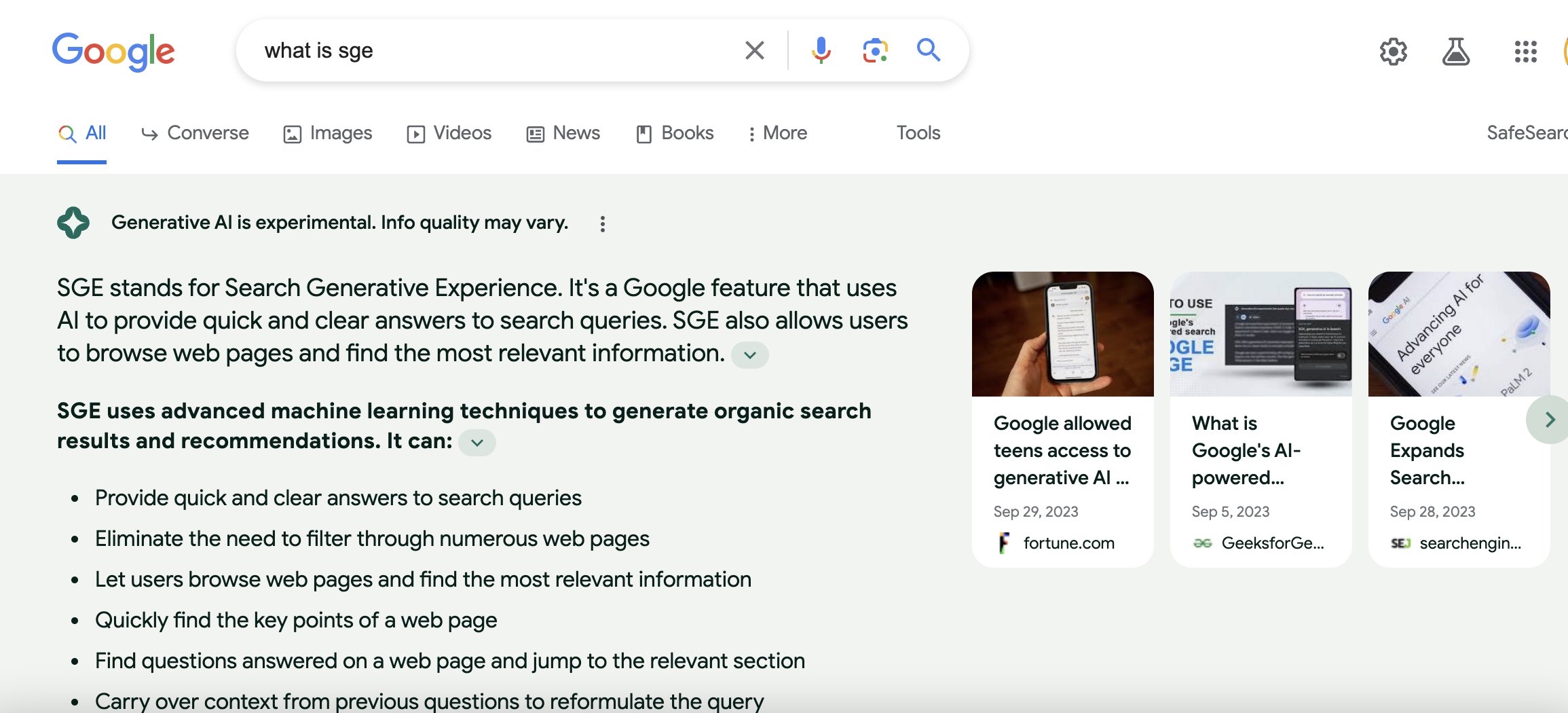
Google Next Big Thing: Search Generative Experience (SGE)

Have you ever imagined a search engine doing more than just fetching information? Enter Google’s Search Generative Experience (SGE), a game-changer in how we use search engines. In our ever-connected world, where we’re constantly bombarded with information, SGE emerges as a beacon of innovation. This piece aims to unwrap SGE’s cool new features, highlighting its skills in creating images and penning drafts.

Understanding the New Wave of Search

Before diving into the specifics of SGE, let’s simplify what “generative search” means. In essence, instead of just showing us existing info, generative search uses a pinch of AI magic to create fresh content. This could be anything – a block of text, a beautiful image, or even more detailed content, based on what we ask for.

Artistry in Action: Making Pictures with Words

One of SGE’s standout tricks is its ability to whip up images. Say you’re thinking of a unique design or concept. Tell SGE to “draw” it, and voilà! You get a set of four sample images. These aren’t just random pictures but crafted visuals shaped by advanced AI, flaunting some serious artistic chops.

What’s cooler is the freedom you get. Pick an image, tweak it to your liking, or even download it for keeps. Through SGE, Google is essentially giving us a nifty new tool to think out of the box and bring our visions to life.

The Magic Behind the Scenes

It might sound complicated, but SGE has blended our natural curiosity with some smart AI moves. When you request an image, it quickly crafts one, merging our dreams with digital reality. It’s like having a chat with a futuristic artist, bringing to life things we could only imagine before.

Beyond Just Typing: SGE Meets Google Images

SGE isn’t limited to just a search bar. Google has baked this feature straight into Google Images. For those trying out the SGE feature, looking up things like “quirky Halloween setups” or “funny doggy designs” now comes with an added sprinkle of creativity. It’s a fresh way to discover and explore visually.

Who Gets to Play?

Just a heads up, currently, SGE’s image-making tool is available mainly for English speakers in the US. It’s for those who’ve joined the SGE experiment and are 18 years or older. But don’t fret! Google’s careful rollout hints they’re gearing up to bring this cool feature to many more soon.

From Ideas to Words: SGE’s Writing Skills

SGE isn’t just about pretty pictures. It’s got a way with words too. Understanding our constant hunt for writing inspiration, Google has added a feature that helps draft texts in SGE.

This is super handy, especially for folks knee-deep in research. SGE can help jot down drafts, fine-tuning them to fit the desired length or style. Looking for a quick summary or a friendly chat-like reply? SGE’s got you covered, standing by as a trusty writing buddy.

Google’s latest venture in image and text generation is reshaping what we thought search engines could do. As we dive deeper into these creative features, it’s clear that the future of online searching is set to be more interactive, fun, and powered by some smart AI moves.

Source: Search Engine Land – Barry Schwartz

Posted in AI

6 Killer Digital Marketing Tips for Beginners

Entering the dynamic world of digital marketing can initially feel like diving into deep waters without a life jacket. But here’s the thing: armed with determination, a touch of resilience, and the right guidance, you can not only swim but also make some serious waves. To help you navigate these waters, we’ve crafted a comprehensive guide that can serve as your digital marketing compass:

1. Setting the Stage with Clear Goals and Audience Insight

  • Purpose: Before anything, define why you’re diving into digital marketing. Are you introducing a groundbreaking product, aiming for a stellar email campaign, or pushing to make your app the next big thing?
  • S.M.A.R.T Goals: To steer your ship right, set goals that are Specific, Measurable, Achievable, Relevant, and Time-bound. It’s the roadmap to your digital success.
  • Audience Mapping: It’s not enough to know their age and location. Go deeper. What’s keeping them up at night? How does your product fit into their lives?
  • Feedback is Gold: Regularly touch base with your audience. Their feedback isn’t just valuable; it’s the cornerstone of your strategy refinement.
  • Staying Adaptive: The beauty of digital marketing lies in its fluidity. As market trends shift, so should your goals and strategies.

2. The Power of Thorough Research

  1. Mastering Keywords: These are the searchlights in the vast digital expanse. Experiment with variations, and always strive to think like your audience.
  2. Platform Exploration: The digital world isn’t limited to the usual suspects like Facebook or Instagram. Platforms like TikTok or Clubhouse might be where your next audience boom awaits.
  3. Analytics & Competitive Intel: Tools like BuzzSumo can give you a sneak peek into what your competitors are up to. And SWOT analysis? It’s your blueprint for competitive strategy crafting.

3. Crafting a Digital Strategy Blueprint

  1. Vision vs. Immediate Gains: It’s easy to get caught up in the hustle for immediate results. But remember, a sound strategy focuses on long-term vision and sustainable growth.
  2. Interconnected Efforts: Imagine your digital channels as cogs in a machine. They should work in harmony. Your PPC campaign should resonate with your blog’s message, which in turn should align with your social media voice.
  3. Budgeting with Precision: Test multiple channels, but invest more in platforms giving you the best bang for your buck.
  4. Frequent Reviews: A quarterly check isn’t just for finance folks. Review your strategy effectiveness periodically and tweak based on results and emerging trends.

4. Unleashing the Power of SEO

  1. Technical Mastery: The backbone of your online presence, ensures your website’s backend is robust, quick, and user-friendly.
  2. Content Kingdom: Create content that doesn’t just attract but also retains. Timeless content pieces can serve as traffic magnets for years.
  3. Algorithm Alertness: With platforms like Google frequently changing their algorithms, stay updated. Sites like Moz can be your window into the latest in SEO.
  4. Link Building Brilliance: Cultivate high-quality backlinks to bolster domain authority and drive organic traffic, positioning your site as a trusted resource.
  5. User Experience (UX) Optimization: Prioritize user-centric design and navigation. A seamless on-site experience can boost rankings and keep visitors engaged longer.

5. Run an Engaging Digital Marketing Blog

  1. Showcase and Share: Your blog is your stage. Highlight client success stories, and weigh in on the latest industry chatter.
  2. Interactive Elements: Keep your audience engaged. Throw in an occasional quiz, infographic, or poll.
  3. Collaborate to Elevate: Bringing in industry experts for interviews or webinars not only enriches your content but also broadens your reach.
  4. SEO-Infused Writing: Integrate relevant keywords naturally, ensuring your blog posts rank higher and attract organic traffic from search engines.
  5. Consistent Posting Schedule: Maintain a regular content calendar. Consistency can build reader trust and establish your blog as a reliable information source.

6. The Journey of Continuous Learning

  1. Upskilling Platforms: Coursera, Udemy, and their ilk offer a treasure trove of digital marketing knowledge. Dive in!
  2. Practical Exposure: Theory is great, but practical experience is irreplaceable. Launch a side project, intern, or freelance to apply what you learn.
  3. Community Engagement: Join digital marketing forums or attend conferences. They offer a mix of learning, networking, and trend insights.

Diving into the digital marketing realm can seem daunting, especially for a novice, but consider this guide your safety net. With each strategic move, meticulous planning, and an insatiable hunger for learning, you’ll not only see your business grow but flourish in the digital age. So, take a deep breath and dive in; the digital ocean awaits your exploration!

Posted in SEO

SEO Audits: A Detailed Guide

Performing an SEO audit is an essential process for any website owner or marketer looking to improve their website’s search engine ranking and overall visibility. An SEO audit can help identify technical issues, on-page optimizations, and opportunities for improvement. In this guide, we will walk you through the steps to perform an effective SEO audit.

Step 1: Define Goals

Before starting the audit, it’s essential to define your goals. Ask yourself what you want to achieve with the SEO audit. Are you looking to increase traffic, improve search engine rankings, or identify technical issues? Defining clear goals will help you stay focused and prioritize your efforts during the audit.

Step 2: Review Website Architecture

The website’s architecture and structure play a crucial role in SEO. Therefore, it’s essential to review the website’s architecture and structure during the audit. Make sure the website has a clear and organized hierarchy of pages, with important pages being easily accessible from the homepage. Check that the website’s URL structure is optimized for search engines and users.

Step 3: Review Technical SEO

Technical SEO is the foundation of any SEO strategy. Therefore, it’s essential to review the website’s technical SEO during the audit. Check for crawl errors, broken links, and duplicate content issues. Review the website’s robots.txt file and XML sitemap to ensure search engines can crawl and index the website’s pages.

Step 4: Analyze On-page Optimization

On-page optimization refers to the practice of optimizing individual web pages to rank higher and earn more relevant traffic in search engines. Analyze the website’s on-page optimization during the audit. Check for keyword optimization, meta descriptions, headers, and title tags. Review the website’s content for relevance, quality, and readability.

Step 5: Check for Mobile Responsiveness

With more and more users accessing websites on mobile devices, it’s essential to ensure the website is mobile-responsive. Check the website’s mobile responsiveness during the audit, and make sure the website’s design and layout adjust to different screen sizes.

Step 6: Review Off-page Optimization

Off-page optimization refers to the practice of optimizing external factors that impact the website’s search engine ranking, such as link building and social media engagement. Analyze the website’s off-page optimization during the audit. Check for backlinks, social media engagement, and brand mentions.

Step 7: Analyze Website Speed

Website speed is a crucial factor that impacts user experience and search engine rankings. Analyze the website’s speed during the audit, and make sure the website loads quickly on both desktop and mobile devices. Check for large images, uncompressed files, and other factors that may slow down the website.

Step 8: Check for Security Issues

Security is becoming an increasingly important factor in SEO. Make sure the website is secure and uses HTTPS encryption during the audit. Check for malware and other security issues that may impact the website’s search engine ranking.

Step 9: Prioritize Recommendations

After completing the audit, prioritize the recommendations based on their impact and ease of implementation. Focus on fixing technical issues and on-page optimization first, as they have the most significant impact on search engine ranking.

Step 10: Track and Monitor Progress

SEO is an ongoing process, and it’s essential to track and monitor progress over time. Use analytics tools to track website traffic, search engine rankings, and user engagement. Make adjustments to the SEO strategy based on the data and continue to monitor progress over time.

Follow the Steps

Performing an SEO audit is a crucial step in improving a website’s search engine ranking and overall visibility. By following the steps outlined in this guide, you can identify technical issues, on-page optimizations, and opportunities for improvement. Remember to define clear goals, prioritize recommendations, and track progress over time.

Posted in SEO

Google’s Dual Updates for October 2023: Core and Anti-Spam Enhancements

This month, Google announced two pivotal updates: the “October 2023 Core Update” and the “October 2023 Spam Update.” This third core update for the year comes after the March and August releases, and both are expected to be fully rolled out over several weeks.

Insights on Google’s Core Algorithm Updates

Google frequently updates its core algorithm to boost search quality and prevent system exploitation.

These changes can have significant effects, such as altering website rankings and SERP visibility.

For optimal outcomes, webmasters should consider the following:

  • Routinely refine web content to enhance its value and relevance.
  • Stay abreast of Google’s guidelines and industry shifts.
  • Exercise patience as the changes take effect.

While Google’s algorithm updates can be challenging to navigate, with the right strategies and a proactive approach, webmasters can continue to thrive, and grow their online presence.

Essential Points on Google Core Algorithm Updates

Navigating the ever-evolving landscape of search engine optimization requires a keen understanding of Google’s algorithmic shifts:

  • Frequency: Google releases several updates each year, each focusing on varied algorithm components.
  • Impact: Rankings can see changes, affecting different websites in different ways.
  • Recovery: Should rankings drop, it’s imperative to assess and make necessary changes.
  • Content Quality: Emphasis is on high-quality, relevant content.
  • User Experience: Aspects like website speed, mobile-friendliness, and user navigation are critical.
  • E-E-A-T: Establishing expertise, authority, and trust is vital for better rankings.
  • Adapting: Keeping up with changes in the search algorithms is crucial.

In this digital dance with Google, staying informed and being adaptable are the steps to mastering the rhythm.

Highlights of the October 2023 Spam Update

Google aims to accomplish the following with this update:

  • Deliver a cleaner search experience by refining its algorithm.
  • Enhance spam detection, especially in languages like Turkish, Vietnamese, Indonesian, Hindi, and Chinese.

The update particularly targets “black hat” tactics such as:

  • Cloaking.
  • Hacked content.
  • Auto-generated content.
  • Scraped content.

This initiative was driven by feedback from the community on increased spam results. Google is keen on keeping search results spam-free.

Google’s Anti-Spam Techniques

Google combats spam by using the following methods:

  • Using both automated systems and human reviews.
  • Implementing tools like “SpamBrain,” which harnesses AI and machine learning to spot new spam strategies.
  • Conducting frequent updates to stay current with emerging spam trends.

For sites impacted by these updates, rechecking Google’s guidelines for compliance is advised. Areas Google Identifies as Spam:

  • Hidden Elements: Texts or links unseen by users but detected by search engines.
  • Low-Value Content: Automatically generated content offering little to users.
  • Content Theft: Unauthorized, mass content scraping.
  • Ad Overload: Pages cluttered with intrusive ads, detracting from the user experience.
  • Shallow Affiliate Pages: Content with a primary focus on monetization.
  • Deceptive Practices: Tactics such as cloaking, sneaky redirects, and misleading “doorway” pages.
  • Unethical Commercial Practices: Deceptive product or service claims.

In the 25 years since Google launched, its aim has been the same: deliver quality results. So trying to game the system will ultimately lead to the demise of your website and online presence. If you’re using any of the above tactics, now’s the time to stop.

The Path Forward

SEO is always evolving. While core updates can lead to ranking changes, persistent efforts, and patience remain crucial. The recent spam update will also require a few weeks for complete integration. Google encourages user feedback to enhance its anti-spam measures and continues to adapt its strategies based on user insights.

Source: Search Engine Journal

Posted in SEO

We use cookies to enhance your browsing experience, personalize content, and analyze our traffic. By clicking “Accept,” you consent to our use of cookies. View our Privacy Policy for more information.