Should I Run Google LSA Ads for My Business?

If your business depends on local customers, phone calls, and service bookings, Google Local Services Ads (LSAs) could be an effective way to generate qualified leads. 

These ads help eligible businesses appear prominently in Google Search when potential customers look for nearby services. However, whether you should invest in LSAs depends on your industry, location, advertising budget, and ability to convert inquiries into paying customers.

Before launching a campaign, it is important to understand how Local Services Ads work, what they cost, and how they fit into your broader digital marketing strategy.

What Are Google Local Services Ads?

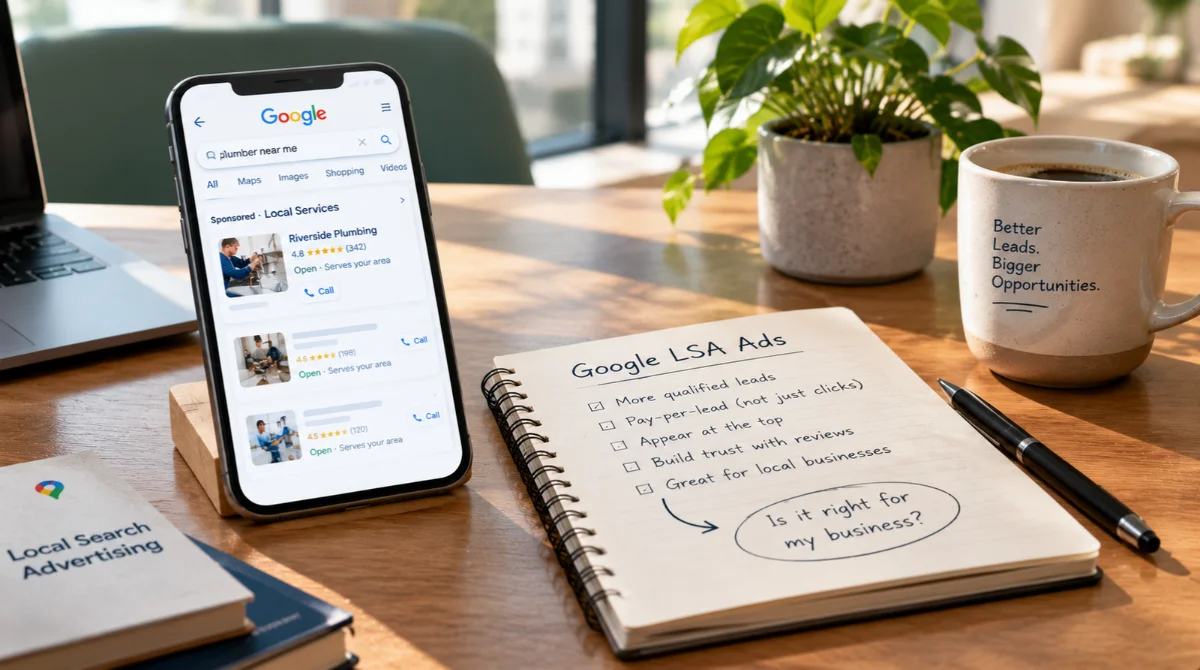
Google Local Services Ads are paid advertisements designed to connect customers with local service providers. Unlike traditional pay-per-click advertising, where businesses generally pay for clicks, eligible LSA advertisers typically pay for valid leads generated through calls or messages, subject to Google’s billing policies.

These ads can appear prominently in search results when users look for services such as plumbing, roofing, electrical repairs, legal assistance, cleaning, and other eligible categories. Depending on the industry and location, eligible businesses may also display a Google screening or verification badge.

For businesses that rely on local inquiries, LSAs offer a direct way to reach people who are actively searching for professional help. Google determines eligibility and placement based on factors that can include relevance, proximity, reviews, and responsiveness.

What Do the Statistics Say About Local Advertising?

Local search visibility matters because customers frequently use search engines to find nearby businesses and compare service providers. The following general statistics provide context for the broader digital marketing opportunity.

General statisticWhat it means for businesses
46% of Google searches have local intent, according to a widely cited Google statistic.Local SEO and location-based advertising can help businesses reach customers searching for nearby services.
Google reports that Local Services Ads can generate leads through phone calls and messages.Businesses can connect directly with prospects who express interest in their services.
Google supports Local Services Ads across multiple industries, including home services, professional services, healthcare, beauty, and automotive categories.Eligible businesses in different sectors may be able to use LSAs to attract local customers.

Source: The 46% figure is a widely cited historical Google statistic

When Should You Run Google LSA Ads?

Google Local Services Ads may be worth testing if your business serves a defined geographic area and customers regularly search online for the services you provide.

1. Your Business Depends on Local Leads

Plumbers, electricians, roofers, lawyers, and other eligible service providers can benefit from appearing when customers need immediate assistance. LSAs can help your business reach high-intent prospects who are already looking for a provider.

2. Your Industry Is Eligible

Not every business can advertise through Google Local Services Ads (LSAs). Eligibility depends on your business category and location, and Google may require business registration, licenses, insurance, background checks, and other verification steps.

Google currently lists the following eligible business categories in the United States. Availability varies by market, and certain categories are limited to California and Florida.

Eligible business categories include:

  • Home services: Plumbers, electricians, HVAC companies, roofers, and landscapers.
  • Legal services: Personal injury, criminal defense, family law, and immigration attorneys.
  • Health care and wellness: Dentists, chiropractors, dermatologists, and physical therapists.
  • Professional services: Financial planners, real estate professionals, and tax services.
  • Education and child care: Tutors, preschools, and child care providers.
  • Pet services: Veterinarians, pet groomers, and boarding facilities.
  • Automotive services: Auto repair shops, detailing services, and towing companies.
  • Beauty and personal care: Hair salons, barber shops, and nail salons.
  • Food and dining: Restaurants, bakeries, and coffee shops.

Availability and verification requirements vary by category and location.

  • Additional categories currently limited to California and Florida: Architects, drain experts, home insulation services, insurance agencies, interior designers, piercing studios, and tattoo studios.

Before allocating funds, check your business’s eligibility with Google. Being listed in an eligible category does not guarantee availability in your area or approval. If LSAs are unavailable for your business, traditional Google Ads, local SEO, and other digital marketing services can provide alternative ways to reach potential customers.

3. You Can Respond Quickly to Inquiries

Generating leads is only part of the process. Your team must answer calls, respond to messages, schedule appointments, and follow up with prospects. Prompt communication can improve customer experience and increase the likelihood of turning inquiries into bookings.

4. You Have a Clear Customer Acquisition Budget

Before launching, estimate your average job value, profit margin, acceptable cost per lead, and lead-to-customer conversion rate. These numbers help determine whether your advertising investment can produce profitable results.

What Are the Benefits and Limitations of LSA Ads?

LSAs offer several advantages, but they are not a guaranteed source of inexpensive leads. Their effectiveness depends on competition, service demand, location, profile quality, and the accuracy of lead billing.

Potential benefits include prominent search visibility, direct customer inquiries, review-based credibility, and payment based on eligible leads rather than ordinary clicks. Businesses can also manage their advertising budget and track incoming opportunities.

However, lead quality can vary, competitors may have stronger reviews, and some inquiries may not become paying customers. Screening requirements can take time, while lead costs may fluctuate across markets. 

You should monitor disputed or unsuitable leads according to Google’s current policies and avoid evaluating performance solely by the number of inquiries received.

How Can You Improve Your Google LSA Results?

Start by completing your business profile accurately and selecting the services and locations you genuinely serve. Build a consistent review-generation process, maintain strong customer service, and keep your business information updated.

Track calls, messages, qualified leads, booked appointments, and completed sales. Calculate your cost per acquired customer rather than focusing exclusively on cost per lead. A campaign that generates fewer but more valuable customers may outperform one that produces a high volume of low-quality inquiries.

Your website and Google Business Profile also matter. Professional web design, local SEO, useful service pages, and online reputation management can reinforce customer trust when people research your business before making contact.

Should You Choose an SEO Agency to Manage Your Campaign?

Working with an experienced SEO agency can help you evaluate whether LSAs fit your business goals and how they should complement your wider marketing efforts. A trusted partner can review local search competition, identify conversion opportunities, improve website performance, and help establish meaningful reporting.

Sky SEO Digital offers SEO, Local SEO, search engine marketing, web design, content marketing, and online reputation management services. Combining these capabilities can help businesses build a more coordinated strategy instead of relying on paid advertising alone.

An expert team can also help assess campaign performance, improve lead tracking, and identify opportunities to strengthen organic visibility alongside paid search.

Are Google LSA Ads Worth It for Your Business?

Google Local Services Ads can be a valuable lead-generation channel for eligible businesses that serve local customers, have competitive service offerings, and can respond promptly to inquiries. However, success depends on more than appearing in search results. 

Budget planning, lead quality, customer reviews, conversion tracking, and follow-up processes all influence profitability.

Before investing, confirm your eligibility, calculate your target acquisition cost, and evaluate whether LSAs align with your business objectives. Sky SEO Digital can help you explore Local SEO, paid search, website optimization, and other digital marketing services to build a practical strategy for sustainable growth.

FAQs

Are Google Local Services Ads worth it for small businesses?

Google Local Services Ads can be worthwhile for eligible small businesses that want to generate local leads, receive customer inquiries, and increase bookings. Results depend on competition, lead costs, and conversion rates.

How much do Google LSA Ads cost?

Google LSA Ads generally use a pay-per-lead model. Costs vary by industry, location, service type, and competition. Businesses should monitor lead quality and customer acquisition costs to measure profitability.

Which businesses are eligible for Google Local Services Ads?

Eligibility depends on Google’s supported business categories, location, and verification requirements. Eligible categories may include home services, legal services, healthcare, cleaning, and other local businesses.

What is the difference between Google Ads and Google Local Services Ads?

Traditional Google Search Ads generally charge per click, while Local Services Ads charge for eligible leads. LSAs focus on direct customer inquiries, whereas traditional Google Ads offer broader campaign and keyword-targeting options.

How can I get more leads from Google Local Services Ads?

Optimize your business profile, select relevant service areas, complete Google’s verification requirements, respond promptly to inquiries, and monitor lead quality. Regular performance reviews can help improve your advertising results.

Your Business Shows Up in AI Search. Is It Actually Generating Leads?

AI search visibility can help potential customers discover your business, but a mention or citation does not automatically produce a lead. To understand whether Answer Engine Optimization (AEO) is supporting growth, businesses need to connect visibility with website visits, inquiries, qualified opportunities, and sales.Appearing in an AI-generated recommendation is a meaningful step. The next question is what happens afterward. Does the prospect visit your website? Call your office? Request a quote? Book a consultation?

At Sky SEO Digital, we approach AI visibility as part of a broader customer journey. Getting discovered creates an opportunity. Your content, website, tracking, and follow-up help determine whether that opportunity becomes business.

AI Visibility vs. Lead Generation

AI visibility means your business or content appears in an AI-generated response. Lead generation happens when a potential customer takes an identifiable step toward working with you.

Those are connected stages, but they measure different things.

A Miami homeowner might ask an AI assistant for help finding a landscaping company. Your business could appear in the answer, alongside several competitors. That appearance gives the homeowner a chance to consider you. It does not establish that they visited your website or requested an estimate.

The same distinction applies to attorneys, medical practices, restaurants, consultants, and other local businesses.

From AI Visibility to Business Results
Stage Example What It Demonstrates
Visibility Your business appears in an AI answer. Your brand was included in that response.
Website visit A person follows a source link to your website. The answer generated a visit, when the referral can be identified.
Inquiry The visitor submits a form or calls. Someone expressed interest in your business.
Qualified lead The prospect needs a service you provide in an area you serve. The inquiry represents a relevant opportunity.
Customer The prospect signs an agreement or purchases. The opportunity produced a business outcome.

Our real AI search examples for Miami businesses show what captured search appearances can look like. Those screenshots document visibility; determining lead generation requires additional tracking.

How AI Search Can Influence Customer Decisions

AI search can introduce your business during research, comparison, or provider selection. A useful measurement strategy accounts for more than an immediate click.

Consider this illustrative journey:

  1. A business owner asks an AI assistant how to improve local search visibility.
  2. The response mentions several marketing agencies.
  3. The owner later searches Google for one agency by name.
  4. They review its services and examples.
  5. They return another day to schedule a consultation.

In that situation, AI may have helped introduce the agency, while another channel receives credit for the eventual inquiry. Without customer feedback or supporting journey data, the original influence may remain unknown.

This is why businesses should review both trackable referrals and what customers say about how they found the company. Neither provides a complete picture on its own.

Which Metrics Should You Track?

Relevant AI Appearances

Monitor questions that reflect your services, locations, and customers’ needs. Record the platform, prompt, date, business mention, and any linked page. AI answers can vary, so one screenshot should not be treated as a permanent ranking.

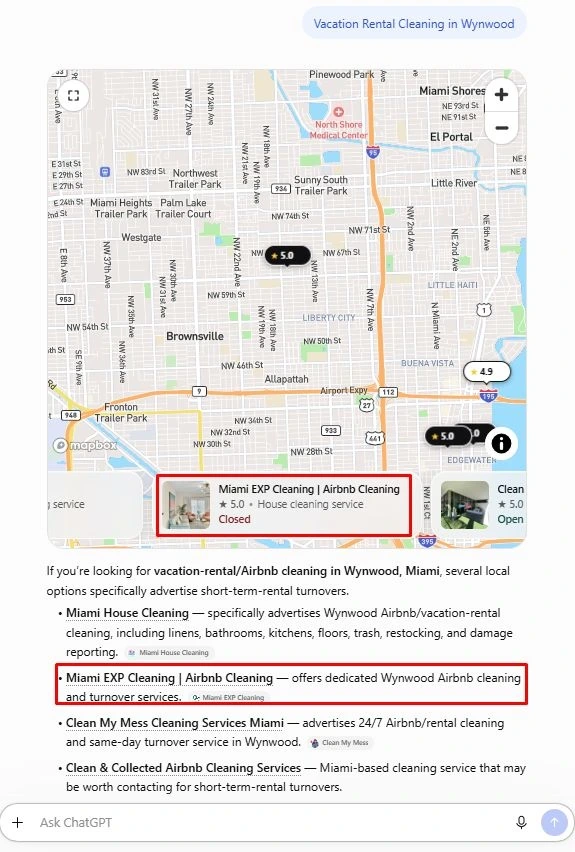
A question such as “Who provides vacation rental cleaning in Wynwood?” is more closely connected to hiring a provider than a broad informational question about cleaning.

Identifiable Referral Visits

Review visits from AI platforms where referral information is available. Look at the pages visitors enter through and whether those visits lead to meaningful actions.

Actual Inquiries

Track successful contact form submissions, completed bookings, and genuine phone inquiries. Keep actions such as clicking a phone number separate from confirmed calls or conversations.

Lead Quality and Sales

Determine whether inquiries match your services, geographic coverage, and customer requirements. Then follow those opportunities through appointments, proposals, and sales.

A campaign that produces fewer inquiries can still be valuable if those inquiries are more relevant and lead to profitable work.

How to Track Leads From AI Search

1. Review Your Website’s Traffic Sources

In Google Analytics 4, use the Traffic acquisition report and review the Session source / medium dimension. Look for identifiable AI referral sources and compare their visits with relevant key events.

Google’s Traffic acquisition documentation explains these reporting dimensions. Identifiable referrals are useful evidence, but missing referral information means the report should not be treated as a complete count of AI-influenced visits.

2. Verify That Conversion Tracking Works

Test each important contact path before relying on the numbers:

  • Submit a test inquiry through your contact form.
  • Complete a test booking through your scheduling platform.
  • Check whether a successful submission triggers the intended event once.
  • Confirm that mobile visitors can reach and use your contact options.
  • Separate test submissions, spam, and duplicate inquiries from real leads.

If your booking platform uses a separate domain, check whether the source information carries through correctly. Otherwise, a completed consultation may be disconnected from the visit that started it.

3. Connect Inquiries With Your CRM

Your customer relationship management system should help answer what happened after someone contacted you. Where technically available, retain the original source and landing page, then record whether the prospect qualified, booked, received a proposal, and became a customer.

This lets you evaluate the quality of opportunities alongside the volume.

4. Ask Customers How They Found You

Add a short question to your intake process: “How did you first hear about us?” Include AI assistants as an option and allow people to explain in their own words.

Keep that answer separate from the source recorded by your analytics software. “The customer said ChatGPT” and “the website recorded a Google visit” can both be accurate descriptions of different steps in the same journey.

5. Use Search Console to Understand Google AI Visibility

Google’s Search Generative AI performance reports provide dedicated information about impressions and pages appearing in Google’s generative AI features.

Use those reports to understand visibility. An impression does not establish that someone contacted your business, and Google’s reporting does not cover every external AI platform. Review it alongside website analytics and CRM outcomes.

How to Turn AI Visibility Into More Inquiries

Answer Questions That Come Before a Purchase

Build content around the decisions customers need to make before contacting you:

  • Do you provide the specific service they need?
  • Do you serve their city or neighborhood?
  • What affects pricing?
  • What does the process involve?
  • What experience or evidence supports choosing your business?
  • What should they do next?

Our guide to AEO for businesses provides background on planning content for AI-driven discovery.

Make the Landing Page Match the Customer’s Need

If someone arrives looking for a particular service, the page should explain that service clearly. Include relevant locations, useful details, credible supporting information, and an obvious next step.

A visitor evaluating commercial landscaping maintenance needs different information from someone planning a one-time residential installation. The content should help each person determine whether the service fits.

Give Visitors a Clear Next Step

Use a call to action that matches the decision, such as “Request an Estimate,” “Schedule a Consultation,” or “Check Availability.” Explain what happens after the person submits their information.

Keep forms focused on what your team needs to respond. Test buttons, confirmation messages, and booking links on mobile devices.

Support AI Visibility With SEO Fundamentals

Google’s guidance for generative AI search emphasizes established SEO practices and helpful content. It also explains that there is no special schema markup required for inclusion.

Our Answer Engine Optimization services connect content and search visibility work with the practical goal of helping relevant prospects discover and evaluate your business.

What Should an AEO Report Include?

A useful AEO report should show where your business appeared, what measurable activity followed, and what remains uncertain.

  • Visibility: Relevant prompts, platforms, captured responses, and cited pages.
  • Traffic: Identifiable AI referrals and their landing pages.
  • Inquiries: Valid forms, calls, and completed bookings.
  • Quality: Qualified opportunities and reasons other inquiries did not fit.
  • Business outcomes: Customers and associated revenue where attribution is supported.
  • Next actions: Specific content, tracking, website, or follow-up improvements.

For example, if visibility improves while identifiable visits remain flat, review the types of questions and whether the answers contain usable links. If visits increase without inquiries, examine the landing pages and contact process. If inquiries increase without sales, review qualification and follow-up.

These patterns guide investigation. They do not, by themselves, prove why a result changed.

Build a Strategy Around Business Results

AI search creates another way for customers to discover your business. Making that discovery valuable requires relevant content, a useful website, reliable measurement, and responsive follow-up.

Sky SEO Digital helps businesses connect their SEO and AEO efforts with customer acquisition goals. The aim is to understand both where your brand appears and what those opportunities contribute to your business.

Schedule a 30-minute conversation to discuss your AI visibility, lead tracking, and opportunities to improve your website’s conversion path.

Frequently Asked Questions

Does appearing in AI search automatically generate leads?

No. An appearance creates an opportunity for discovery. A lead occurs when a potential customer contacts you or takes another meaningful step toward purchasing. Track those stages separately.

How can I tell whether a lead came from an AI assistant?

Combine identifiable referral data, tested conversion tracking, CRM records, and customer feedback. Some journeys will remain uncertain, especially when someone discovers you through AI and later returns through another channel.

Can Google Analytics track AI search traffic?

Google Analytics can report visits from AI platforms when usable referral information is available. Review traffic sources and relevant key events, while recognizing that missing source information can limit attribution.

Can I identify the exact prompt that generated a lead?

Usually, standard website analytics will not reveal the exact AI conversation or prompt behind a visit. A customer may share that information, but you should not assume every inquiry can be traced to a specific question.

What is the difference between an AI mention and a citation?

A mention names your business. A citation identifies a source used in an answer, often through a link. A response may mention your business while citing another website, so record the distinction when monitoring visibility.

What makes an AI-generated lead qualified?

The same factors that qualify leads from other channels: a relevant service need, an appropriate location, and a reasonable fit with your business. Qualification should follow consistent criteria regardless of source.

Should I stop investing in SEO and focus entirely on AEO?

SEO and AEO have overlapping foundations. Maintain useful content, accessible pages, clear internal links, and accurate business information while evaluating opportunities in AI search. Allocate resources according to your audience and measured outcomes.

How long does it take for AEO to generate leads?

There is no universal timeline. Results depend on your starting visibility, competition, content, customer demand, and sales cycle. An early AI appearance does not establish when inquiries or sales will follow.

Can a business measure AI search ROI?

It can estimate ROI when costs and attributable business outcomes are recorded. Use profit contribution where possible, explain attribution limits, and avoid assigning all new revenue to AEO simply because AI visibility increased during the same period.

Posted in AEO

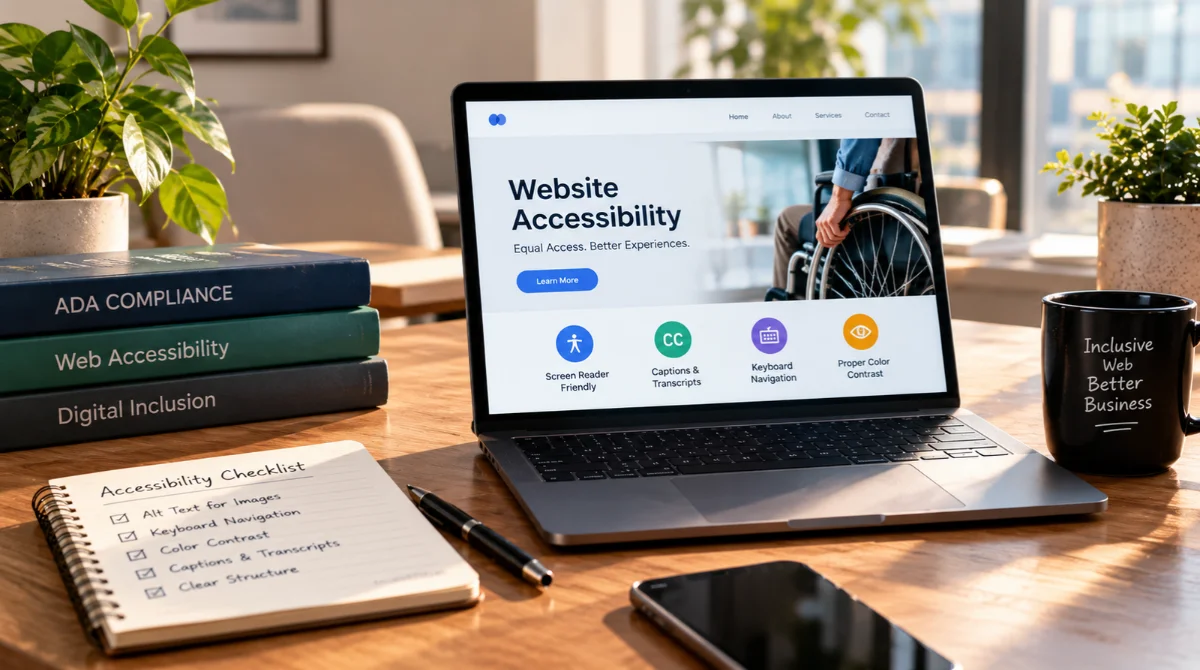
Is My Website at Risk if It’s Not ADA Compliant?

Your website is one of your business’s most important digital assets. It helps customers discover your services, contact your team, make purchases, and learn about your brand. But what happens if people with disabilities cannot navigate your website or access its essential features? Beyond creating a poor user experience, inaccessible website features may expose your business to potential legal complaints and compliance concerns.

The Americans with Disabilities Act (ADA) prohibits disability discrimination in covered circumstances, and the U.S. Department of Justice has stated that ADA requirements apply to the goods and services businesses offer to the public through their websites. Although the precise legal requirements depend on the circumstances, website accessibility is an important responsibility for businesses of different sizes and industries.

Understanding ADA website compliance can help you identify risks, improve usability, and create a more inclusive online experience.

Why Is ADA Website Compliance Important?

Website accessibility means designing and maintaining digital content so people with disabilities can perceive, understand, navigate, and interact with it. Visitors may use screen readers, keyboard navigation, voice recognition software, captions, or browser zoom to access online information.

When a website is difficult to use with these tools, customers may be unable to complete essential tasks. For example, an inaccessible checkout process could prevent someone from purchasing a product, while an improperly labeled contact form could stop a prospective customer from submitting an inquiry.

The U.S. Department of Justice identifies website accessibility as an important part of providing equal access to goods and services under the ADA. Businesses open to the public should therefore take accessibility seriously rather than treating it as an optional website enhancement. Source: ADA.gov.

What Statistics Reveal About Website Accessibility?

Accessibility research demonstrates the importance of evaluating websites systematically. The following table highlights key standards and guidance relevant to accessibility planning.

Accessibility IndicatorGeneral InformationWhy It Matters
WCAG principlesFour principles: perceivable, operable, understandable, and robustProvides a framework for accessible web content
WCAG 2.213 guidelines organized under four principlesHelps teams identify accessibility requirements
WCAG conformance levelsA, AA, and AAAProvides different levels of accessibility criteria

Source: Web Content Accessibility Guidelines (WCAG) 2.2.

What Are the Risks of Having a Non-ADA-Compliant Website?

Potential Legal Complaints and Lawsuits

One of the most significant concerns is the possibility of legal action. If a website creates barriers that prevent people with disabilities from accessing a covered business’s goods or services, the business may face an ADA complaint or lawsuit, depending on the circumstances.

Potential consequences can include legal expenses, settlement costs, remediation requirements, and the time needed to respond to a dispute. The outcome depends on the applicable law and the specific facts of the case.

Importantly, there is no single automated score that guarantees legal compliance, and installing an accessibility widget alone does not eliminate legal risk.

Losing Customers and Revenue

An inaccessible website can discourage customers from completing purchases, booking appointments, or requesting services. Missing form labels, confusing navigation, inaccessible payment systems, and unreadable text may prevent visitors from completing important actions.

These issues can affect conversion rates and customer satisfaction. Improving accessibility helps more people interact with your business independently and can create a smoother experience for users across different devices and abilities.

Damage to Brand Reputation

Customers expect businesses to provide welcoming, usable digital experiences. When a website excludes visitors, it can negatively affect perceptions of the brand and reduce customer trust.

Accessibility improvements demonstrate that your business values inclusion, usability, and customer service. Clear accessibility information and a practical process for reporting problems can also help businesses respond to concerns more effectively.

Website Maintenance and Remediation Costs

Delaying accessibility improvements may allow problems to spread across multiple pages, templates, forms, and third-party integrations. Fixing these issues later can require more development time than addressing accessibility during the initial design process.

Regular accessibility audits help identify issues early, prioritize essential fixes, and establish a more manageable long-term maintenance plan.

How Can You Make Your Website More Accessible?

Follow WCAG Accessibility Guidelines

The Web Content Accessibility Guidelines (WCAG) provide a widely used framework for improving website accessibility. WCAG 2.2 organizes its requirements around four principles: perceivable, operable, understandable, and robust. 

Businesses should determine which technical criteria apply to their websites and any relevant legal obligations. WCAG conformance is a valuable accessibility target, but meeting a particular standard does not automatically guarantee compliance with every applicable law.

Fix Common Accessibility Barriers

Start by checking the website for issues such as:

  • Missing or inaccurate alternative text for meaningful images.
  • Poor color contrast and text that cannot be resized easily.
  • Forms without clear labels, instructions, or error messages.
  • Menus and buttons that cannot be operated using a keyboard.
  • Videos without appropriate captions.
  • Incorrect heading structures that make pages difficult to navigate.

Conduct Regular Accessibility Audits

Automated accessibility testing tools can identify many common issues, but they cannot reliably detect every usability barrier. Combine automated scans with manual keyboard testing, screen-reader checks, and testing by people with disabilities where possible.

Review important customer journeys, including checkout processes, appointment booking, contact forms, and account registration. Recheck accessibility after major website updates.

Work With an Experienced Digital Marketing Agency

Website accessibility should be considered alongside website design, technical SEO, mobile usability, and conversion optimization. These areas overlap because a clear website structure and well-organized content can improve usability for a wider audience.

Sky SEO Digital offers ADA compliance and WCAG website accessibility services, including accessibility audits, remediation, and testing. Its digital marketing services also include SEO, web design, local SEO, and online reputation management.

An expert team can help identify technical barriers, prioritize improvements, and establish a practical remediation plan. However, accessibility service providers cannot guarantee that a website will never face a legal complaint.

Website Accessibility: A Step Toward Digital Inclusion

An inaccessible website can create potential legal exposure, exclude customers, damage brand reputation, and make essential online tasks unnecessarily difficult. Businesses should treat website accessibility as an ongoing responsibility rather than a one-time technical fix.

Start with an accessibility audit, address the most significant barriers, and use WCAG as a practical framework for improvement. Partnering with a trusted provider such as Sky SEO Digital can help your business combine website accessibility, professional web design, and digital marketing services into a more inclusive and effective online experience.

FAQs

Is it illegal to have a website that is not ADA compliant?

A website may raise ADA concerns if it prevents people with disabilities from accessing covered goods or services. Whether a particular website violates the law depends on the circumstances and applicable legal requirements.

Can small businesses be sued for website accessibility issues?

Small businesses may face accessibility complaints or lawsuits, depending on the business, circumstances, and applicable law. Business size alone should not be treated as a guarantee of exemption.

Does an accessibility plugin make my website ADA compliant?

Not necessarily. Plugins and overlays may help with certain features, but they cannot automatically correct every underlying design, content, or coding issue. Manual testing and appropriate remediation remain important.

What is the difference between ADA compliance and WCAG compliance?

The ADA is a U.S. civil rights law, while WCAG is a technical standard for web accessibility. WCAG provides practical criteria for improving accessibility, but legal compliance depends on the requirements applicable to the organization.

How often should I audit my website for accessibility?

Conduct an initial audit and repeat testing after significant design, content, or functionality changes. Regular reviews help identify newly introduced barriers and maintain accessibility over time.

Google’s Generative AI Reports and Settings Explained

Can your website appear in Google’s AI answers, and how do you know whether it does? Google Search Console now offers dedicated generative AI performance reports and a setting that controls participation. For businesses investing in search visibility, these tools help connect AI search strategy with actual evidence.The setting opens the door to participation. Your website’s content, technical health, and relevance still determine its opportunities to appear. Here is what business owners should understand about the reports, inclusion settings, and an effective answer engine optimization strategy.

Background: Google Search and AI Answers

Google’s AI Overviews summarize information within search results. AI Mode supports more conversational exploration, including follow-up questions. Both can introduce people to websites through supporting links. Google also offers generative AI experiences in Discover.

For a business, this creates another opportunity to reach potential customers while they research a problem or compare services. A useful answer about a service, its costs, or the decision process can become part of that research journey. Our guide to real AI search results for Miami businesses explores the broader visibility opportunity.

What Google’s Generative AI Performance Reports Show

Google announced the reports on June 3, 2026, and updated the announcement to confirm worldwide availability as of August 31, 2026. There are dedicated views for generative AI visibility in Search and Discover. This visibility is also included in overall performance reporting, so avoid adding the dedicated view to the overall total.

Report detail What it tells you
Impressions How often your URLs appeared in the covered AI features.
Pages Which URLs received visibility.
Countries Where that visibility occurred.
Devices Device breakdowns for the Search report.
Dates Trends across hourly, daily, weekly, and monthly intervals.

An impression is evidence of visibility, not a lead. The announcement describes impression reporting; it does not establish dedicated AI click, conversion, query, or ranking-position metrics. Evaluate business results separately through analytics, call tracking, forms, and your CRM.

Understanding the Search Generative AI Settings

In Search Console, open Settings > Search generative AI. The screenshot from Sky SEO Digital’s property shows inclusion selected and marked as the default. This confirms the participation setting shown at that moment; it does not prove that any particular page has appeared in an AI answer.

  • Include: Allows your site’s links and content to participate in the covered AI experiences, including supporting generated answers.
  • Exclude: Prevents participation in those experiences, removing that source of impressions and traffic.
  • Inherit: Child properties can follow a parent’s choice or have an owner configure an override.

Google’s documentation for this control explains that it covers AI Overviews, AI Mode, and generative AI features in Discover. It does not control ChatGPT or Perplexity, and it is separate from AI training controls. Exclusion is not a ranking or inclusion signal for other parts of Google Search.

How to Set Up Your Website for Generative AI Inclusion

  1. Verify your website in Search Console. Select the property covering the website you want to manage.
  2. Review the participation control. Open Settings, then Search generative AI. Choose inclusion if your goal is visibility in these experiences, and save if you changed the selection.
  3. Check related properties. Review inheritance and overrides so a more specific property does not have an unexpected choice.
  4. Check your important URLs. Use URL Inspection to investigate indexing and access problems. Review accidental Googlebot blocks, noindex directives, and snippet restrictions.
  5. Establish a measurement baseline. Review available generative AI performance data and record which pages receive impressions before assessing subsequent changes.

Google’s generative AI optimization guide says pages must be indexed and eligible for a search snippet, and the site must permit inclusion through Search Console. Eligibility does not guarantee an appearance. Google also says special AI files or markup, including llms.txt, are unnecessary for visibility in Google Search.

Think of inclusion as opening your business’s front door. People still need a reason to enter. Our recommended next step is to improve the pages that answer your customers’ most important questions, supported by clear service information, relevant examples, and an easy way to contact you.

Benefits for Businesses Investing in AI Search

The practical benefit is better decision-making. Instead of relying entirely on occasional searches or screenshots, you can investigate which pages Google reports showing in AI experiences and use that evidence to guide your content priorities.

  • Find useful content patterns: Compare visible service pages and guides to identify topics worth developing.
  • Review market relevance: Assess whether visibility aligns with the countries your business serves.
  • Monitor progress: Compare consistent periods and record major website changes alongside the trend.
  • Improve the customer journey: Make pages receiving attention more helpful, persuasive, and easy to navigate.

These are opportunities, not promised outcomes. More impressions do not automatically produce more visitors or revenue. A useful reporting process asks whether increased visibility coincides with qualified inquiries and sales, while acknowledging that attribution may be incomplete.

How Sky SEO Digital Helps With AEO

Sky SEO Digital helps businesses build a stronger presence across traditional search and AI answers. Our answer engine optimization services focus on how potential customers ask questions, what information they need, and how clearly your website demonstrates your expertise.

AEO and SEO have different objectives, with substantial overlap in execution. SEO supports discoverability and organic search performance. AEO adds focused work on answer visibility, customer questions, and monitoring across AI experiences. Google’s inclusion setting is one checkpoint within that broader work.

  • Visibility and settings review: Assess available reporting, participation controls, and technical barriers.
  • Service-page development: Explain your offerings, service areas, process, and relevant decision factors.
  • Content planning: Develop useful FAQs, comparisons, and detailed guides through our content marketing services.
  • Technical and credibility improvements: Strengthen internal links, review appropriate structured data, and make business information easier to verify.
  • Ongoing measurement: Review Google’s reported visibility alongside separately measured AI citations, website engagement, and qualified inquiries.

Our approach combines website evidence with business goals. As we explain in our guide to the limitations of AI-generated marketing strategies, useful recommendations require more than a surface-level website review. No agency can guarantee selection in an AI answer.

Want to understand your website’s AI visibility? Schedule a 30-minute conversation with Sky SEO Digital to discuss your settings, content opportunities, and AEO priorities.

Google Generative AI FAQs

Is generative AI inclusion enabled by default?

Yes. Inclusion is the default for properties without an inherited parent choice. Check the effective setting and any child-property overrides.

Does enabling inclusion guarantee AI visibility?

No. It permits participation. Google still decides whether an eligible page is relevant enough to show for a particular search.

Does this setting control AI training?

No. Google distinguishes participation in Search AI experiences from training controls. Consult its Google-Extended documentation when evaluating training preferences.

Will excluding my site remove it from all Google results?

No. This control applies to the specified generative AI experiences. It is separate from removing pages from the wider search index.

Does Search Console measure ChatGPT and Perplexity visibility?

No. Those platforms require separate monitoring. Google’s reports concern its own covered experiences.

Do I need special AI schema or an llms.txt file?

Google says neither is required for its search visibility. Use structured data where appropriate for supported purposes, without treating it as a guarantee of AI selection.

What if I cannot find the setting?

Confirm that you selected the intended property and check with its owner about your access. Google notes that available settings vary by property and permissions.

What should I do after confirming inclusion?

Review your important service pages, identify unanswered customer questions, and establish a reporting baseline. Prioritize changes that help people evaluate and contact your business.

Posted in AEO

The Complete Digital Marketing Strategy for Miami Businesses

Miami is one of Florida’s most competitive business markets, where companies must stand out online to attract local customers, build brand awareness, and generate consistent leads. Whether you operate a real estate agency, dental clinic, law firm, e-commerce store, or hospitality business, having a strong digital presence is essential for sustainable growth.

A successful digital marketing strategy combines search engine optimization (SEO), local search visibility, paid advertising, content marketing, website design, and online reputation management. Businesses must also adapt to AI-powered search platforms that increasingly influence how customers discover services and compare providers.

Working with an experienced SEO agency can help Miami businesses identify opportunities, reach the right audience, and turn website traffic into measurable results.

Why Is Digital Marketing Important for Miami Businesses?

Consumers often research businesses online before making purchasing decisions. They compare reviews, explore websites, check service details, and search for nearby providers. Without a clear digital marketing plan, even established companies can lose potential customers to competitors with stronger online visibility.

Miami’s diverse population and competitive industries make targeted marketing particularly valuable. Businesses may need to reach English- and Spanish-speaking audiences, target specific neighborhoods, or promote specialized services across South Florida.

A comprehensive strategy helps companies improve brand recognition, attract qualified prospects, and strengthen customer relationships. It also provides measurable performance data, allowing businesses to understand which marketing channels generate the best return on investment.

What Statistics Reveal About Digital Marketing?

General digital marketing statistics help explain why businesses should prioritize online visibility and customer experience.

Digital Marketing MetricGeneral StatisticBusiness Significance
Local search intentApproximately 46% of Google searches have local intentLocal SEO can help businesses reach nearby customers
Mobile experienceMobile devices account for a substantial share of web traffic worldwideResponsive design supports a better browsing experience
Organic searchSearch engines remain an important discovery channelSEO can attract users actively researching products and services

Source: Statistics

How to Build a Complete Digital Marketing Strategy for Miami Businesses

Invest in Search Engine Optimization (SEO)

SEO is the foundation of long-term online visibility. It helps businesses improve their presence in search results when potential customers look for relevant products, services, or local providers.

An effective SEO strategy begins with keyword research, competitor analysis, and a technical website audit. Businesses should optimize page titles, meta descriptions, headings, internal links, image descriptions, and service pages around relevant search terms.

For example, a Miami dental practice could target phrases such as “dentist in Miami,” “cosmetic dentistry Miami,” and “emergency dental services near me.”

Technical SEO is equally important. Fast-loading pages, mobile-friendly layouts, secure connections, logical navigation, and properly indexed content help search engines understand a website and make it easier for visitors to use.

Strengthen Your Local SEO Presence

Local SEO helps businesses connect with customers searching for services in their immediate area. It is particularly valuable for restaurants, healthcare providers, contractors, real estate professionals, and other location-based businesses.

Start by optimizing your Google Business Profile with accurate contact information, business hours, service categories, photographs, and service descriptions. Maintain consistent business details across reputable online directories and local listings.

Customer reviews also influence how prospective customers evaluate a business. Encourage genuine feedback, respond professionally to reviews, and address concerns constructively.

Creating useful location-specific landing pages can further improve relevance. Rather than repeating the same content across multiple pages, provide unique information about the services and communities you serve.

Use Content Marketing to Build Authority

High-quality content helps answer customer questions, demonstrate industry knowledge, and support organic search performance. A consistent publishing schedule can establish your business as a helpful resource rather than simply another service provider.

Consider creating educational blog posts, service guides, frequently asked questions, case studies, and local industry insights. A Miami real estate company, for example, might publish neighborhood guides, home-buying tips, and property investment articles.

Content should address real customer concerns while incorporating relevant keywords and semantic variations naturally. These LSI-related terms, also known as semantically related keywords, may include “local search optimization,” “online lead generation,” “organic website traffic,” and “customer acquisition.”

Avoid keyword stuffing. Useful, original, accurate content is more valuable than pages written solely to repeat search terms.

Combine Paid Advertising With Organic Growth

Search engine marketing (SEM) and pay-per-click (PPC) advertising can help businesses reach potential customers while their organic visibility develops.

Google Ads campaigns can target specific search queries, geographic areas, audiences, and conversion goals. Businesses can also use remarketing to reconnect with eligible visitors who previously interacted with their websites.

Begin with a clearly defined budget, focused landing pages, and relevant ad copy. Track phone calls, form submissions, qualified leads, and sales rather than relying exclusively on clicks or impressions.

Paid campaigns should complement SEO and content marketing, creating a balanced strategy that supports both immediate opportunities and long-term growth.

Improve Website Design and Conversion Rates

Your website is often the first meaningful interaction a customer has with your brand. A professional, responsive website should communicate your value clearly and make it easy for visitors to take the next step.

Prioritize fast loading speeds, intuitive navigation, accessible content, clear service descriptions, and prominent calls to action. Display trustworthy contact information and relevant testimonials where appropriate.

Website accessibility is also important. Following recognized accessibility guidelines can help make digital experiences more usable for people with disabilities.

Review conversion data regularly to identify pages where visitors leave without contacting your business. Small improvements to forms, headlines, navigation, or mobile usability can make your existing traffic more valuable.

Manage Your Online Reputation and AI Search Visibility

Online reputation management helps businesses monitor reviews, maintain brand consistency, and respond to customer feedback. A positive, credible online presence can support customer confidence and improve the likelihood of inquiries.

Businesses should also prepare for AI-powered discovery through platforms such as ChatGPT, Google AI Overviews, Gemini, and Perplexity. Answer Engine Optimization (AEO) and Generative Engine Optimization (GEO) focus on making business information clear, relevant, structured, and easier for AI systems to interpret.

Helpful FAQs, accurate business details, appropriate schema markup, authoritative content, and credible third-party mentions can support this effort. However, visibility in AI-generated answers is not guaranteed and should be measured alongside traditional SEO performance.

How Can an Expert SEO Agency Help Your Business Grow?

Managing multiple digital marketing channels requires time, specialized knowledge, and consistent analysis. A trusted SEO agency can help develop a strategy aligned with your industry, audience, budget, and growth objectives.

Sky SEO Digital provides services for businesses seeking to improve their online presence, including SEO, local SEO, AEO, search engine marketing, content marketing, web design, and online reputation management. Its approach also incorporates technical optimization and AI-focused search visibility.

With expert guidance, businesses can prioritize high-impact improvements, monitor campaign performance, and adjust their strategies as customer behavior and search technology evolve. 

How to Measure Digital Marketing Success

A strategy should be evaluated through meaningful performance indicators rather than rankings alone. Monitor organic traffic, local search visibility, keyword performance, conversion rates, cost per lead, customer acquisition cost, and return on advertising spend.

Use tools such as Google Analytics and Google Search Console to understand how visitors discover and interact with your website. Monthly reporting can reveal opportunities, highlight underperforming campaigns, and guide budget decisions.

Set realistic targets and compare results over time. SEO typically requires sustained effort, while paid advertising may generate traffic more quickly. Actual outcomes depend on competition, budget, website quality, and execution.

Building a Stronger Digital Presence in Miami

A complete digital marketing strategy gives Miami businesses a practical framework for increasing visibility, attracting qualified customers, and building lasting relationships. Combining SEO, local search optimization, content marketing, paid advertising, website improvements, reputation management, and AI search readiness creates a more balanced approach to online growth.

The most effective strategy is not necessarily the one with the most channels, but the one that connects the right services to measurable business objectives. With consistent optimization, meaningful performance tracking, and support from an experienced partner such as Sky SEO Digital, businesses can strengthen their digital presence and compete more effectively in Miami’s evolving marketplace.

FAQs

How much does digital marketing cost in Miami?

Costs depend on your business objectives, competition, campaign scope, and selected services. SEO retainers, website projects, content production, and paid advertising budgets can vary significantly. Request a tailored proposal based on your priorities.

How long does SEO take to produce results?

SEO often takes several months to produce meaningful improvements. Timelines vary according to website condition, competition, content quality, technical issues, and the consistency of optimization efforts.

Which digital marketing services should a Miami business prioritize?

Most businesses should begin with a technically sound website, relevant SEO, local search optimization, and clear conversion tracking. Content marketing, PPC advertising, reputation management, and AEO can then be added according to audience needs and growth targets.

How do I choose a trusted digital marketing agency?

Look for relevant experience, transparent reporting, realistic expectations, clear communication, and a strategy tailored to your business. Ask how performance is measured and avoid agencies that promise guaranteed rankings.

How can SEO services help Miami businesses attract more customers?

SEO services help Miami businesses improve search engine visibility, target relevant local keywords, increase organic website traffic, and connect with potential customers actively searching for their products or services.

How Miami Businesses Can Combine SEO, AEO, and Google Ads

Miami is one of Florida’s most competitive business markets, with companies across real estate, healthcare, hospitality, legal services, home improvement, and e-commerce competing for online visibility. To attract qualified customers, businesses need more than a website and occasional advertising. They need a coordinated digital marketing strategy that connects traditional search engine optimization (SEO), Answer Engine Optimization (AEO), and Google Ads.

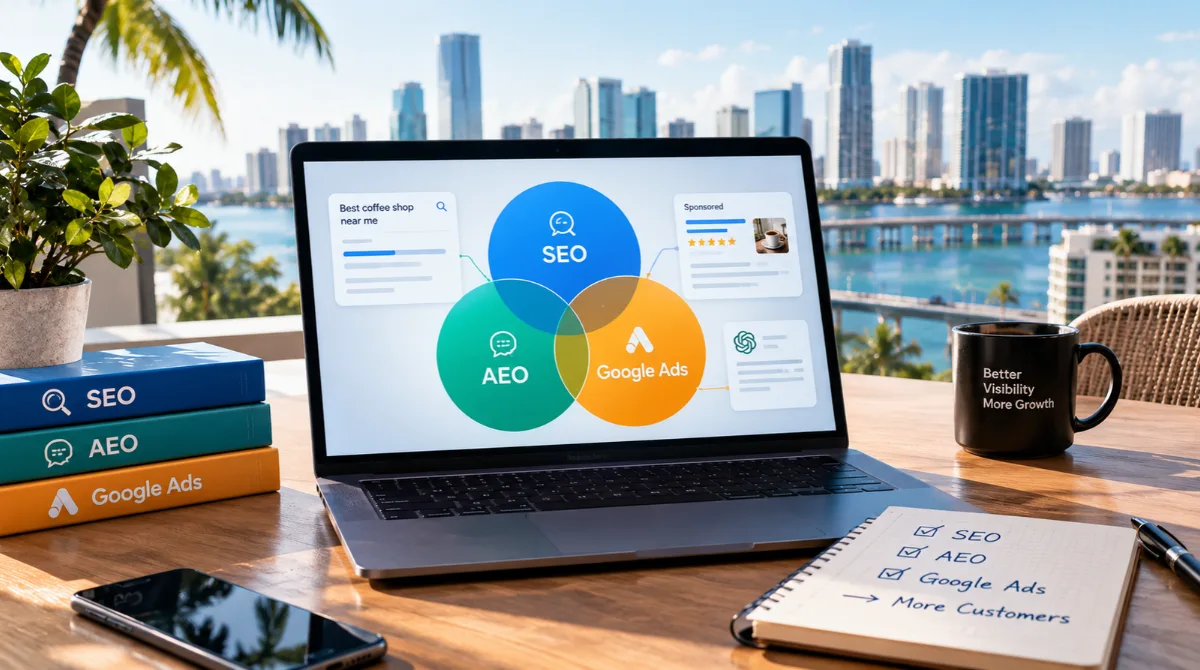
Each approach serves a different purpose. SEO builds organic visibility, AEO helps businesses become useful sources in AI-generated answers, and Google Ads reaches potential customers through paid search placements. When these strategies work together, Miami businesses can improve brand awareness, generate qualified leads, and support sustainable online growth.

How Do SEO, AEO, and Google Ads Work Together?

SEO, AEO, and Google Ads target different stages of the customer journey. SEO helps users discover relevant web pages, AEO makes information easier for search engines and AI assistants to understand, and Google Ads captures demand from people actively searching for products or services.

Consider a Miami dental practice. Local SEO can help it appear for searches such as “dentist in Brickell,” AEO can provide clear answers to questions about dental treatments, and Google Ads can promote appointments to people searching for a dentist nearby.

The following general statistics illustrate why businesses should consider a combined approach.

General statisticWhat it means for businesses
Google has historically accounted for over 90% of the global search engine market.Google visibility remains important for reaching customers through search.
Research by BrightEdge has reported that organic search drives approximately 53% of website traffic across industries.Organic SEO can be an important long-term traffic source.
Google reports that businesses with complete Business Profiles are more likely to be considered reputable by customers.Accurate business information supports local discovery and customer confidence.

Source: Brightedge 

How Can SEO Improve Long-Term Online Visibility?

Search engine optimization helps websites appear for relevant searches by improving technical performance, page content, keyword targeting, and website authority. For Miami businesses, an effective SEO campaign should address both general industry searches and local search intent.

For example, a real estate company may target “Miami commercial real estate services,” while a plumbing business may focus on “emergency plumber in Miami.” These location-specific keywords help connect service pages with potential customers who are actively looking for assistance.

A strong SEO strategy typically includes:

  • Keyword research: Identify relevant search terms, long-tail keywords, and customer questions.
  • On-page optimization: Improve title tags, meta descriptions, headings, internal links, and service page content.
  • Technical SEO: Address site speed, mobile usability, crawlability, indexing, and structured data.
  • Local SEO: Optimize the Google Business Profile, business citations, local landing pages, and customer reviews.
  • Content marketing: Publish informative blogs, service guides, and FAQs that demonstrate industry knowledge.

SEO generally takes time to deliver meaningful results, but its long-term value can grow as a website develops stronger content, authority, and organic rankings. Consistent optimization also creates a stronger foundation for paid campaigns and AI search visibility.

How Does AEO Help Miami Businesses Appear in AI Search?

Answer Engine Optimization (AEO) focuses on making website content clear, accurate, and useful for systems that provide direct answers. These include Google AI Overviews and AI-powered assistants such as ChatGPT, Gemini, and Perplexity.

Unlike conventional keyword targeting alone, AEO emphasizes answering specific questions, demonstrating expertise, and organizing information so search systems can interpret it effectively.

Miami businesses can strengthen their AEO strategy by:

  • Creating FAQ sections that address common customer questions.
  • Writing concise answers beneath descriptive, question-based headings.
  • Publishing original insights, practical guides, and industry-specific information.
  • Using relevant structured data and accurate business details.
  • Building brand credibility through authentic reviews, reputable mentions, and consistent information.

For example, a Miami real estate agency could publish a guide answering, “What should first-time homebuyers know before purchasing property in Miami?” A well-researched article can serve traditional organic search visitors while making the information easier for AI-powered search experiences to understand.

Google emphasizes that established SEO fundamentals, helpful content, and technical accessibility remain important for its AI search features. However, no SEO or AEO strategy can guarantee inclusion in AI-generated answers.

How Can Google Ads Generate Immediate Leads?

SEO and AEO help establish long-term visibility, but businesses may also need a faster way to reach customers with immediate purchase intent. Google Ads can fill this role by placing targeted advertisements in front of people searching for relevant products and services.

For instance, a Miami air-conditioning company could advertise for “emergency AC repair Miami” and direct visitors to a dedicated landing page featuring its services, service area, contact information, and a clear call to action.

An effective Google Ads strategy should include:

  • High-intent keywords: Target searches that indicate a strong likelihood of requesting a service or making a purchase.
  • Geographic targeting: Focus advertising on Miami neighborhoods and surrounding areas the business actually serves.
  • Relevant landing pages: Match ad messaging to the user’s search and provide a straightforward conversion path.
  • Negative keywords: Exclude irrelevant searches that waste advertising budget.
  • Conversion tracking: Measure phone calls, appointment bookings, form submissions, and completed purchases.

Google Ads performance should be evaluated through qualified leads, conversion rates, cost per acquisition, and return on ad spend rather than clicks alone. Conversion tracking helps businesses identify which campaigns and keywords generate meaningful customer activity.

Paid search can also provide useful insights into customer language and demand. These insights can inform organic keyword research, website content, and future AEO topics.

How Can Miami Businesses Combine All Three Strategies?

The strongest approach is to make SEO, AEO, and Google Ads part of one coordinated marketing plan rather than treating them as separate channels.

Start by identifying the services that matter most to your business and researching the keywords customers use when searching for them. Develop optimized service pages for organic visibility, create helpful content that answers customer questions, and use paid campaigns to reach high-intent prospects.

Next, connect your measurement systems. Google Analytics, Google Search Console, and Google Ads reporting can help reveal how customers discover your website, which pages attract engagement, and which marketing channels contribute to conversions.

For example, if a Miami law firm discovers that prospective clients frequently search for answers to a particular legal question, it can publish an informative article, improve the relevant service page, and run a targeted Google Ads campaign for related commercial searches.

Over time, this integrated approach can help businesses improve brand recognition, refine targeting, and allocate their budgets more effectively.

How Can an SEO Agency Support Your Digital Marketing Strategy?

Managing organic search, AI visibility, and paid advertising requires technical knowledge, content planning, ongoing testing, and reliable performance measurement. Working with an experienced SEO agency can help businesses coordinate these activities around specific commercial objectives.

Sky SEO Digital offers digital marketing services that include search engine optimization, Answer Engine Optimization, local SEO, content marketing, search engine marketing, and website design. Its service offerings are relevant to Miami businesses seeking to strengthen traditional search visibility while adapting to AI-driven discovery.

A trusted digital marketing partner should understand your industry, develop a strategy based on your business goals, and provide transparent reporting. Look for an expert team that explains its recommendations, measures qualified leads, and adjusts campaigns using actual performance data rather than promising guaranteed rankings.

What Is the Next Step for Miami Businesses?

The future of online customer acquisition is not about choosing SEO over paid advertising or prioritizing AI search at the expense of traditional optimization. It is about building a connected strategy that supports visibility wherever potential customers search.

SEO establishes a sustainable foundation, AEO helps make business information accessible to answer engines, and Google Ads delivers targeted exposure to people with relevant needs. Together, these channels can create a more consistent path from discovery to conversion.

Miami businesses can begin by auditing their websites, identifying their most valuable local keywords, improving customer-focused content, and reviewing existing advertising performance. By working with an experienced SEO agency and tracking results consistently, companies can develop a practical, measurable digital marketing strategy designed for long-term growth.

Ready to strengthen your online visibility? Explore Sky SEO Digital to learn more about its digital marketing services and discuss an approach suited to your business goals.

FAQs

What is the difference between SEO, AEO, and Google Ads?

SEO improves organic search rankings, AEO helps content appear in answer-based and AI-powered search experiences, and Google Ads delivers paid visibility for targeted keywords. Combining all three helps businesses reach customers through multiple search channels.

Why should Miami businesses combine SEO, AEO, and Google Ads?

Miami businesses can improve local search visibility, answer customer questions, and attract high-intent prospects through paid advertising. An integrated strategy supports brand awareness, qualified lead generation, and long-term online growth.

How long does SEO take to produce results for Miami businesses?

SEO results depend on competition, website condition, content quality, and optimization efforts. Businesses may notice early improvements within a few months, while meaningful and sustained growth can take six to twelve months or longer.

Can AEO help Miami businesses appear in AI-generated search results?

Yes. AEO practices, such as creating helpful content, answering specific questions, maintaining accurate business information, and improving website accessibility, can help search systems understand a business. However, inclusion in AI-generated answers is never guaranteed.

How can an SEO agency help businesses combine these strategies?

An experienced SEO agency can coordinate keyword research, local SEO, helpful content, AEO, paid search campaigns, and conversion tracking. Sky SEO Digital offers digital marketing services to help businesses explore strategies for improving online visibility and attracting potential customers.

Real AI Search Results for Miami Businesses: AEO in Action

When someone asks AI for a lawyer in Coral Gables, vacation rental cleaning in Wynwood, or a brand consultant in Miami, does your business appear among the recommendations?

At Sky SEO Digital, we help businesses compete for those opportunities. Our Client Services & AI Search Results report includes actual captured responses featuring local businesses across several industries. The screenshots below show what that visibility looks like.

Can your business achieve AI visibility within 7 to 14 days of publishing content? Early appearances can be possible in that window, particularly when relevant new content builds on an established website. Timing varies with competition, discovery, indexing, and the platform. The report documents search appearances; it does not include publishing dates that establish a 7–14 day turnaround for these examples.

Six real AI search examples from our report

These are captured search responses from our report, rather than illustrations of hypothetical placements. Each example pairs a specific customer question with a business that appears in the answer. A business mention, a map listing, and a link to a website are different forms of visibility; we pay attention to which one a result actually provides.

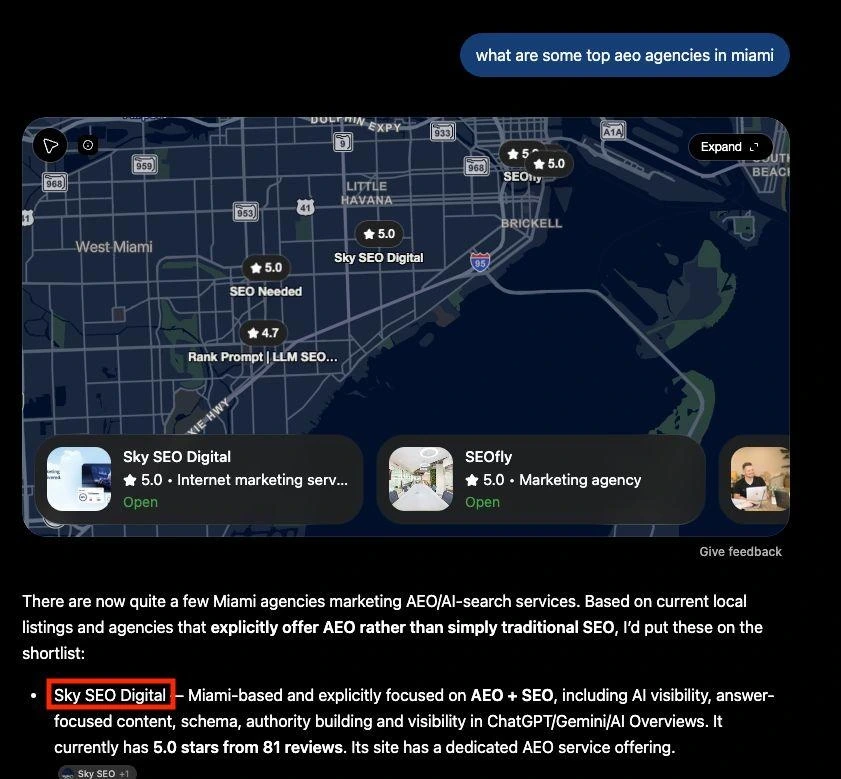
Sky SEO Digital

The search: “what are some top aeo agencies in miami”

The captured answer includes Sky SEO Digital in the map results and written shortlist. This is the same visibility challenge our clients face: being considered when a customer asks for providers in a specific market. The screenshot shows our agency appearing alongside other options for an AEO agency search.

Captured AI search response featuring Sky SEO Digital for the query what are some top aeo agencies in miami

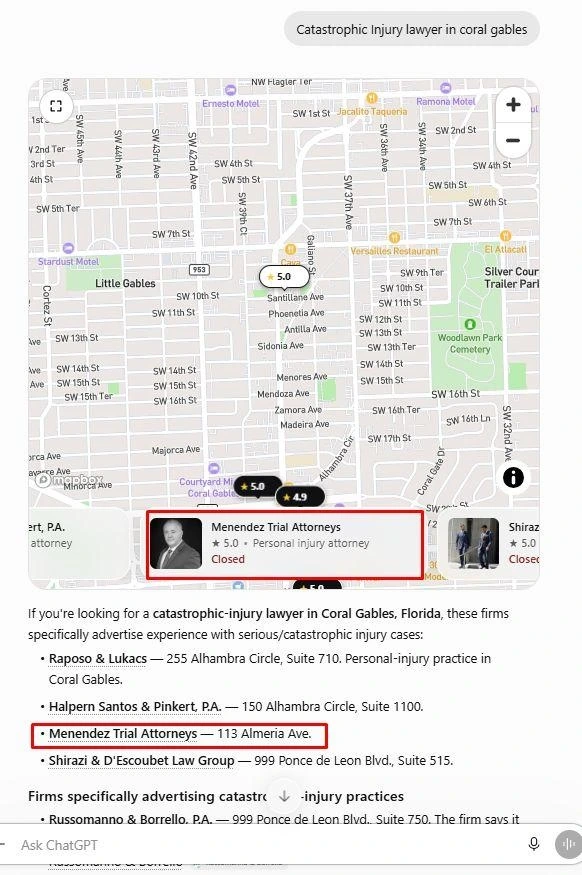
Menendez Trial Attorneys

The search: “Catastrophic Injury lawyer in coral gables”

The captured response includes the firm in a local listing and the written answer. This search combines a specific legal service with a city. For a law firm, content needs to explain the relevant practice area and where the firm serves clients. A general homepage alone may leave important questions unanswered.

Captured AI search response featuring Menendez Trial Attorneys for the query Catastrophic Injury lawyer in coral gables

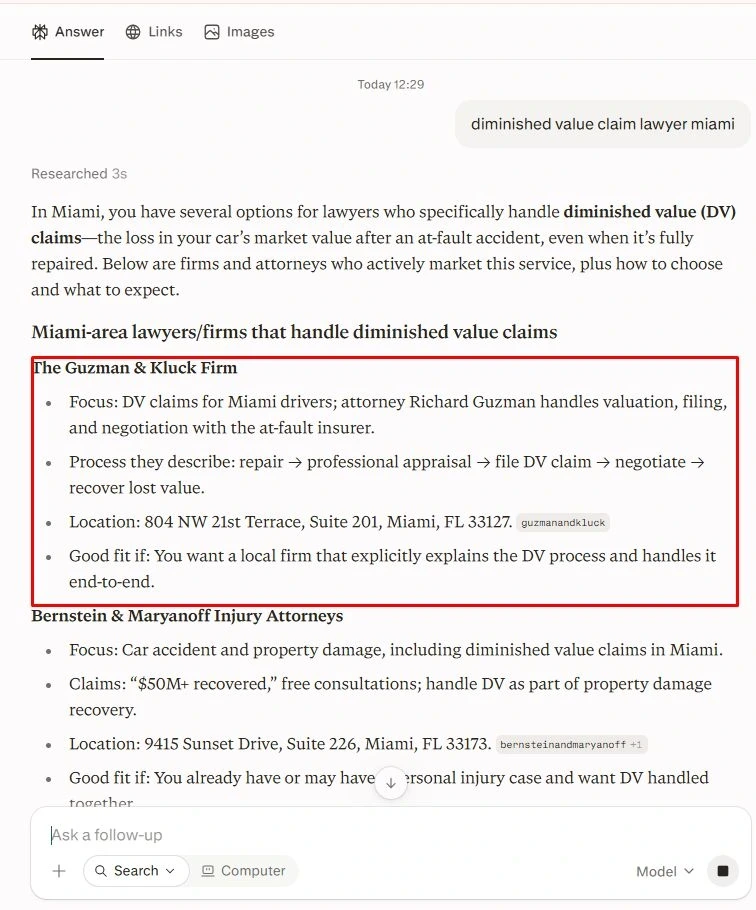
Guzman & Kluck

The search: “diminished value claim lawyer miami”

The firm appears first in the captured written answer, with a detailed explanation of its service. A narrow service query can create an opportunity that a broad search such as “Miami lawyer” does not. This example illustrates why we look beyond general industry keywords and identify the particular services customers need.

Captured AI search response featuring Guzman & Kluck for the query diminished value claim lawyer miami

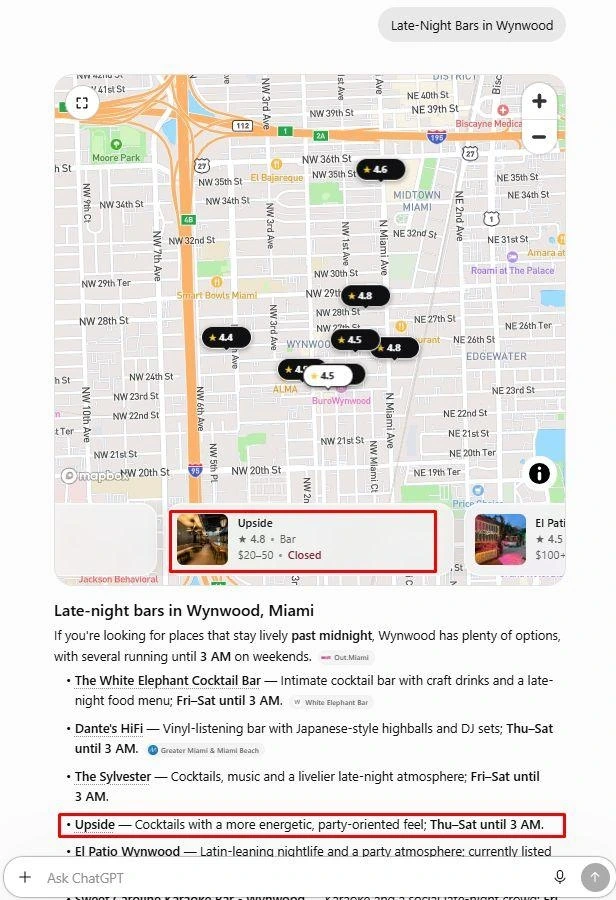
Upside in Wynwood

The search: “Late-Night Bars in Wynwood”

Upside appears in the captured map results and written recommendations. Hospitality searches often depend on neighborhood, hours, and the experience a customer wants. Keeping those details accurate and easy to find helps customers evaluate whether a venue fits their plans.

Captured AI search response featuring UPSIDE in Wynwood for the query Late-Night Bars in Wynwood

Miami EXP Cleaning

The search: “Vacation Rental Cleaning in Wynwood”

The business appears in the captured answer for a specific service and neighborhood. This is a practical example of local buying intent. A property manager looking for vacation rental cleaning has a different need from someone searching for general house cleaning. Our content planning accounts for those differences.

Captured AI search response featuring Miami EXP Cleaning for the query Vacation Rental Cleaning in Wynwood

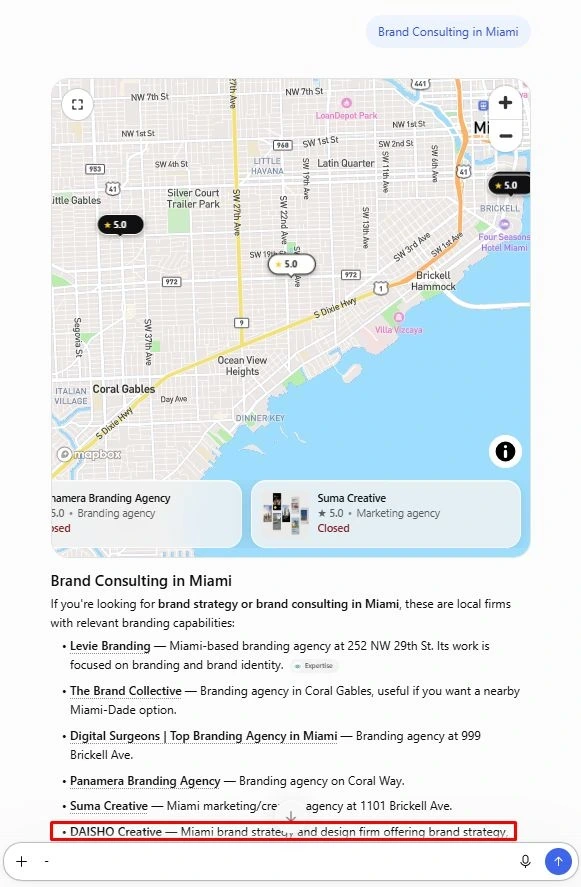
Daisho Creative

The search: “Brand Consulting in Miami”

The agency appears among the local firms listed in the captured answer. Professional services businesses also compete for inclusion in AI recommendations. Clear service descriptions, useful explanations of the process, and relevant examples help prospective clients understand what makes an agency a fit.

Captured AI search response featuring DAISHO Creative for the query Brand Consulting in Miami

What these results mean for a local business

The practical value is straightforward: a business that appears in a relevant recommendation has an opportunity to be considered. These examples span specialized legal services, nightlife, cleaning, creative services, and digital marketing. AI visibility is relevant to more than technology companies or national brands.

These screenshots establish appearances for the displayed searches at the time of capture. They do not establish a permanent number-one ranking, a before-and-after improvement, or a specific number of new customers. We use them as concrete examples of visibility, then look at repeated checks and business outcomes to understand progress.

How we help local businesses earn AI visibility

Our Answer Engine Optimization services start with the business: its services, customers, locations, and competitive advantages. From there, we identify the questions a prospective customer might ask and the information the website needs to answer them well.

Start with a useful baseline

We review the website, Google Business Profile, existing content, competitors, and AI visibility. With access to Search Console, analytics, and lead tracking, we can connect that review to actual performance data. A useful baseline tells us what already works and where the most important gaps are.

Publish content around specific customer needs

“Cleaning company” is broad. “Vacation rental cleaning in Wynwood” identifies a service, a location, and a likely customer. We build content around those distinctions through relevant service pages, substantive local pages, educational articles, and direct answers to common questions.

Our content marketing work focuses on information a customer can use: what a service includes, who it suits, what the process involves, and what to consider when comparing providers. Adding a neighborhood name to otherwise identical pages provides little value.

Strengthen the website and local business information

Useful content needs to be accessible and connected to the rest of the site. Our SEO services address issues such as internal links, indexing barriers, page structure, and accurate structured data where appropriate. Our local SEO work also reviews business details and relevant local information.

Google’s guidance for AI features in Search says established SEO practices remain relevant. Google does not require special AI schema, and eligibility does not guarantee inclusion. That supports a practical approach built on useful content and sound website fundamentals.

Your competitors are competing for the same recommendation

The screenshots show businesses alongside other providers. That is the competitive reality: when someone asks for local options, your business needs a clear reason to belong in the answer. A vague service description gives a prospective customer less to evaluate than a page that explains the service, location, experience, and process.

A smaller business can find opportunities in specific questions that larger competitors address poorly. We look for those gaps rather than treating every broad keyword as equally valuable. That might mean a specialized legal service, a particular property type, or a neighborhood where the business genuinely operates.

How we turn competitive gaps into practical work
Competitive gap What we do Why it matters
A competitor explains a specialized service; your site barely mentions it. Build or expand a substantive service page. Customers can understand whether your business handles their need.
Your location or service area is unclear. Clarify accurate business details and add useful local context. Location is central to many local provider searches.
Customers’ comparison questions go unanswered. Explain process, scope, differentiators, and common questions. Visitors have more information to evaluate your business.
You have one favorable screenshot but no ongoing measurement. Repeat a defined set of prompt checks and review inquiry data. You can assess consistency and practical value.

Competition also changes. Another company may improve its content, attract new reviews, or become more relevant for a particular search. Ongoing work helps us respond to those changes and expand coverage beyond a single successful prompt.

What can happen within 7 to 14 days of publishing?

Our aim is to create opportunities for early visibility within 7 to 14 days after targeted content goes live. That window starts with publication, rather than the first consultation. It is an opportunity for initial progress, not a deadline that every business or platform will meet.

Early movement is more plausible when an established website is accessible, the content fills a clear gap, and the query closely matches the business. A new website, unresolved technical problems, or a highly competitive search may require considerably more time. Publication and discovery are separate events.

  1. Before publication: assess the starting point, choose relevant questions, and create accurate content.
  2. At publication: make the page accessible, connect it through relevant internal links, and check for obvious indexing barriers.
  3. During the next 7 to 14 days: monitor discovery where data is available and check a consistent set of relevant AI searches.
  4. After the initial window: refine content, expand useful coverage, and track whether appearances repeat.

A first appearance is a useful milestone. Consistent visibility across relevant searches and qualified inquiries are stronger measures of long-term value.

We track more than a favorable screenshot

For repeatable monitoring, we record the prompt, platform, date, location context, businesses mentioned, and any supporting links. We distinguish between a business being named and its website being cited. Repeated checks help us understand whether an appearance is isolated or part of a broader pattern.

Where tracking allows, we also review referral traffic, calls, forms, and qualified inquiries. Not every AI interaction produces a click or identifiable referral, so screenshots and analytics answer different questions. Together, they provide a more useful picture than either does alone.

Frequently asked questions

Can Sky SEO Digital help my business appear in AI search?

Yes. We help local businesses improve their visibility through AEO, SEO, useful service and location content, technical improvements, and ongoing measurement. The report shows captured AI search appearances across several industries. Placement for a particular prompt cannot be guaranteed.

Can AI search results appear within 7 to 14 days of publishing content?

Early visibility can be possible within 7 to 14 days after targeted content is published. Timing depends on discovery, indexing, existing authority, competition, and the platform. This is a potential early outcome, not a guaranteed deadline. The screenshots in this post do not establish how long each example took.

Are the screenshots real results?

They are actual captured search responses reproduced from Sky SEO Digital’s Client Services & AI Search Results report. They show the businesses appearing for the displayed searches when the captures were taken. They do not establish permanent placement, typical results, or a specific increase in leads.

Is AEO the same as SEO?

AEO focuses on visibility in generated answers and recommendations. SEO focuses on visibility in search results, while local SEO also supports discovery in local listings and maps. The goals differ, but much of the underlying work overlaps.

Can a smaller local business compete with larger companies?

Yes, smaller businesses can appear for relevant local and specialized searches. A focused service, a clear location match, useful content, and credible business information can create opportunities. Budget alone does not determine every result, and competition still affects the work required.

Do FAQs or schema markup guarantee AI rankings?

No. FAQs can make useful answers easier to find, and accurate structured data can describe page content. Neither guarantees inclusion. Google says its AI search features do not require special schema or additional technical optimizations beyond its existing search requirements.

How do you measure progress?

We record a defined set of prompts, the platform, date, location context, mentions, links, and competing businesses. Repeated checks help reveal patterns. Where tracking permits, we also review referral traffic, calls, forms, and qualified inquiries.

Find out where your business stands in AI search

Our report shows local businesses appearing for the kinds of specific questions customers ask. We help businesses pursue those opportunities through a coordinated plan for content, AEO, SEO, and local visibility.

Want to see where your competitors appear and what your website could explain better? Schedule a 30-minute conversation with Bryan Wisotsky at Sky SEO Digital.

About the author: Bryan Wisotsky founded Sky SEO Digital in 2022 and brings 18 years of digital marketing experience to helping businesses improve their online visibility.

Evidence note: Screenshots are reproduced from the supplied Client Services & AI Search Results report. Capture dates, publishing dates, pre-publication baselines, and conversion attribution are not provided in that report. Examples are individual observations, not a promise of typical results.

Posted in AEO

Why ChatGPT, Claude, and Other AI Tools Can’t See the Full Marketing Picture

ChatGPT, Claude, and other AI tools can help develop marketing ideas, but their advice is incomplete without relevant business data, verified findings, and informed judgment. A website URL can reveal public content. It does not automatically reveal your analytics, advertising results, customer quality, or revenue—the information needed to build a dependable strategy.

Key Takeaways

  • A polished AI website audit can be a useful starting point, but its conclusions depend on what the tool actually inspected.
  • Public browsing does not automatically provide access to Google Analytics, Google Search Console, advertising accounts, or sales records.
  • Generic best practices can identify possibilities. They cannot establish your biggest business problem without evidence.
  • Uploaded reports and connected tools make AI analysis more useful, but data quality, interpretation, and verification still matter.
  • A dependable strategy connects findings to priorities, implementation, qualified leads, and measurable results.

Why AI Marketing Advice Sounds So Convincing

Ask an AI tool to audit your website, and you may receive a professional-looking report within minutes. It might recommend better page titles, more FAQs, stronger calls to action, additional blog posts, and a clearer keyword strategy. The headings are organized. The explanations sound logical. The recommendations feel specific because your business name appears throughout the response.

But presentation is not proof. Putting your company name into a marketing checklist does not make that checklist a diagnosis. It is like receiving a beautifully printed home inspection report from someone who has only seen the listing photos: some observations may be useful, but the wiring, plumbing, and foundation still need investigation.

AI tools also make factual mistakes. OpenAI explains that ChatGPT can produce incorrect or misleading answers, including confident statements and fabricated references. Anthropic acknowledges similar limitations for Claude. For a business owner, that means recommendations should earn your trust through evidence, rather than through confident wording.

Why a URL-Only Website Audit Is Incomplete

A public website review can assess what is visible. A performance audit must also investigate what is happening behind the scenes. Depending on its browsing and technical tools, an AI assistant may inspect page copy, headings, navigation, links, metadata, or selected technical signals. Those are real observations when the tool actually retrieves and examines them.

However, sending a URL does not automatically grant access to private reporting. Browsing your homepage cannot tell an assistant how many organic visitors became qualified leads, which ad searches wasted money, or whether your most profitable customers came from referrals. Those answers require authorized account access, supplied reports, or other relevant evidence.

Think of it like asking a mechanic to diagnose a car by looking at its exterior. The mechanic might notice worn tires or a broken light. Determining why the engine stalls requires a different level of inspection. Your website’s appearance and content are the exterior; performance data helps explain what is happening under the hood.

What Is Missing When You Only Share a Website Link?

  • Search performance: Queries, impressions, clicks, and average positions from Google Search Console.
  • Visitor behavior: Traffic sources, landing-page engagement, and recorded key events from analytics.
  • Advertising performance: Spend, search terms, targeting, conversion settings, and campaign history.
  • Lead quality: Whether inquiries are relevant, qualified, booked, or closed.
  • Business economics: Margins, customer value, capacity, and the services you actually want to grow.
  • Historical context: Website migrations, tracking changes, seasonality, and previous marketing work.

Google’s documentation explains the search impressions, clicks, click-through rate, and position metrics available in Search Console. Reading a public page is a different activity from analyzing those performance records.

AI Website Review vs. a Complete Marketing Audit

The comparison below describes a URL-only review without private account connections or supplied reports. AI supported by additional tools and data can do substantially more. A professional audit also needs a defined scope; hiring an agency does not automatically guarantee a thorough investigation.

Comparison Chart: Public Observations vs. Verified Performance
Area URL-Only AI Review Evidence-Based Audit
Content Can review retrieved pages for clarity, relevance, and unanswered questions. Combines page review with search demand, performance, business goals, and content gaps.
Organic traffic Cannot establish actual traffic from page content; external estimates need clear labels. Analyzes authorized analytics and Search Console data over defined periods.
Keyword rankings May check selected live searches if tools allow; this is a limited snapshot. Uses documented query, location, device, and historical ranking evidence.
Technical SEO Findings depend on accessible pages and the technical tools actually used. Uses a defined crawl, indexing checks, performance tests, and manual validation.
Backlinks Public mentions do not establish the full backlink profile or explain a traffic decline. Reviews available link datasets, trends, relevance, and other evidence before recommending action.
Paid advertising May suggest messaging or landing-page improvements. Examines account settings, spend, queries, conversion tracking, and lead outcomes.
Conversion performance Can identify possible usability barriers but cannot infer an actual conversion rate. Checks tracking and connects user journeys to recorded inquiries and sales where possible.
Priorities Often produces plausible tasks without enough evidence to rank their value. Weighs likely impact, confidence, cost, dependencies, and business needs.

How Reasonable Advice Becomes the Wrong Priority

Advice can be technically reasonable and still be wrong for the moment. Adding FAQs may improve a service page. Publishing helpful articles may expand your visibility. Shortening an awkward title may make it easier to read. None of those observations establishes that these changes deserve your next marketing dollar.

Consider a hypothetical Miami law firm. An AI review recommends more blog posts because the website has a small article library. A deeper investigation finds that several important practice areas lack dedicated pages, the mobile inquiry form fails, and paid campaigns generate inquiries outside the firm’s target market. Publishing articles may still help, but it will not repair the form or correct campaign targeting.

A generic strategy is like a GPS giving directions without knowing your starting point. The route may look organized, but it cannot reliably move your business toward its goal until the starting conditions are understood.

Comparison Chart: Common AI Recommendations and the Questions They Leave Open
Recommendation Missing Question Evidence to Review
Publish more blogs Is missing content the bottleneck, or are core service pages underdeveloped? Search queries, landing-page results, service priorities, and competitor coverage.
Increase your ad budget Are current campaigns producing customers at a sustainable cost? Verified conversions, qualified leads, closed sales, and margins.
Redesign your website Is the design causing a measurable problem, and which journeys need improvement? Usability testing, device-level performance, form testing, and tracking checks.
Remove spammy backlinks Is there evidence of harmful link activity that warrants action? Link history, manual actions, acquisition practices, and current Google guidance.
Target higher-volume keywords Will those searches bring the customers and services you want? Search intent, location, competition, lead quality, and commercial relevance.

Why AI Cannot Simply Declare Your AI Visibility

Asking ChatGPT whether your company appears in AI search is not a complete visibility audit. An assistant’s answer in one conversation does not establish how often your brand appears across other prompts, users, platforms, or locations. If the assistant did not run and document relevant tests, a confident visibility score is not a measured result.

A useful review records the platform, prompt, date, relevant location, and whether the answer mentioned your business or cited your website. Repeated checks across a defined prompt set help establish patterns. Referral traffic and resulting leads add another layer, although referral tracking alone will not capture every exposure or customer journey.

“We did not detect your business in these tests” is a supported finding when the tests are documented. “Your business never appears in AI” is a much broader claim. Our Answer Engine Optimization services address AI search visibility as a distinct part of marketing, alongside SEO for traditional search. Visibility in either setting needs evidence.

Do Uploaded Reports and Integrations Solve the Problem?

They can substantially improve the analysis. It would be inaccurate to say that ChatGPT or Claude can never access data. AI can analyze uploaded exports, and supported integrations can provide authorized access to business systems. Anthropic also documents Claude’s ability to search the web and retrieve public pages.

However, better access does not remove the need to check the inputs and reasoning. A report might cover the wrong dates, omit a campaign, or count spam submissions as leads. A tracking change can make a chart look like business growth. A traffic decline that follows a website update does not, by itself, prove that the update caused it.

AI is like a powerful calculator: it can accelerate useful work, but the wrong inputs or the wrong formula still produce the wrong answer. The same standard applies to human marketers. Both need reliable evidence and a willingness to revise their conclusions.

What a Complete Digital Marketing Strategy Includes

A useful strategy explains where your business stands, what is limiting growth, what to change first, and how success will be measured. It also acknowledges uncertainty. Some findings are confirmed; others are hypotheses that need testing.

  1. Define the business goal. Identify the services, locations, customers, budget, and capacity that matter.
  2. Establish a trustworthy baseline. Review available analytics, search performance, ads, local visibility, lead records, and tracking quality.
  3. Investigate the causes. Combine technical checks, content review, customer journeys, and market context.
  4. Prioritize the work. Explain each recommendation’s evidence, expected benefit, effort, and dependencies.
  5. Assign implementation. Specify who will make changes, what access is needed, and when work will happen.
  6. Measure and adjust. Review relevant results over suitable periods and refine the plan as evidence develops.

For a Miami business, the mix might include local SEO, deeper service pages, content marketing, and paid search management. The mix should follow the opportunity and the budget. A list that recommends every channel equally has not yet made the decisions a strategy requires.

How to Use AI More Effectively

Use AI to organize research, summarize supplied reports, generate questions, compare possible approaches, and draft content for review. Give it your business goals and relevant evidence, then ask it to identify missing information before recommending action.

A stronger audit prompt sets an evidence standard:

Review the pages and reports I provide. State exactly what you accessed and the dates covered. Separate verified findings from hypotheses. Do not invent traffic, rankings, conversions, or AI visibility scores. Explain what additional evidence is needed and prioritize recommendations by likely business impact.

Then check whether the response meets that standard. Ask the same of any agency or consultant: Which pages were inspected? What supports each conclusion? Which claims remain uncertain? Who will implement the changes? How will we know whether they worked?

At Sky SEO Digital, we believe AI belongs inside a process that connects research, business context, execution, and measurement. If you have an AI-generated audit and want help evaluating its recommendations, schedule a 30-minute conversation about the findings and the data needed to assess them.

Frequently Asked Questions

Can ChatGPT or Claude perform a website audit?

Yes, within the scope of the pages, data, and tools available. They can review accessible content and help analyze supplied reports. A URL-only review cannot establish private traffic, conversion, advertising, or sales performance without additional evidence.

Does sharing my website URL give AI access to Google Analytics?

No. A public website URL does not grant access to your Google Analytics account. The assistant needs relevant exports or an authorized integration that supports access to that data.

Why does an AI audit sound specific when it lacks business data?

An assistant can combine your business name, visible website content, and common marketing recommendations into a tailored response. That can be useful, but specific wording does not prove it measured your results or identified the main cause of a problem.

Can AI tell me which keywords my website ranks for?

It can help analyze Search Console exports or ranking reports, and suitable tools may check selected live results. Without that evidence, a keyword list is a set of possible targets rather than a verified record of your rankings.

Can AI tell me whether my business appears in ChatGPT answers?

An assistant can help run and document visibility tests when suitable tools are available. One answer is only one observation. A useful assessment covers a defined set of prompts, platforms, dates, and relevant locations, with repeated checks.

Is an AI marketing strategy reliable if I upload reports?

Relevant reports make the analysis better informed, but reliability still depends on data quality, date ranges, tracking accuracy, business context, and interpretation. Important recommendations should be verified and tested before major budget changes.

Should businesses stop using AI for digital marketing?

No. AI can support research, analysis, brainstorming, and content creation. Businesses should use it with appropriate data, verification, and accountable implementation rather than treat an unsupported response as a complete strategy.

Posted in AI

ChatGPT Citations: What Business Owners Need to Know

Key Takeaways

  • Check how your AI visibility is measured. Google rankings and API results may give a different picture from what customers see in ChatGPT.
  • Measure patterns over time. One answer or screenshot provides limited information.
  • Track brand mentions, website citations, and leads separately. Each tells you something different.
  • Keep investing in useful content and technical SEO. These remain practical foundations for search visibility.
  • Treat the findings as a measurement warning. The research does not establish a guaranteed formula for earning citations.

Overview

A new study suggests that Google rankings and OpenAI’s API provide an incomplete picture of the sources ChatGPT cites. For business owners, the practical lesson is to question how AI visibility is measured, check actual customer-facing answers, and focus on useful content, consistent business information, and measurable leads.

What Did the ChatGPT Citation Study Find?

Researchers compared sources cited in ChatGPT’s web application with Google results and OpenAI’s Responses API. An API is a connection that lets software send requests to an AI model without using the consumer chat interface.

For the GPT-5.5 Instant tests, Google results and API sources combined covered 26.2% of cited pages and 48.7% of cited website hostnames. These were averages across the questions tested, according to the original research paper.

Put simply, checking those other systems revealed some of ChatGPT’s sources but left substantial gaps.

The research used 80 English and Chinese questions, with repeated tests across several model settings. It examined systems from GPT-5.2 through GPT-5.5; its percentages should not be assumed to describe newer models.

Search Engine Journal reported on the findings on October 18, 2026. The original research paper, published as an arXiv preprint, provides the underlying analysis. The preprint had not undergone peer review at the time of that coverage.

Why Does This Matter for Your Business?

Imagine your marketing report says your company rarely appears in AI answers. Before changing your strategy, you need to understand what the report actually measured.

Did it check ChatGPT directly? Did it use an API? Did it estimate visibility from Google rankings? Those methods answer different questions.

The study found that the tested substitutes matched website hostnames more closely than individual pages. It also observed variation between repeated runs. That supports using multiple checks and looking beyond a single URL.

For business owners, the practical implication is straightforward: ask how a visibility score was produced before using it to make spending decisions.

An API-based report can still provide useful information. Its value depends on whether its methodology is clear and whether its conclusions match what it measured.

What Is the Difference Between a Mention, a Citation, and a Lead?

These outcomes should appear separately in your reporting.

How to interpret different AI visibility measurements
Measurement What It Means What to Check
Brand mention Your business name appears in an answer. Is the description accurate and relevant?
Website citation An answer links to your website as a source. Which page is linked, and what does it support?
Third-party reference Another website discusses your business. Is the information correct and current?
Referral visit Someone clicks through to your website. What do they do after arriving?
Lead or sale Someone contacts or buys from your business. Was the inquiry qualified and valuable?

A citation can support visibility without immediately producing a customer. A mention can create awareness without sending a measurable click.

Your reporting should help you understand that path instead of treating every appearance as equal.

What Business Owners Should Do Now

The following steps are practical recommendations informed by the research and official search guidance. They are not citation tactics proven by this study.

1. Ask Your Agency How It Measures AI Visibility

Request a plain-English explanation of the reporting method.

Useful questions include:

  • Which platforms and models are being tested?
  • Are answers collected directly from the app or through an API?
  • How often is each question repeated?
  • Are brand mentions and website citations counted separately?
  • Are location and account settings recorded?
  • Can I see examples behind the score?

A good report should make its scope clear enough that you understand what a change means.

2. Test Questions Your Customers Actually Ask

Build a small list of questions based on sales calls, consultation requests, and customer emails.

For a Miami service business, examples might include:

  • “Which companies offer residential landscaping in Coconut Grove?”
  • “What should I ask before hiring a roofing contractor?”
  • “How much does ongoing SEO cost for a small business?”
  • “Which accounting services does a growing business need?”

Include both discovery questions and questions about your company. They measure different parts of the customer journey.

As a starting routine, test 10–15 priority questions several times across the month. Record the date, platform, available model information, answer, and linked sources. This is a manageable monitoring approach, not a statistically validated sample size.

3. Answer Important Questions Clearly on Your Website

Review whether your website explains what a prospective customer needs to know before contacting you.

Useful topics include:

  • Services and who they are suitable for.
  • Locations and service areas.
  • Pricing factors and what affects cost.
  • Timelines and what the process involves.
  • Qualifications and relevant experience.
  • Common limitations and frequently asked questions.

Start each section with a direct answer, then add supporting detail. Include examples from your actual work where permission allows.

For instance, a page about custom closets could explain how room size, materials, accessories, and installation affect the estimate. That gives readers more useful information than repeatedly describing the company as “the best.”

This approach makes content easier to evaluate and use. It does not guarantee that an AI platform will cite it.

4. Check Whether Search Systems Can Access Your Content

Ask your website team to review indexing, crawler access, internal links, and whether important information appears as readable text.

OpenAI’s search guidance says websites should allow OAI-Searchbot and its published searchbot IP addresses to be eligible for inclusion in ChatGPT search. It also states that placement is not guaranteed.

Google’s guidance for AI search features separately says its established SEO practices remain relevant for AI Overviews and AI Mode. Its recommendations include accessible text, internal links, accurate business information, and structured data that matches visible content. Google does not require special AI markup for these features.

These are eligibility and quality checks. They should accompany content improvements.

5. Connect Visibility to Business Results

Alongside mentions and citations, track referral visits, consultation requests, qualified calls, and sales.

Add “How did you hear about us?” to your intake process. Let customers describe their discovery path in their own words, including ChatGPT or another AI assistant.

Use those answers alongside analytics. Neither provides a complete attribution picture alone, but together they can help you understand whether visibility is contributing to business growth.

Does This Change Your SEO and AEO Strategy?

It should sharpen how you measure results.

SEO focuses on visibility in search engines. Answer Engine Optimization, or AEO, focuses on how your business and information appear in generated answers. They overlap, but their reporting should reflect their different outcomes.

Maintain your SEO foundation while reviewing AI answers for accuracy, relevant mentions, and useful citations. For Google’s AI search features specifically, Google confirms that existing SEO fundamentals continue to apply.

Avoid making major changes because of one missing mention. Look for a recurring gap, identify what customers need, and improve the relevant content or business information.

Frequently Asked Questions

What is a ChatGPT citation?

A citation is a source reference attached to an answer. In ChatGPT search, users can open citations to review the supporting material. A linked source should still be checked for accuracy and relevance, as explained in OpenAI’s search guidance.

Does ranking well on Google guarantee a ChatGPT citation?

No. The research found that Google results only partially overlapped with ChatGPT’s cited sources. A Google ranking report should therefore be treated as a separate measurement.

Does this mean AI visibility tracking tools are unreliable?

The paper did not test commercial tracking products. Evaluate each tool’s collection method, coverage, and reporting limits before deciding how much weight to give its scores.

Why can ChatGPT give different results for the same question?

ChatGPT can rewrite a question into targeted searches, and context such as location or saved preferences may influence those searches. Record your testing conditions to make comparisons more useful.

Should I add FAQs to every page?

Add FAQs where customers have relevant questions that the page has not already answered clearly. Avoid repeating generic questions across your website. Their purpose should be to help readers make informed decisions.

Can anyone guarantee that my business will appear in ChatGPT?

No. OpenAI states that search placement is not guaranteed. Be cautious about promises of permanent positions or guaranteed citations.

Build a Clearer Picture of Your Search Visibility

Start by reviewing your current reporting and identifying the questions that matter most to your customers. Then check your website’s answers, search accessibility, and conversion tracking.

Sky SEO Digital helps businesses develop SEO and AEO strategies around useful content, accurate business information, and measurable growth. Schedule a 30-minute conversation to discuss your visibility and next steps.

Sources and Further Reading

A Panda-Style Google Update? How to Prepare Your Website

A prediction about a possible Google update has put content quality back in the spotlight. For businesses that depend on organic traffic, the useful question is what to improve now: the accuracy of published information, the value each page offers, and the editorial controls behind new content.

A forecast cannot confirm Google’s plans, and no checklist can guarantee protection from ranking changes. However, a practical review can uncover weaknesses that deserve attention regardless of when another update arrives.

What the Prediction Actually Says

In an October 15, 2026 Search Engine Journal article, Dan Taylor describes a model that assigns a 96.8% probability to a Google update within 30 days. He connects that forecast with the possibility of a quality-focused shift reminiscent of Panda, particularly around scaled content and deceptive authorship.

The model uses historical update patterns, timing signals, volatility, and industry discussion. Those inputs support a prediction; they do not provide access to Google’s release schedule or establish what a future update will target. An estimate of update timing also does not establish the probability that any particular website will lose rankings.

Our assessment: treat the article as a reason to review publishing practices. Documentation changes can clarify Google’s expectations, but their timing alone does not prove that a specific algorithm change is imminent.

What “Panda-Style” Means Today

Google’s ranking systems guide describes Panda as a system designed to promote high-quality, original content. It launched in 2011 and became part of Google’s core ranking systems in 2015. The same guide explains that the helpful content system became part of core ranking systems in March 2024.

“Panda-style” is therefore a comparison with an earlier approach to quality. It should not be presented as the official name of an upcoming release. Google uses both page-level and site-wide signals; it would also be premature to claim that a predicted update will automatically affect every page on a domain.

For a business owner, the practical test is straightforward: would a customer find the website useful if they arrived through a referral instead of Google? A service page that answers real buying questions can have value even when it is short. A lengthy article can still leave the reader without a useful answer.

Which Website Practices Deserve a Closer Look?

Publishing volume without editorial control

Google’s scaled content abuse policy addresses large amounts of content created primarily to manipulate rankings while offering little value. It applies regardless of whether the content is produced through automation, people, or a combination.

A useful operational warning sign is a publishing schedule that exceeds your team’s ability to review the work. If nobody can explain who verified an article, which sources support it, and what it adds, slow the workflow and resolve those questions before publishing more.

AI-assisted content that nobody checks

Google’s generative AI content guidance calls for manual fact-checking and review before publication. That includes titles, meta descriptions, structured data, and image alt text.

Create a review record for each draft. Identify the reviewer, record the sources checked, and flag details that need confirmation from the business. An invented price, outdated service area, or unsupported performance claim can create a customer problem even before it creates a search problem.

Authorship and expertise that cannot be verified

Google’s helpful content guidance explicitly identifies fabricated authors, false credentials, and deceptive creator profiles as trust problems. It also explains that E-E-A-T is not itself a specific ranking factor.

Use truthful bylines and biographies. If a company team produced a page, identify the team accurately. Name a reviewer only when that person actually reviewed the material. A headshot and an impressive title cannot substitute for real accountability.

Pages that repeat a template without helping a distinct audience

Review city pages, service variations, and overlapping blog posts together. A landscaping company might need separate pages for landscape design and ongoing maintenance because customers have different questions. Twenty pages that only substitute neighborhood names deserve a different conversation.

Ask what each location page helps someone decide. Relevant project examples, actual service availability, original photographs, and location-specific logistics can make a page useful. Add details only when they are true and relevant. Our content marketing services can help turn that review into a manageable editorial plan.

A Practical 30-Day Preparation Plan

The schedule below is our suggested workflow. It is not a Google deadline or a promise that changes will produce results within 30 days.

Week 1: Establish a baseline and choose priorities

Start with the pages that generate qualified leads, sales, or important customer support value. Add a sample of recently published articles and any large groups produced from a shared template. A focused first review is easier to act on than a spreadsheet containing hundreds of unranked tasks.

  • Record each page’s purpose, intended audience, and responsible owner.
  • Export Search Console performance and save a dated baseline.
  • Record organic leads or sales alongside traffic where measurement is available.
  • Keep a change log covering content edits, plugin changes, migrations, and tracking updates.
  • Assign a review decision: keep, improve, investigate overlap, or assess for removal.

Low traffic alone is insufficient evidence that a page should disappear. A specialized service page may attract few visits while helping the right customer make an important decision.

Week 2: Improve the pages closest to revenue

Read each priority page as a prospective customer. Can visitors understand the service, determine whether it fits their situation, and see what happens next? Replace vague claims with concrete information the business can support.

For example, a website redesign page could explain discovery, content preparation, approval stages, and launch responsibilities. A local contractor could show a real project and explain the scope and practical constraints. These additions give the reader information that a generic overview cannot provide.

  • Correct unsupported or outdated claims.
  • Answer questions customers actually ask before buying.
  • Add original examples, images, or explanations where available.
  • Make the next step easy to find and test the contact form.
  • Use internal links when another page helps the visitor continue their research.

Week 3: Resolve overlap and verify website access

When multiple pages serve the same purpose, compare their content and business value before choosing a preferred page. Consolidation can make sense when the combined resource serves the reader better. Keep pages separate when they meet genuinely different needs.

Review URL changes with someone responsible for technical SEO. Use redirects when a relevant replacement exists, update internal links, and avoid sending every retired page to the homepage. Also check that priority pages remain accessible, load on mobile, and have the intended indexing settings. A technical review through our SEO services can help connect publishing decisions with website structure.

Week 4: Make quality control repeatable

Choose one person to approve publication and define when subject expertise is required. Keep the process short enough that the team will actually follow it. A small business might use a shared document; a larger organization may need approval stages in its content system.

  • Require source checks for factual claims.
  • Verify authorship and reviewer information.
  • Review metadata and structured data alongside the visible article.
  • Check that links work and point to the intended destinations.
  • Set a review date based on how quickly the information changes.

Track whether important corrections are completed and whether improved pages help generate qualified inquiries. Publishing fewer pieces can be a sensible tradeoff when it gives the team time to make each one useful.

What to Do If Organic Traffic Drops

First, establish what changed. Google’s traffic drop troubleshooting guide covers multiple possible causes, including technical problems, changing demand, and algorithmic changes. A decline that happens near an update does not establish the cause by itself.

  1. Verify measurement. Compare Search Console clicks with analytics and lead data. A tracking failure needs a different response from a ranking decline.
  2. Check technical access. Investigate downtime, accidental indexing restrictions, redirect problems, and recent website changes immediately.
  3. Find the pattern. Separate affected pages, queries, devices, and search types. Check whether losses concentrate in one topic or template.
  4. Check official update information. Use the Google Search Status Dashboard rather than relying solely on volatility reports.
  5. Compare the results customers now see. Examine what competing pages answer more clearly and whether the intent behind the query has shifted.
  6. Make documented improvements. Assign an owner, record the reason for each change, and evaluate outcomes over a suitable period.

For a core-update assessment, Google’s core update guidance recommends waiting at least a full week after rollout completion before analyzing the results. That waiting period does not mean leaving an obvious outage or indexing mistake unresolved.

Google also advises against quick fixes and treats deletion as a last resort. Improvements may take days or months to be reflected, and recovery is not guaranteed. Avoid rewriting strong pages simply because rankings move slightly.

What This Means for SEO and AEO

SEO supports visibility in traditional search. Answer Engine Optimization, or AEO, focuses on helping businesses become discoverable and understandable in AI-driven answers. They address different discovery experiences, and both benefit from accurate, clearly presented business information.

As a practical publishing approach, answer the main question early, explain the reasoning, identify the business accurately, and support important claims with appropriate sources. Those choices help readers evaluate the material. They do not guarantee rankings, AI citations, or recommendations.

Our AEO services can complement an SEO program by reviewing how clearly your website explains your expertise, services, and answers to customer questions.

Frequently Asked Questions

Does the Search Engine Journal article confirm a new Panda update?

No. It presents Dan Taylor’s prediction and interpretation. The forecast should not be described as a Google announcement or a confirmed update schedule.

Does using AI automatically put my website at risk?

AI use alone does not establish a problem. Review the output for accuracy, usefulness, and originality, and avoid publishing large amounts of low-value material to manipulate rankings.

Should I delete all short blog posts?

No. Evaluate whether each page fulfills its purpose. A concise answer can be useful, while a long article may need substantial improvement. Google does not specify a preferred word count.

Should every page have a named expert author?

Use authorship information that accurately reflects the work. An expert review can help where the subject requires it, but invented authors and credentials undermine trust.

Can a website audit prevent every ranking loss?

No. An audit can identify weaknesses and guide improvements. Search results also change as competitors, search demand, and Google’s systems evolve.

What should a small business do first?

Review the pages most important to customer inquiries. Verify their claims, clarify service details, test contact methods, and establish a performance baseline before expanding the review.

How quickly can rankings recover after improvements?

There is no fixed recovery timeline. Google’s guidance allows for effects ranging from days to months and makes clear that improvements do not guarantee a return to previous positions.

Sources and Resources

Need help deciding what to fix first? Sky SEO Digital can review your content, technical SEO, and search performance to build a prioritized improvement plan. Schedule a conversation to discuss your website.