Guide to Answer Engine Optimization (AEO) for Businesses

Updated for 2026

For most of the last two decades, getting found online meant getting found on Google. A customer typed a few words into a search box, Google displayed a page of links, and businesses competed to appear as close to the top as possible.

That model is changing.

People still use traditional search engines, but they are also asking complete questions of ChatGPT, Google AI Overviews, Google AI Mode, Microsoft Copilot, Gemini, Perplexity, voice assistants, and other AI-powered systems. Instead of simply receiving a list of links, users can increasingly receive a synthesized answer.

That creates a new challenge for businesses:

How do you become one of the businesses, websites, experts, products, or sources that an AI system understands well enough to reference, cite, surface, or recommend?

That is where Answer Engine Optimization (AEO) comes in.

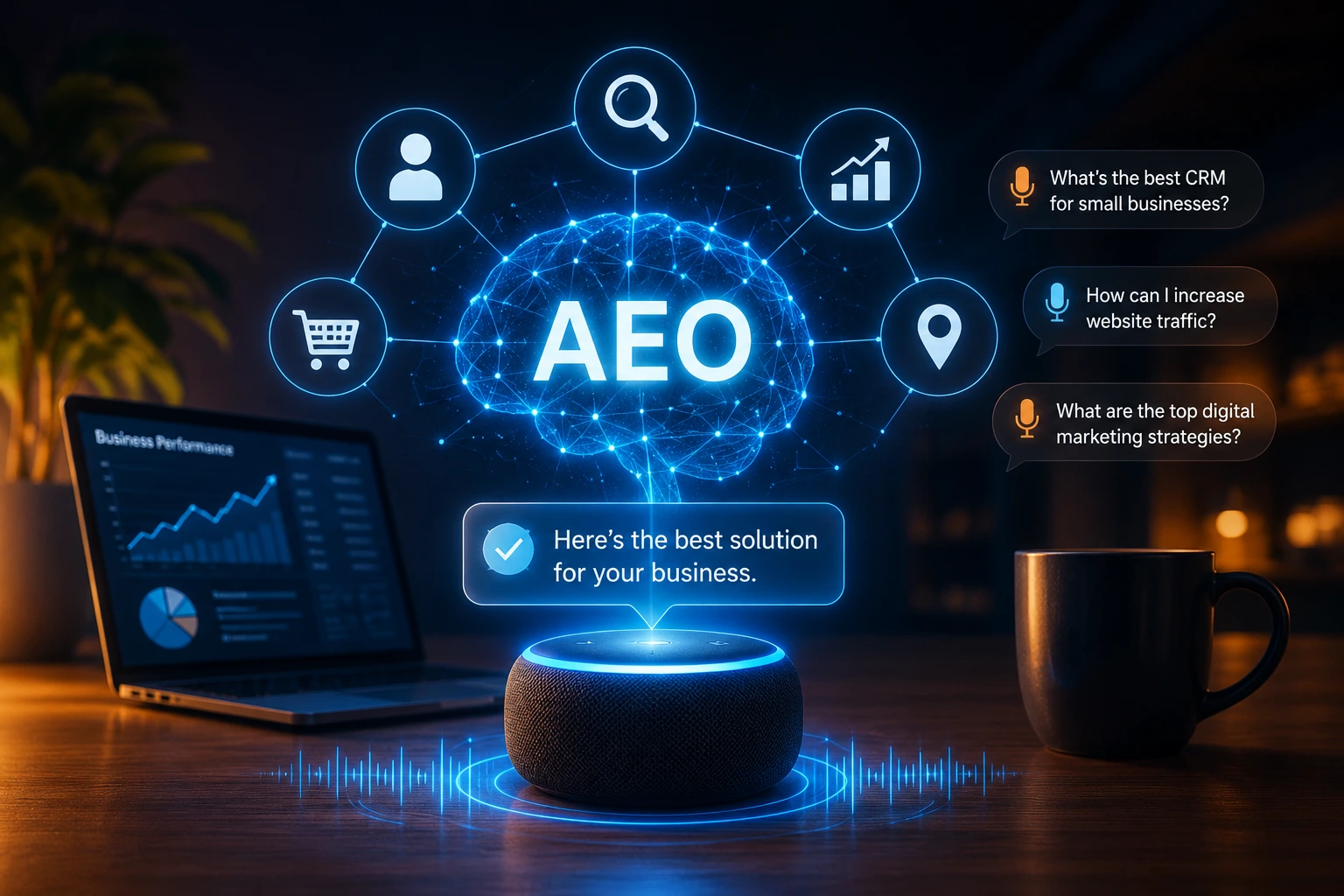
AEO is the process of making a business and its digital information easier for search engines and AI-powered answer systems to discover, understand, verify, retrieve, and use when responding to questions.

It does not mean abandoning traditional search engine optimization. In fact, SEO and AEO increasingly work together. Strong technical SEO, useful content, authoritative references, internal linking, accurate business information, structured data, and clear website architecture provide the foundation. AEO builds upon that foundation by paying particular attention to questions, entities, context, direct answers, citations, machine comprehension, and conversational search.

This guide explains AEO from the ground up. It is written for business owners, executives, marketers, attorneys, physicians, professional service firms, e-commerce companies, local businesses, and anyone else who wants to understand how AI is changing online discovery.

No computer science degree is required.

Table of Contents

What Is Answer Engine Optimization (AEO)?

Answer Engine Optimization, or AEO, is the practice of improving digital content so that search engines and AI-powered systems can more easily discover, understand, retrieve, verify, and potentially use it when answering a user’s question.

The easiest way to understand AEO is to think about the difference between being a search result and being part of an answer.

Traditional SEO might focus on a search such as:

Miami divorce attorney

AEO must also consider questions such as:

  • What type of attorney do I need for a high-net-worth divorce in Miami?
  • How is a business divided during a Florida divorce?
  • What should I ask a divorce attorney before hiring one?
  • How long does an uncontested divorce normally take in Florida?
  • What is the difference between contested and uncontested divorce?

The underlying customer may be the same. The way that customer searches is different.

When someone uses an AI assistant, the conversation can become even more specific:

“I own a business, have two investment properties, and have been married for 15 years. What should I look for when choosing a divorce attorney in Miami?”

That is dramatically different from optimizing a page around a two- or three-word keyword.

An effective AEO strategy therefore considers not only what people search for, but also what they ask, what they mean, what additional questions they are likely to have, and what information an answer system would need to respond confidently.

Businesses interested in professional implementation can learn more about Answer Engine Optimization services from Sky SEO Digital.

Why AEO Matters for Businesses

The fundamental purpose of digital marketing has not changed. Businesses want to be visible when potential customers are looking for something they provide.

What has changed is where that discovery happens and what the result looks like.

A prospective customer may discover a company through:

  • a traditional Google result;
  • a Google AI Overview;
  • Google AI Mode;
  • ChatGPT;
  • Microsoft Copilot;
  • Gemini;
  • Perplexity;
  • a voice assistant;
  • a map or local result;
  • a review platform;
  • a social platform;
  • or another AI-powered interface.

This means businesses increasingly have to think beyond the traditional search engine results page.

A Simple Example

Imagine that you own an air-conditioning company.

Historically, your SEO campaign might target:

  • AC repair Miami
  • Miami AC company
  • air conditioning repair near me

Those searches still matter.

But a homeowner could now ask:

“My AC is running but my house isn’t cooling. What could be wrong, and when should I call an HVAC company?”

A useful answer might discuss dirty filters, thermostat problems, frozen evaporator coils, refrigerant issues, blocked condensers, duct problems, and situations requiring a licensed professional.

A business whose website thoroughly and accurately explains those issues has created information that may be useful during the answer-generation process.

A business with a five-page website containing little more than sales language has given an answer engine far less information to work with.

Your website should not merely say that you are an expert. It should contain information that demonstrates your expertise.

To understand why AEO exists, it helps to understand how search has evolved.

The Early Search Era: Matching Words

Early search engines relied heavily on matching words appearing on a webpage with words entered into a search box.

If somebody searched for “Miami plumber,” a page that prominently used those words had a better chance of being considered relevant.

This contributed to primitive SEO tactics such as keyword stuffing:

“Looking for a Miami plumber? Our Miami plumbers provide Miami plumbing services for anyone needing a plumber in Miami.”

That sounds terrible to a human because it was often written more for algorithms than for people.

Search Engines Became Smarter

Over time, search engines became much better at understanding context, synonyms, relationships, quality, location, intent, authority, and meaning.

A page no longer needed to repeat the exact same keyword constantly. Search engines increasingly attempted to understand what the page was actually about.

The Rise of Direct Answers

Search also began moving beyond lists of links.

Featured snippets, knowledge panels, People Also Ask results, maps, product results, calculators, definitions, and other features allowed search engines to answer certain questions directly.

AEO did not suddenly appear with ChatGPT. The underlying shift toward answers had been developing for years.

The Conversational AI Era

Generative AI accelerated this shift dramatically.

Instead of searching:

best roofing material Florida

a homeowner can ask:

“I live in South Florida about five miles from the coast. Is a metal roof worth the extra cost compared with tile if I’m concerned about hurricanes, insurance, maintenance, and resale value?”

The question contains location, budget considerations, weather concerns, insurance concerns, maintenance concerns, and a comparison request.

The answer may require information from several sources.

This is the environment modern AEO is designed for.

AEO vs. SEO: What Is the Difference?

AEO and SEO overlap significantly, but they are not identical concepts.

SEO AEO
Focuses heavily on search engine visibility Focuses on visibility and usefulness within answer-driven experiences
Targets searches, topics, and keywords Places additional emphasis on questions, intent, topics, entities, and conversational queries
Often measures rankings, impressions, clicks, traffic, and conversions May also measure AI citations, mentions, answer visibility, referral traffic, and assisted conversions
Optimizes pages for discovery, relevance, and ranking Also considers how information can be understood, retrieved, verified, and used in answers
Uses technical SEO, content, links, and authority Uses many of the same foundations while emphasizing clarity, entities, answers, context, evidence, and machine comprehension

The mistake is treating the two as enemies.

AEO does not make SEO obsolete.

Strong technical SEO, content quality, authority, crawlability, indexability, and website architecture continue to provide an important foundation for visibility.

A useful way to think about the relationship is:

SEO helps make your information discoverable. AEO goes further by considering how easily that information can become useful within an answer.

Businesses should therefore avoid the false choice of “SEO or AEO.”

For most businesses, the better strategy is SEO + AEO.

Sky SEO Digital offers both SEO services and AEO services as part of a broader search visibility strategy.

AEO vs. GEO vs. AI SEO

One confusing part of the AI search industry is terminology.

You may encounter several phrases:

  • Answer Engine Optimization (AEO)
  • Generative Engine Optimization (GEO)
  • AI SEO
  • AI Search Optimization
  • LLM Optimization

There is significant overlap between these concepts, and terminology continues to evolve.

Answer Engine Optimization

AEO focuses on making information understandable, retrievable, authoritative, and useful for systems that answer questions.

Generative Engine Optimization

GEO is commonly used when discussing visibility specifically within generative AI experiences.

AI SEO

AI SEO is often used more broadly to describe search optimization in an environment where artificial intelligence increasingly influences search interfaces, content discovery, analysis, and results.

Does the Name Really Matter?

Not as much as the strategy.

A business does not benefit simply because an agency labels something “AEO,” “GEO,” or “AI SEO.”

The important questions are:

  • Can search engines crawl the website?
  • Can they understand what the business does?
  • Is the information accurate?
  • Does the site answer meaningful customer questions?
  • Does the content demonstrate real expertise?
  • Are important entities clearly defined?
  • Can important claims be verified?
  • Does the business have authority beyond its own website?
  • Is the content original and useful?
  • Are important pages internally connected?
  • Is structured data accurate?
  • Is business information consistent?

How AI-Powered Search Works in Plain English

You do not need to understand the mathematics behind artificial intelligence to understand the basic concept.

Think of an AI-powered answer system as a very fast researcher and writer.

A user asks a question.

The system may need to determine:

  • What is the person actually asking?
  • What information is needed?
  • What sources might contain that information?
  • Which information appears relevant?
  • Which information appears trustworthy?
  • Is the information current enough for the question?
  • How should the information be combined into an understandable response?

Different platforms handle this process differently, and their exact systems are proprietary and constantly evolving.

From a business owner’s perspective, however, the practical lesson is straightforward:

Your information needs to be discoverable, understandable, relevant, and credible before it has a realistic chance of contributing to an answer.

Retrieval, Grounding, and RAG

One term frequently encountered in discussions of AI search is retrieval-augmented generation, commonly abbreviated as RAG.

The name sounds complicated. The basic idea is not.

A Simple RAG Example

Suppose you ask an AI system:

“What are the current requirements for obtaining a particular professional license in Florida?”

An AI model’s previously learned information could be incomplete or outdated.

A retrieval system can instead look for relevant current information. That retrieved information can then help the system construct its response.

This process is often described as grounding an answer in external information.

For businesses, this concept matters because information published online has a better chance of being useful if it is:

  • accessible;
  • specific;
  • accurate;
  • well organized;
  • current;
  • easy to interpret;
  • supported by evidence where appropriate.

What Is Query Fan-Out?

An AI system may not treat a complex question as one simple search.

It can break the question into related searches, concepts, or subtopics.

Example

A user asks:

“What should I consider before installing an outdoor kitchen at my Miami home?”

That one question could involve many subtopics:

  • outdoor kitchen cost in Miami;
  • weather-resistant outdoor cabinets;
  • South Florida outdoor kitchen materials;
  • permitting requirements;
  • gas and electrical requirements;
  • hurricane considerations;
  • outdoor refrigeration;
  • covered versus uncovered kitchens;
  • maintenance near saltwater;
  • landscape integration;
  • resale value.

A website with one 400-word page saying “We build beautiful outdoor kitchens” cannot comprehensively support those information needs.

A business that has created authoritative resources addressing each major concern has a much richer information footprint.

This is why modern content strategies should focus on topics and customer journeys rather than isolated keywords.

Why Entities Matter in AEO

An entity is essentially a distinct person, place, organization, product, service, or concept that a system can identify.

For example:

  • Sky SEO Digital is an organization.
  • Miami is a place.
  • Answer Engine Optimization is a concept.
  • Google is an organization.
  • A particular attorney is a person.

Modern search is not simply about recognizing strings of words. Systems increasingly attempt to understand things and the relationships between those things.

For a business, that means your website should make basic facts unambiguous.

A search or answer system should ideally be able to determine:

  • who you are;
  • what your company is called;
  • what you do;
  • where you operate;
  • which services you provide;
  • who your experts are;
  • what topics you have expertise in;
  • how your pages relate to one another.

Weak Entity Information

“We are experts providing innovative solutions for clients.”

Stronger Entity Information

“ABC Engineering is a Miami-based structural engineering firm serving commercial property owners, condominium associations, developers, and contractors throughout South Florida.”

The second statement gives both a machine and a human far more context.

Authority, Trust, and Verification

A business can say almost anything about itself on its own website.

That is one reason third-party validation matters.

Imagine two fictional attorneys.

Attorney A

Attorney A’s website says:

“We are one of the most experienced law firms in Florida.”

But there is little information elsewhere supporting that statement.

Attorney B

Attorney B’s website contains a detailed biography, education, admissions, practice areas, published articles, case experience where ethically permissible, speaking appearances, professional memberships, interviews, and citations from reputable publications.

The broader web also contains consistent information about Attorney B.

Attorney B has created a much richer collection of signals that can potentially help systems understand who the attorney is and what the attorney knows.

This does not guarantee an AI recommendation. Nothing does.

But it illustrates an important AEO principle:

Authority is stronger when it can be corroborated.

How to Structure Content for Answer Engines

Good AEO content should also be good human content.

If a page is confusing to a person, making it machine-readable will not solve the underlying problem.

Useful content structure commonly includes:

  • a descriptive H1;
  • a concise introduction;
  • a direct definition when appropriate;
  • logical H2 and H3 headings;
  • focused paragraphs;
  • examples;
  • tables for comparisons;
  • bullets where they improve readability;
  • statistics with sources;
  • clear explanations of technical terms;
  • FAQs where useful;
  • internal links;
  • relevant external citations;
  • author information;
  • updated dates where relevant.

Notice that none of those practices require writing unnaturally for an algorithm.

The goal is clarity.

The Answer-First Content Model

One of the simplest AEO improvements is to stop making readers hunt for the answer.

Weak Version

A page titled “How Much Does Landscaping Cost in Miami?” begins with six paragraphs about the history of landscaping, Miami’s tropical climate, the importance of curb appeal, and how every property is unique.

The reader still does not know what landscaping costs.

Better Version

“Landscaping costs in Miami vary significantly depending on property size, plant selection, irrigation, hardscaping, site preparation, drainage, lighting, and design complexity. A small enhancement may cost several thousand dollars, while comprehensive landscape transformations can reach tens of thousands of dollars or more.”

The article can then explain the variables in detail.

This structure provides an immediate answer while preserving the nuance necessary for accuracy.

That is good for humans and good for answer-focused content.

Build Content Around the Questions Customers Actually Ask

AEO research should start with customers, not software.

Ask your sales team:

  • What questions do prospects ask repeatedly?
  • What confuses customers?
  • What objections delay a sale?
  • What do people compare?
  • What causes customers to choose one service over another?
  • What does someone need to know before requesting a quote?
  • What mistakes do customers make?

Your customer service team, receptionist, salespeople, attorneys, physicians, technicians, estimators, and account managers can provide extremely valuable content ideas.

Example: Cosmetic Dentist

Instead of publishing only a page targeting Miami veneers, the practice can build resources answering:

  • How much do veneers cost?
  • How long do veneers last?
  • Do veneers damage natural teeth?
  • Who is not a good candidate for veneers?
  • Porcelain veneers vs. composite bonding: which is better?
  • Can veneers stain?
  • What happens if a veneer breaks?
  • How many veneers do most people need?
  • Can you get veneers if you grind your teeth?

This creates a body of information around the actual decision the patient is trying to make.

Topical Depth: Become a Useful Resource, Not a Keyword Collection

Historically, some SEO strategies created a separate page for nearly every keyword variation.

That can produce dozens or hundreds of shallow pages.

A stronger modern approach is often to build comprehensive topical coverage.

Example: Bankruptcy Law Firm

A law firm focusing on bankruptcy could build an educational ecosystem covering:

  • Chapter 7 bankruptcy;
  • Chapter 11 bankruptcy;
  • Chapter 12 bankruptcy;
  • Chapter 13 bankruptcy;
  • bankruptcy eligibility;
  • means testing;
  • automatic stays;
  • foreclosure;
  • business debt;
  • personal guarantees;
  • credit consequences;
  • bankruptcy alternatives;
  • exempt assets;
  • frequently asked questions;
  • common misconceptions.

The goal is not to create pages merely because keywords exist.

The goal is to build a genuinely useful resource around the subject.

Why Original Information Matters More Than Ever

AI makes generic content incredibly inexpensive and fast to produce.

That changes the economics of content marketing.

If almost anybody can generate a generic article called “10 Benefits of Hiring a Personal Injury Attorney” in seconds, publishing another generic version provides little competitive advantage.

Businesses increasingly need information that cannot simply be reproduced from thousands of other websites.

Examples of Original Value

  • proprietary research;
  • original surveys;
  • real project examples;
  • expert commentary;
  • case studies;
  • before-and-after comparisons;
  • original photographs;
  • industry data;
  • firsthand observations;
  • pricing ranges based on real projects;
  • common mistakes your team actually encounters;
  • unique processes;
  • local knowledge;
  • original charts and calculations.

Businesses should ask themselves:

What information can we publish that another company cannot create simply by giving an AI tool the same generic prompt?

That question can dramatically improve a content strategy.

Real-World AEO Examples

The easiest way to understand AEO is through examples.

Example 1: Personal Injury Attorney

A traditional service page might target Miami car accident lawyer.

An AEO content ecosystem could also answer:

  • What should I do immediately after a car accident?
  • Should I speak to the other driver’s insurance company?
  • What happens if the other driver is uninsured?
  • How are car accident settlements calculated?
  • How long can a Florida car accident claim take?
  • What evidence should I preserve?
  • Can social media hurt an injury claim?

Example 2: Landscaping Company

A traditional page might target landscaping company Miami.

Supporting answer-focused resources could cover:

  • best plants for South Florida;
  • salt-tolerant landscaping;
  • low-maintenance tropical landscaping;
  • landscape installation costs;
  • irrigation requirements;
  • drainage problems;
  • privacy landscaping;
  • landscaping around pools;
  • hurricane-resistant landscape planning.

Example 3: CPA Firm

Instead of only targeting Miami CPA, the firm could explain:

  • LLC vs. S corporation tax considerations;
  • estimated tax payments;
  • business expense documentation;
  • tax planning for high-income professionals;
  • tax implications of selling a business;
  • what happens during an IRS audit;
  • common bookkeeping mistakes.

Example 4: E-Commerce Company

A company selling professional kitchen equipment could create:

  • product comparisons;
  • size guides;
  • installation guides;
  • maintenance instructions;
  • technical specifications;
  • compatibility information;
  • buying guides;
  • use-case recommendations;
  • troubleshooting resources.

The common theme is simple: teach customers enough to make an informed decision.

AEO for Local Businesses

Local AEO combines traditional local SEO fundamentals with answer-focused content and strong entity consistency.

A local business should make it exceptionally easy to determine:

  • business name;
  • location;
  • service area;
  • phone number;
  • hours;
  • services;
  • specialties;
  • credentials;
  • reviews;
  • relevant local expertise.

Businesses should keep important profile information accurate across major platforms.

Local Content Should Actually Be Local

Simply replacing city names is not meaningful localization.

A roofing company serving Miami could discuss:

  • South Florida weather;
  • hurricane preparation;
  • coastal conditions;
  • common local roofing materials;
  • insurance considerations;
  • local permitting considerations;
  • maintenance in hot, humid environments.

That is more useful than creating 30 nearly identical pages where only the city name changes.

AEO for Law Firms

Legal searches are particularly well suited to answer-focused content because prospective clients usually have questions before they know exactly what service they need.

Someone may not initially search for a specific legal practice area.

They might ask:

“My business partner emptied our company bank account. What can I do?”

or:

“My insurance company denied my property damage claim after a storm. What are my options?”

The individual is describing a problem rather than naming a legal service.

A law firm’s content should therefore address:

  • legal concepts;
  • common scenarios;
  • frequently asked questions;
  • potential options;
  • processes;
  • timelines;
  • terminology;
  • documents;
  • common mistakes;
  • when professional legal advice may be appropriate.

Because legal information can have significant consequences, accuracy, attorney review, jurisdictional clarity, and appropriate disclaimers are particularly important.

AEO for Medical and Healthcare Businesses

Healthcare searches also frequently begin with questions.

A prospective patient may ask:

  • What causes spider veins?
  • How long does Botox last?
  • What is the difference between Botox and Dysport?
  • How long does laser skin resurfacing take to heal?
  • Who is a candidate for dental implants?

Medical content should prioritize accuracy and patient safety over aggressive optimization.

Strong healthcare content can include:

  • provider credentials;
  • medical review;
  • clear explanations;
  • risks and limitations;
  • candidate considerations;
  • recovery expectations;
  • when medical evaluation is necessary;
  • credible medical sources.

AEO should never mean exaggerating medical claims simply to obtain visibility.

AEO for E-Commerce

E-commerce AEO is not limited to writing blog posts.

Product information itself matters.

A strong product page can clearly communicate:

  • what the product is;
  • who it is designed for;
  • dimensions;
  • materials;
  • features;
  • compatibility;
  • price;
  • availability;
  • shipping information;
  • returns;
  • warranty;
  • installation requirements;
  • maintenance;
  • frequently asked questions.

Think About Comparison Questions

Consumers frequently ask AI systems to compare products.

“Which range hood is better for a 36-inch gas cooktop in a modern kitchen with 10-foot ceilings?”

Answering that question requires much more than a product name.

Detailed product data and buying guidance give retrieval systems more useful information to work with.

AEO for B2B and Professional Service Companies

B2B buyers often conduct extensive research before speaking with a salesperson.

That makes educational content extremely important.

A B2B company should consider content around:

  • how its service works;
  • implementation;
  • pricing models;
  • integrations;
  • security;
  • ROI;
  • alternatives;
  • comparisons;
  • use cases;
  • industry-specific applications;
  • case studies;
  • common implementation problems.

The best B2B content helps someone evaluate a purchase rather than simply telling them to schedule a demo.

Technical AEO: Make Sure Machines Can Access the Information

Excellent content has limited value if important systems cannot reliably discover or access it.

Technical SEO therefore remains a major component of AEO.

Important considerations include:

  • crawlability;
  • indexability;
  • robots.txt configuration;
  • canonical URLs;
  • XML sitemaps;
  • internal linking;
  • HTTP status codes;
  • mobile usability;
  • page speed;
  • server reliability;
  • rendering;
  • structured data;
  • clean site architecture.

Do Not Hide Important Information

Critical information should generally exist in accessible text rather than only inside an image, video, animation, or interactive widget.

If your pricing explanation appears only inside an image, for example, it may be more difficult for machines to interpret consistently than if the information is also available as properly structured HTML text.

Do You Need an llms.txt File?

This topic has received considerable attention in AEO discussions.

Businesses should understand that there is no universal magic file that automatically makes a website appear in AI answers.

An llms.txt file should not be treated as a substitute for a technically sound website, high-quality content, strong authority, and clear information architecture.

Schema Markup and Structured Data

Structured data is machine-readable information added to webpages to help systems understand specific facts about the content.

Schema.org provides a widely used vocabulary for structured data.

Depending on the website, structured data can help describe:

  • organizations;
  • local businesses;
  • people;
  • articles;
  • products;
  • offers;
  • events;
  • videos;
  • breadcrumbs;
  • reviews;
  • and other information.

Schema Is Not a Magic AEO Button

Adding schema does not guarantee that ChatGPT, Google, Bing, Gemini, Copilot, Perplexity, or another system will cite or recommend your business.

Structured data should be viewed as a way of making legitimate information clearer, not as a way to manufacture authority.

The structured data should also accurately represent what users can see on the webpage.

Example

If a page identifies the organization, its address, its services, its author, the article publication date, and the updated date, appropriate structured data can reinforce that information in a machine-readable format.

The content itself still has to be useful.

Internal links connect one page of your website to another.

They help users discover related information and help search systems understand relationships between pages.

For example, an article discussing AEO naturally relates to traditional SEO services, local SEO, and the broader range of digital marketing services available from Sky SEO Digital.

Build Topic Relationships

A strong website may have:

  • a primary service page;
  • supporting guides;
  • FAQ resources;
  • case studies;
  • comparison articles;
  • industry pages;
  • location pages where justified.

These pages should not exist as isolated islands.

They should link naturally where the relationship is useful.

Use Descriptive Anchor Text

Instead of repeatedly writing click here, use descriptive language that explains what the linked resource contains.

For example, learn more about professional Answer Engine Optimization services.

External Authority, Citations, and Brand Mentions

Your website is only one part of your digital footprint.

Other websites can help establish context around your organization.

Depending on the business, meaningful third-party signals may include:

  • news coverage;
  • industry publications;
  • professional associations;
  • conference appearances;
  • podcasts;
  • directories;
  • academic references;
  • government records;
  • partner websites;
  • reviews;
  • reputable backlinks;
  • expert quotations.

Why Brand Mentions Matter

Imagine an AI system attempting to understand whether a company genuinely specializes in a particular field.

If the company’s own website says it does, that is one source of information.

If independent, reputable sources consistently associate that company with the same field, the entity can become easier to understand and corroborate.

This is one reason digital PR, legitimate link building, thought leadership, reputation management, and brand development increasingly intersect with AEO.

Content Freshness and AEO

Some information changes rapidly.

Examples include:

  • laws;
  • tax rules;
  • prices;
  • technology;
  • software features;
  • medical recommendations;
  • statistics;
  • product availability;
  • business hours;
  • industry regulations.

Old information can create problems for both users and answer engines.

Businesses should establish a content maintenance process.

A Content Refresh Should Do More Than Change the Date

Changing “2025” to “2026” does not make an article current.

A legitimate update may involve:

  • checking statistics;
  • reviewing external links;
  • confirming laws or regulations;
  • adding new examples;
  • removing outdated recommendations;
  • updating screenshots;
  • improving explanations;
  • adding newly relevant questions.

How Do You Measure AEO?

AEO measurement is more complicated than traditional rank tracking.

A conventional SEO report might show:

  • keyword rankings;
  • impressions;
  • clicks;
  • organic sessions;
  • conversions;
  • backlinks.

Those metrics remain valuable.

But AEO introduces additional questions.

AI Citation Visibility

Is your website being cited or referenced in relevant AI-generated responses?

Brand Mentions

Does your company appear when relevant questions are asked?

Competitive Share of Voice

Are competitors appearing more frequently than you for important questions?

Referral Traffic

Are AI platforms sending measurable visitors to your website?

Conversion Quality

Do visitors arriving from AI experiences convert into leads or customers?

Assisted Discovery

Did someone first learn about your brand through an AI answer and later search for the company directly?

This can be difficult to measure because discovery and conversion may occur across multiple platforms, devices, and sessions.

Do Not Rely on One “AEO Score”

AEO performance should be evaluated using multiple signals rather than a single proprietary score.

A useful reporting framework can combine:

  • traditional organic search performance;
  • AI citations;
  • AI referrals;
  • brand search growth;
  • competitive visibility;
  • leads;
  • revenue;
  • content performance.

Common AEO Mistakes

Mistake: Believing AEO Replaces SEO

AI-powered discovery still depends heavily on accessible web information, relevance, quality, authority, and technical foundations.

Ignoring SEO while pursuing AEO is like building a second floor without finishing the foundation.

Mistake: Publishing Hundreds of Generic AI Articles

More content does not automatically create more authority.

Publishing hundreds of shallow articles can create duplication, quality problems, weak topical focus, and a poor experience for visitors.

Mistake: Writing Only for Bots

If your content sounds robotic, repetitive, unnatural, or stuffed with questions simply because you think AI systems want them, the strategy is backwards.

The goal is to make content easier to understand, not less human.

Mistake: Assuming Schema Guarantees AI Visibility

It does not.

Mistake: Ignoring Brand Authority

Technical optimization cannot manufacture genuine expertise.

Mistake: Making Unsupported Claims

Statements such as “the #1 company,” “the best attorney,” or “the leading provider” should not be treated as objective facts without legitimate support.

Mistake: Creating Fake FAQs

FAQ sections should answer questions people actually have.

Do not add dozens of nearly identical questions simply to make a page longer.

Mistake: Chasing Every New AEO Trick

The AI search industry moves quickly, and new theories appear constantly.

Before rebuilding your website around a new tactic, ask:

  • Is this supported by credible evidence or official documentation?
  • Does it improve the website for users?
  • Does it make information clearer?
  • Does it strengthen accessibility or authority?
  • Would this still be useful if AI search changed tomorrow?

A Practical AEO Strategy for Businesses

A sustainable AEO campaign should be systematic rather than based on isolated tricks.

Start With an AEO and SEO Audit

Evaluate:

  • technical health;
  • crawlability;
  • indexation;
  • site architecture;
  • existing rankings;
  • AI visibility;
  • brand mentions;
  • structured data;
  • content quality;
  • content gaps;
  • competitor visibility;
  • local signals;
  • authority signals.

Define the Business Entity Clearly

Make sure important pages consistently explain:

  • who the business is;
  • what it does;
  • where it operates;
  • who works there;
  • what those people specialize in;
  • how to contact the business.

Map Customer Questions

Create a database of questions from:

  • sales calls;
  • emails;
  • customer service;
  • search data;
  • People Also Ask;
  • forums;
  • reviews;
  • competitor research;
  • AI conversations;
  • industry publications.

Group Questions by Intent

Intent Example
Definition What is AEO?
Comparison AEO vs. SEO
Cost How much does AEO cost?
Process How does AEO work?
Evaluation How do I choose an AEO agency?
Troubleshooting Why isn’t my business appearing in AI answers?
Local Who provides AEO services in Miami?
Commercial What should I look for in an AEO agency?

Create Pillar Resources

Develop authoritative pages covering important topics comprehensively.

Create Supporting Content

Use focused articles to explore specific questions in greater detail.

Strengthen Internal Links

Connect related information logically.

Add Original Expertise

Interview the people inside the business. Ask them what customers misunderstand, what unusual situations they encounter, and what experience has taught them.

Strengthen External Authority

Pursue legitimate coverage, links, mentions, partnerships, speaking opportunities, reviews, and thought leadership.

Measure and Improve

AEO is not a one-time website edit.

Search systems change. Competitors change. Customer questions change. Your business changes.

Optimization should therefore be continuous.

A 90-Day AEO Roadmap

Days 1–30: Build the Foundation

During the first month, focus on understanding the current situation.

  • Complete a technical SEO audit.
  • Review crawl and indexing issues.
  • Audit existing structured data.
  • Identify core business entities.
  • Review important service pages.
  • Evaluate author and expert information.
  • Benchmark traditional search visibility.
  • Benchmark AI visibility.
  • Research competitors.
  • Build a customer-question database.
  • Identify content gaps.

Days 31–60: Improve and Expand

The second month can focus on implementation.

  • Improve core service pages.
  • Add direct answers to important questions.
  • Improve heading structure.
  • Add useful tables and comparisons.
  • Strengthen internal linking.
  • Add or correct appropriate structured data.
  • Improve author information.
  • Publish high-priority supporting resources.
  • Update outdated content.
  • Strengthen local business information where applicable.

Days 61–90: Build Authority and Measure

The third month can expand beyond on-site optimization.

  • Promote original research or expert resources.
  • Pursue relevant digital PR.
  • Earn authoritative links and mentions.
  • Monitor citations and brand visibility.
  • Review search and analytics data.
  • Compare visibility against competitors.
  • Identify new questions.
  • Refresh weak pages.
  • Plan the next content cluster.

Businesses that need help implementing these steps can request an AEO and SEO consultation with Sky SEO Digital.

The Future of AEO

The exact interfaces people use to search will continue changing.

What is less likely to change is the underlying need for trustworthy information.

Whether a person uses Google, ChatGPT, Copilot, Gemini, Perplexity, a voice assistant, an AI agent, or a platform that has not yet been invented, the system still needs information from somewhere.

Businesses that create clear, authoritative, accessible, useful, and verifiable information are building digital assets that can remain valuable across multiple discovery channels.

Search Is Becoming More Conversational

Users can increasingly refine searches through conversation.

A search journey might look like:

“What is AEO?”

“How is that different from SEO?”

“Does a law firm need both?”

“What would an agency actually do?”

“How long does it take?”

“How would I measure whether it works?”

Each question builds upon the previous one.

This means businesses should understand entire customer decision journeys, not just isolated search phrases.

AI Agents Could Change Commercial Search Further

AI systems are also moving beyond simply providing information toward helping users perform tasks.

Over time, that may include more assistance with:

  • researching companies;
  • comparing products;
  • checking availability;
  • requesting information;
  • planning purchases;
  • making appointments;
  • completing transactions.

Businesses therefore need increasingly structured, accurate, accessible digital information.

Brand May Become Even More Important

When dozens of websites publish nearly identical generic information, recognizable expertise becomes a differentiator.

This is why AEO should not be viewed solely as a technical marketing tactic.

It intersects with:

  • SEO;
  • content marketing;
  • public relations;
  • branding;
  • reputation management;
  • user experience;
  • technical web development;
  • subject-matter expertise.

The businesses best positioned for AI search will likely be those that combine these disciplines rather than searching for a single shortcut.

Frequently Asked Questions About AEO

What does AEO stand for?

AEO stands for Answer Engine Optimization. It refers to optimizing digital information so search engines and AI-powered answer systems can more easily discover, understand, retrieve, and potentially use it when answering user questions.

What is Answer Engine Optimization?

Answer Engine Optimization is a digital marketing discipline focused on improving a brand’s visibility and usefulness in answer-oriented search experiences. It can include content structure, technical SEO, entity clarity, authority building, structured data, question-focused content, citations, internal linking, and other practices that make information easier for machines and people to understand.

Is AEO the same as SEO?

No. AEO and SEO overlap substantially, but they emphasize different aspects of search visibility. SEO traditionally focuses on improving visibility within search engines. AEO places additional emphasis on making information suitable for answer-driven and conversational search experiences. Businesses generally should use them together rather than choosing one or the other.

Does AEO replace SEO?

No. Traditional SEO remains an important foundation for online discovery. Crawlability, indexability, useful content, technical performance, links, authority, and relevance continue to matter.

What is the difference between AEO and GEO?

AEO generally refers to Answer Engine Optimization, while GEO refers to Generative Engine Optimization. The terms overlap significantly. GEO is often used specifically for generative AI visibility, while AEO can encompass a broader range of systems that provide direct answers.

Can AEO help my business appear in ChatGPT?

AEO can improve the clarity, accessibility, authority, and usefulness of your digital information, which may improve your overall readiness for AI-driven discovery. However, no legitimate agency can guarantee that ChatGPT or another AI system will cite or recommend a particular business for a particular question.

Can AEO help with Google AI Overviews?

Many AEO practices overlap with good search optimization: useful original content, crawlability, accessible text, internal linking, accurate structured data, strong website architecture, authority, and current information.

Do I need special AI schema?

There is no universal “AI schema” that guarantees inclusion in AI-generated answers. Appropriate structured data can help machines understand legitimate information, but markup should accurately represent the visible content and should not be viewed as a shortcut to authority.

Do I need an llms.txt file for AEO?

An llms.txt file should not be treated as a universal requirement for AEO. The broader priority should be making important website information crawlable, accessible, accurate, well structured, and authoritative.

How long does AEO take?

There is no universal timeline. Results depend on the website’s existing authority, technical condition, content quality, competition, industry, crawl frequency, brand recognition, and the platforms being measured. AEO should generally be treated as an ongoing strategy rather than a one-time project.

How do you measure AEO?

AEO measurement can include AI citations, brand mentions, referral traffic from AI platforms, traditional search performance, conversions, cited pages, competitive visibility, and share of voice for important questions.

Does blogging help AEO?

It can, but simply publishing blog posts is not enough. Content should address genuine customer questions, provide original value, demonstrate expertise, connect logically with core services, and contribute to broader topical depth.

Are FAQs good for AEO?

FAQs can be useful because they present real questions and direct answers in a clear format. However, they should be written for users rather than added merely as an optimization trick.

Are backlinks important for AEO?

Links remain important for discovery and authority in traditional search, while legitimate third-party references can also help establish a business’s broader digital presence. AEO strategies should focus on earning relevant, trustworthy mentions and links rather than manipulating link counts.

Can a small business benefit from AEO?

Yes. Small businesses can benefit because many customer questions are highly specific, local, and tied to firsthand expertise. A smaller business may possess valuable practical knowledge that larger competitors have never published.

Is AEO only for technology companies?

No. AEO can apply to law firms, doctors, dentists, contractors, landscapers, accountants, financial professionals, hotels, restaurants, manufacturers, e-commerce businesses, real estate companies, consultants, and many other industries.

Can AI-generated content be used for AEO?

AI can assist with research, organization, ideation, analysis, and drafting, but businesses should not assume that mass-producing generic AI content will create authority. Human expertise, editorial review, factual accuracy, originality, and genuine usefulness remain important.

What is the most important part of AEO?

There is no single factor. Strong AEO combines technical accessibility, clear content, subject expertise, entity consistency, authority, original value, accurate information, internal linking, and an understanding of the questions customers actually ask.

Should my company invest in SEO or AEO?

For most businesses, the answer is both. AEO works best when supported by a strong SEO foundation. Search and AI discovery increasingly overlap, so separating the two completely can create unnecessary gaps.

AEO Glossary: Important Terms Explained in Plain English

AEO — Answer Engine Optimization

The practice of optimizing digital information to improve its usefulness and visibility within systems that answer user questions directly.

AI Overview

An AI-generated response Google may display for certain searches, often alongside links or sources that allow users to explore the topic further.

AI Mode

A conversational, AI-powered Google search experience designed to help users explore more complex questions and follow-up queries.

AI Search

A broad term for search experiences that use artificial intelligence to interpret questions, retrieve information, summarize sources, or generate responses.

Algorithm

A set of rules or computational processes used to perform a task. Search engines use many algorithms and systems to determine what information to retrieve and display.

Anchor Text

The clickable words used in a hyperlink.

Backlink

A link from another website to your website.

Brand Mention

A reference to a company or brand on another website or digital platform, whether or not the reference contains a clickable link.

Canonical URL

The preferred version of a webpage when multiple URLs contain identical or very similar information.

Citation

A reference to a source used to support information. In AI search, citations may appear as links or source references accompanying generated answers.

Content Cluster

A collection of related pages that comprehensively cover a broader topic.

Conversational Search

A search experience where users ask questions naturally and may continue with follow-up questions.

Crawler

Software used by search systems to discover and access webpages.

Crawlability

The ability of a search crawler to access and navigate a website.

E-E-A-T

An acronym used in SEO discussions for Experience, Expertise, Authoritativeness, and Trust. It is useful as a framework for thinking about content quality and credibility.

Entity

A distinct person, organization, location, product, service, or concept that a system can identify and understand.

Featured Snippet

A search result format that prominently displays information from a webpage to help answer a searcher’s question.

Generative AI

Artificial intelligence capable of generating new content such as text, images, audio, video, or code.

GEO — Generative Engine Optimization

A term used for strategies designed to improve visibility within generative AI-powered search and answer experiences.

Grounding

The process of connecting an AI-generated response to external information or sources to improve accuracy, relevance, or freshness.

Grounding Query

A query used by an AI or retrieval system to find information that may help support an answer.

Indexability

The ability of a webpage to be included in a search engine’s index.

Internal Link

A link connecting one page of a website to another page on the same website.

Intent

The underlying goal behind a search or question.

Knowledge Graph

A structured representation of entities and relationships between them.

Large Language Model (LLM)

A type of AI model trained to understand and generate language.

LLM Optimization

An informal term sometimes used for improving how a business or its information can be understood or surfaced by large language model-powered systems.

llms.txt

A proposed text-file convention intended to provide information to certain AI systems. It should not be confused with robots.txt.

Long-Tail Query

A relatively specific search phrase or question, often reflecting detailed user intent.

Machine-Readable

Information formatted so computer systems can interpret its structure more easily.

Natural Language Query

A search phrased similarly to how a person would naturally speak or write.

Query Fan-Out

A technique in which a system generates multiple related searches or subqueries to gather information needed to address a more complex question.

RAG — Retrieval-Augmented Generation

A technique that combines information retrieval with generative AI so a response can incorporate relevant external information.

robots.txt

A file website owners can use to communicate crawl-access instructions to compliant web crawlers.

Schema Markup

Structured data vocabulary used to describe entities and information on webpages in machine-readable form.

Search Intent

The reason behind a search—for example, learning something, comparing options, finding a local business, or making a purchase.

SEO — Search Engine Optimization

The practice of improving a website’s visibility within organic search results.

SERP — Search Engine Results Page

The page of results displayed by a search engine after a user performs a search.

Structured Data

Standardized machine-readable information that describes specific elements of a webpage.

Topical Authority

A commonly used SEO concept describing the depth, credibility, and breadth of a website’s coverage of a particular subject.

XML Sitemap

A file listing important URLs that can help search engines discover a website’s pages.

Key Takeaways for Business Owners

  • AEO does not replace SEO. Strong SEO remains an important foundation for online visibility.
  • Optimize for questions, not just keywords. Customers increasingly search conversationally.
  • Answer questions clearly. Do not bury useful information beneath unnecessary introductions.
  • Demonstrate expertise. Saying you are an expert is not the same as publishing expert information.
  • Create original value. Generic content is increasingly easy for everyone to produce.
  • Make your business easy to understand. Clearly define who you are, what you do, where you operate, and who your experts are.
  • Build authority beyond your website. Legitimate third-party mentions, links, citations, reviews, and media coverage strengthen your broader digital presence.
  • Use structured data appropriately. Schema can improve machine understanding, but it is not a magic AI-ranking tool.
  • Keep important information current. Outdated information is less useful to users and answer systems.
  • Measure more than rankings. Look at citations, mentions, referrals, conversions, organic performance, and competitive visibility.
  • Avoid shortcuts. Mass-producing generic AI content is not a sustainable AEO strategy.
  • Think about the entire customer journey. The person asking “What is this?” today may ask “Who should I hire?” tomorrow.

AEO Is About Becoming the Best Answer

The transition from traditional search to AI-assisted discovery can make AEO sound highly technical.

Some of it is technical.

But the central idea is surprisingly simple.

Understand what your customers want to know, publish genuinely useful answers, make those answers easy to find and understand, demonstrate why your business is credible, and build enough authority that your information can be trusted.

That approach works for humans.

It works for traditional search engines.

And it provides a strong foundation for an internet increasingly organized around AI-generated answers.

The businesses that succeed in this environment will probably not be the ones that discover one secret schema tag or publish the largest number of AI-generated articles.

They will be the businesses that consistently provide some of the clearest, most useful, most trustworthy information in their markets.

That is ultimately what Answer Engine Optimization is about.

Want to Know How Visible Your Business Is in AI Search?

Sky SEO Digital helps businesses combine traditional SEO with Answer Engine Optimization strategies designed for the changing search landscape.

Our approach examines your website’s technical foundation, content, authority, entity signals, structured data, traditional search performance, and visibility across emerging AI-powered discovery experiences.

Learn more about our AEO services, explore our complete digital marketing services, or contact Sky SEO Digital to discuss your website.

Sources and Further Reading

The following authoritative resources provide additional background on AI-powered search, SEO, structured data, crawling, and search optimization:

AI-powered search is evolving rapidly. Platform capabilities, reporting, crawler behavior, documentation, and terminology can change. Businesses should periodically review official documentation from Google, Microsoft, OpenAI, and other relevant platforms rather than relying solely on older AEO recommendations.
Posted in AEO

Google August 2026 Spam Update: What Website Owners Need to Know

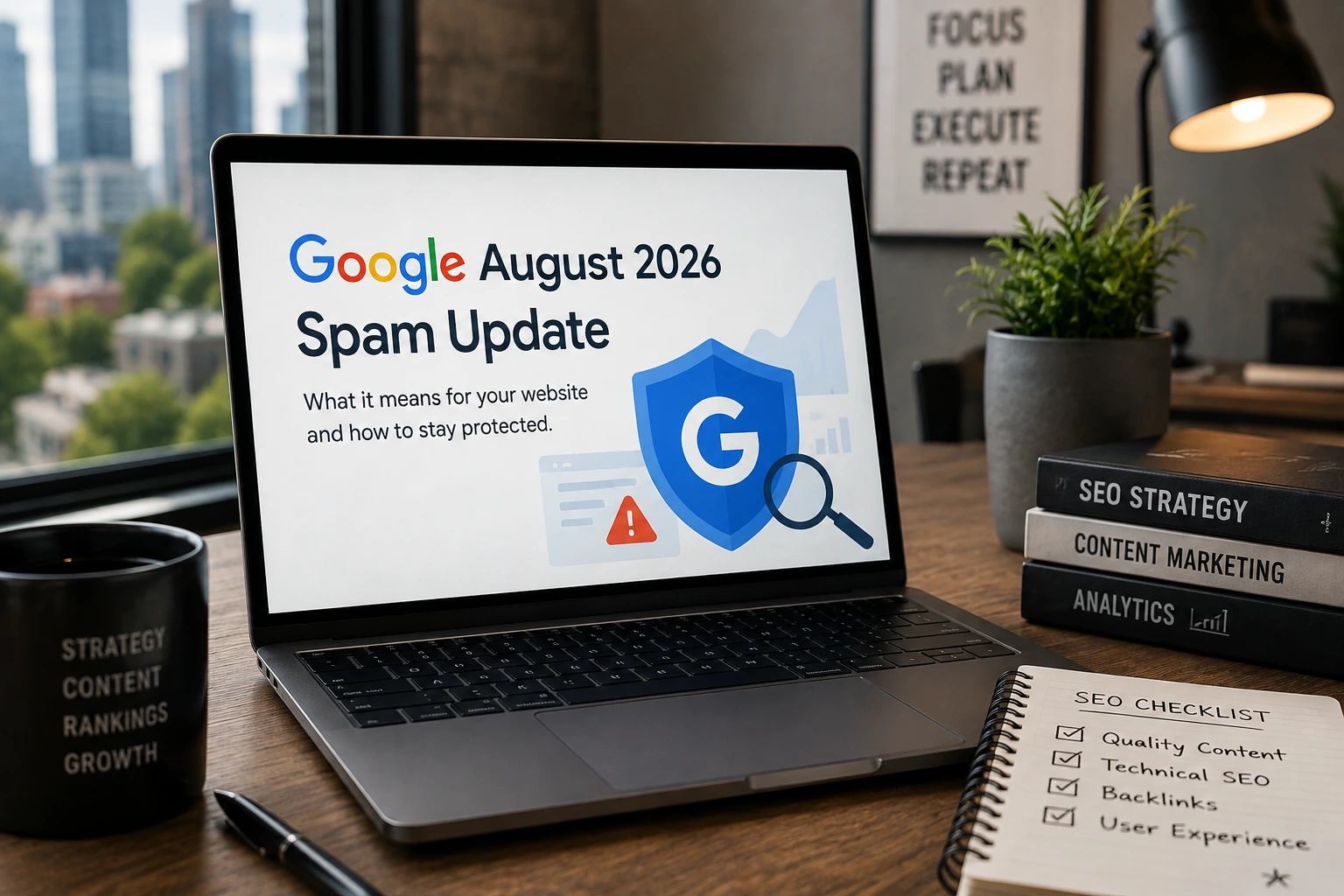
Google has officially launched its August 2026 spam update, another major effort to improve the quality of its search results and reduce the visibility of websites that violate Google’s spam policies.

The update began rolling out on August 18, 2026. According to Google, it applies globally and across all languages, with the rollout expected to take several days to complete.

If you own a business, manage a website, or work in SEO, you may be wondering what this means for your rankings. The short answer: don’t panic over every ranking fluctuation. But this is a good time to make sure your SEO strategy is built around useful content, legitimate authority, a technically sound website, and sustainable optimization rather than shortcuts designed primarily to manipulate rankings.

Google August 2026 Spam Update: Quick Summary

  • Launch date: August 18, 2026
  • Type: Google Search spam update
  • Scope: Global
  • Languages: All languages
  • Rollout: Expected to take several days
  • Primary purpose: Improve Google’s ability to identify and reduce search spam
  • What businesses should do: Monitor Search Console and analytics, review Google’s spam policies, and avoid making rushed changes while the update is still rolling out.

The key takeaway: The August 2026 spam update is not simply another broad algorithm change. It is specifically related to Google’s systems for detecting search spam. Websites relying on manipulative SEO practices therefore have more reason for concern than sites consistently publishing useful, original content and following Google’s guidelines.

What Is the Google August 2026 Spam Update?

Google’s search systems are constantly working to identify spam. However, Google occasionally makes what it considers notable improvements to these systems. Google refers to these changes as spam updates.

On August 18, Google announced the August 2026 spam update. Google stated that the update applies to all languages and locations and that its rollout could take a few days.

That distinction is important. This isn’t necessarily Google changing what makes a page relevant for a particular keyword. Instead, the update is intended to improve Google’s ability to recognize websites, pages, or tactics that violate its search spam policies.

Google has not announced that one specific spam tactic is the exclusive target of this update. That means website owners should be careful about headlines claiming that the update is specifically an “AI content update,” “link update,” or anything similarly narrow unless Google provides additional information.

How Google’s Spam Updates Work

Google uses automated systems to detect search spam on an ongoing basis. A spam update generally represents an improvement to those systems.

Google explains that sites affected by a spam update should review its spam policies to determine whether their website may be violating them. Importantly, recovery isn’t necessarily immediate.

Google’s systems may need time to recognize that a website is no longer engaging in spammy behavior. That makes sustainable SEO especially important. Fixing a questionable tactic today doesn’t necessarily mean rankings will bounce back tomorrow.

This is one reason businesses should think about SEO as a long-term marketing channel rather than a series of tricks designed to temporarily move rankings.

What Types of SEO Practices Could Put a Website at Risk?

Google maintains detailed spam policies covering practices that can result in pages or entire websites ranking lower or disappearing from search results.

Examples of practices addressed by Google’s spam policies include:

  • Cloaking
  • Doorway abuse
  • Expired domain abuse
  • Hacked content
  • Hidden text and hidden links
  • Keyword stuffing
  • Link spam
  • Machine-generated traffic
  • Misleading functionality
  • Scaled content abuse
  • Scraping
  • Site reputation abuse
  • Sneaky redirects

Not every website that experiences a ranking decline during the August update is necessarily guilty of one of these practices. Search rankings move for many reasons, and volatility can occur while an update is rolling out.

The better approach is to diagnose the website based on evidence rather than assuming that every traffic decline is a penalty.

August 2026 Spam Update Risk Chart

The following chart provides a practical framework for evaluating common SEO strategies. These ratings are intended as a general guide based on Google’s published spam policies rather than as a prediction of which individual sites the August update will affect.

SEO Practice General Risk Recommended Action
Original, expert-led content Low Continue improving depth, accuracy, and usefulness.
Helpful AI-assisted content with human review Low to Moderate Make sure content provides genuine value rather than simply increasing publishing volume.
Large volumes of thin or repetitive pages High Consolidate, improve, remove, or noindex pages that don’t serve a meaningful purpose.
Keyword stuffing High Rewrite copy naturally around topics, entities, questions, and search intent.
Manipulative link building High Focus on legitimate editorial mentions, PR, partnerships, and authoritative resources.
Copied or lightly rewritten content High Add original expertise, research, examples, analysis, and first-hand information.
Strong technical SEO and structured content Low Maintain crawlability, indexing, schema, internal linking, and site performance.

Is Google Targeting AI-Generated Content?

This will probably be one of the biggest questions surrounding the August 2026 spam update.

Google’s announcement does not say that the August update specifically targets AI-generated content.

The more important issue is why and how content is being created. Google’s spam policies address scaled content abuse, which can involve generating large amounts of content primarily to manipulate search rankings rather than help users.

That distinction matters in 2026 because AI is now part of many legitimate content workflows. Using AI to assist with research, outlines, organization, editing, or content production does not automatically make a page spam.

The danger comes when businesses use automation as a shortcut to publish hundreds or thousands of low-value pages without meaningful editorial review, expertise, originality, or purpose.

A simple question to ask is:

Would we still publish this page if Google didn’t exist?

If the answer is no, the page deserves a closer look.

SEO and AEO Are Becoming Increasingly Connected

The August spam update is also a reminder that businesses shouldn’t optimize exclusively for traditional blue-link rankings anymore.

People increasingly discover brands and information through Google AI experiences and answer engines. That makes Answer Engine Optimization (AEO) an important extension of traditional SEO.

A strong SEO and AEO page should make its information easy for both people and machines to understand. That generally means using descriptive headings, concise answers to common questions, logical page structure, relevant internal links, reliable sources, clear entity relationships, and appropriate structured data.

At Sky SEO Digital, our SEO strategy increasingly combines traditional search optimization with AEO and AI search visibility. The goal isn’t simply to rank for keywords. It’s to make businesses easier to discover, understand, trust, and cite across the evolving search ecosystem.

What Should You Do During the August 2026 Spam Update?

If your rankings are moving right now, avoid immediately rewriting half your website. The update is still rolling out, which means search results may continue changing until Google finishes deployment.

Instead, use this period to establish a baseline.

1. Check Google Search Console

Look at clicks, impressions, average positions, queries, and landing pages. Compare recent performance with previous periods, but remember that short-term changes don’t necessarily establish a trend.

2. Check Analytics

Search Console tells you what’s happening in Google Search. Analytics can help determine whether those changes are translating into meaningful differences in organic sessions, leads, calls, purchases, or other conversions.

3. Identify Page-Level Patterns

Don’t look only at total organic traffic.

Ask:

  • Did the entire website decline?
  • Did one section decline?
  • Were blog posts affected more than service pages?
  • Did pages targeting similar keywords move together?
  • Did traffic decline while conversions remained stable?
  • Did competitors move up as your pages moved down?

These patterns can tell you much more than a single sitewide percentage.

4. Review Google’s Spam Policies

If your site experienced a significant decline that lines up with the update, conduct an objective review against Google’s published spam policies.

Pay particular attention to scalable tactics. A few mediocre pages might simply need improvement. Hundreds or thousands of near-duplicate pages created mainly to capture keyword variations can represent a much bigger structural issue.

5. Don’t Make Panic Changes

Algorithm updates often create volatility. Making major changes before an update finishes can make it harder to determine what actually caused the movement.

Document what happened, identify obvious problems, and make deliberate improvements rather than reacting emotionally to daily ranking changes.

How to Build an SEO Strategy That Is More Resilient to Spam Updates

No legitimate SEO company can guarantee that a website will never lose rankings. Search is competitive, algorithms evolve, competitors improve, and user behavior changes.

What businesses can do is reduce unnecessary risk.

Create Content With a Real Purpose

Every important page should solve a problem, answer a question, explain a service, demonstrate expertise, or help someone make a decision.

Don’t create 100 pages simply because a keyword tool produced 100 phrases.

Add Information Competitors Can’t Easily Replicate

Originality is increasingly valuable.

This might include:

  • First-hand experience
  • Case studies
  • Original photography
  • Expert commentary
  • Customer questions
  • Industry-specific examples
  • Original research or data
  • Before-and-after results
  • Detailed explanations based on actual experience

These elements don’t just make a page more useful. They also make it much harder for competitors to reproduce your content with a prompt and a few clicks.

Build Authority Naturally

Links still matter, but the objective shouldn’t be accumulating as many links as possible.

Digital PR, legitimate media coverage, partnerships, professional associations, useful resources, industry publications, and genuinely noteworthy business activities can create authority without relying on obviously manipulative link schemes.

Strengthen Your Internal Linking

Internal links help users discover related information and help search engines understand relationships between pages.

Build topic clusters in which service pages, supporting articles, FAQs, case studies, and related resources naturally reinforce one another.

Think Beyond Traditional Google Rankings

Search behavior is changing quickly. Businesses should think about visibility across traditional Google results, AI-powered Google experiences, ChatGPT, Gemini, and other answer platforms.

This doesn’t mean abandoning SEO. It means expanding it.

SEO establishes the technical foundation, relevance, content, and authority. AEO builds on that foundation by making information easier for answer engines to extract, interpret, and potentially cite.

Did Your Traffic Drop? Don’t Automatically Blame the Spam Update

Timing alone doesn’t prove causation.

A website can lose traffic during a Google update because competitors improved, search demand changed, SERP layouts changed, rankings shifted for unrelated reasons, tracking broke, pages became deindexed, technical problems developed, or reporting data became inaccurate.

That last point is particularly relevant this month. Google recently confirmed a Search Console reporting issue affecting Generative AI performance data beginning around August 13. That was described as a reporting issue rather than an actual Search ranking problem.

In other words, diagnose before you optimize.

What Does the August Spam Update Mean for Businesses?

For most legitimate businesses, the August 2026 spam update shouldn’t trigger a complete change in strategy.

If you’ve been investing in original content, good technical SEO, legitimate authority building, useful service pages, strong local signals, structured information, and a positive user experience, keep moving in that direction.

If your SEO strategy depends heavily on mass-produced pages, aggressive link schemes, copied content, keyword stuffing, or other tactics primarily intended to manipulate rankings, this update is another reason to reconsider that approach.

The broader direction of search is becoming clear: sustainable visibility requires more than figuring out what an algorithm wants. Businesses need to become genuinely useful and authoritative sources within their industries.

That’s good SEO, and increasingly, it’s good AEO too.

Google August 2026 Spam Update FAQs

When did the Google August 2026 spam update start?

Google announced that the August 2026 spam update began rolling out on August 18, 2026.

How long will the August 2026 spam update take?

Google said the rollout may take a few days to complete. Rankings may therefore fluctuate while the update is being deployed.

Is the August 2026 spam update global?

Yes. Google stated that the update applies globally and to all languages.

Does the August 2026 spam update target AI content?

Google has not said that this update specifically targets AI-generated content. The more important issue is whether content or other SEO tactics violate Google’s spam policies. Scaled content created primarily to manipulate search rankings can be problematic regardless of whether it was produced manually, with AI, or through another form of automation.

What should I do if my rankings dropped after the update?

First, avoid making major changes based on a day or two of volatility. Wait for the rollout to settle, review Google Search Console and analytics, identify which pages and queries were affected, and compare your website against Google’s spam policies. Then make evidence-based improvements.

Can a website recover from a Google spam update?

Yes, recovery can be possible when the underlying issues are corrected, but it may take time. Google’s systems need to recognize that spammy practices have been addressed, so businesses should not expect every correction to produce an immediate ranking recovery.

How can I protect my website from future Google spam updates?

There is no way to guarantee rankings, but you can reduce risk by following Google’s spam policies, publishing useful and original content, maintaining strong technical SEO, earning legitimate authority, avoiding manipulative link tactics, and focusing on users rather than search-engine loopholes.

Sources

For additional information about the August 2026 spam update and Google’s search policies, see:

Need Help Evaluating Your SEO After the Update?

If your organic traffic or rankings changed during the August 2026 spam update, don’t assume the solution is simply publishing more content or building more links.

A proper SEO review should look at your content quality, technical SEO, backlink profile, search intent, competitors, site structure, internal linking, structured data, and visibility across both traditional and AI-powered search.

Learn more about Sky SEO Digital’s SEO and AEO services and how we help businesses build sustainable organic and AI search visibility.

Why Your Website Needs to Be Optimized for Both Search Engines and AI

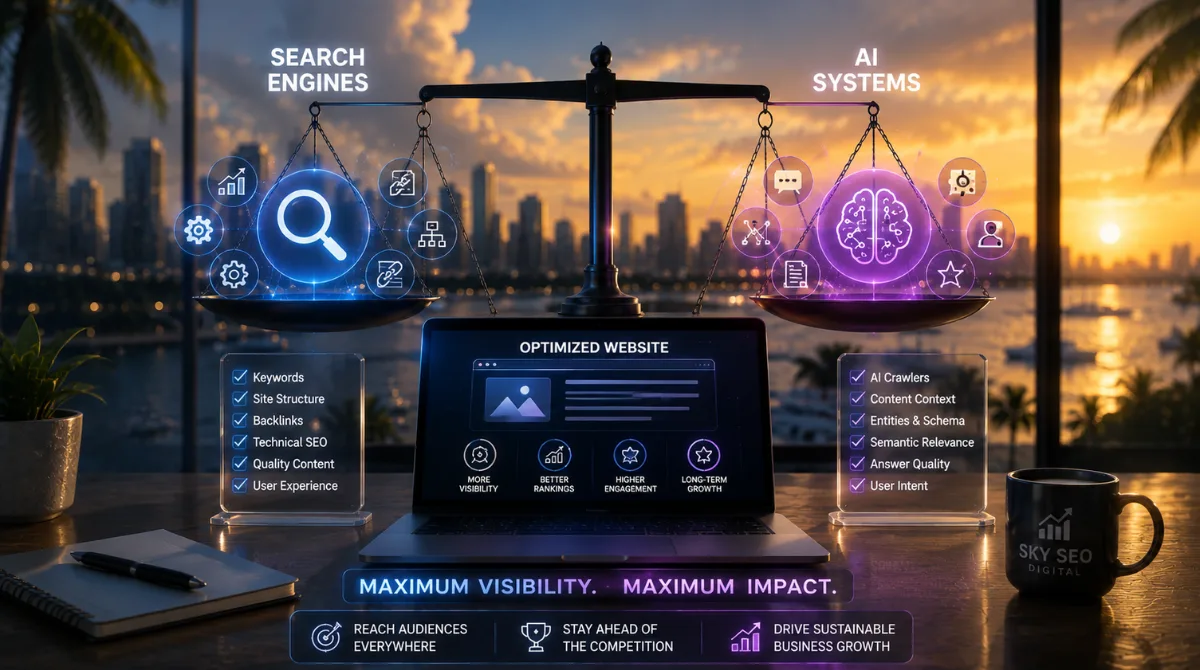
Relying on your website to perform only in traditional Google search is no longer enough. SEO and AI optimization work together to make your website easier to discover, understand, and trust across both search engines and AI-powered search platforms.

As Google expands AI-driven search features and tools such as ChatGPT increasingly help users find information online, businesses need a broader digital visibility strategy. Strong keyword targeting still matters, but it should be supported by helpful content, solid technical SEO, clear website structure, relevant entities, and credible authority signals that help both people and AI systems understand what your business offers.

Why Traditional SEO Still Matters

AI-powered search is changing how people discover information, but it does not replace traditional SEO. Search engines still need to crawl, render, understand, and index your website before they can determine where and when your content should appear.

That makes a strong SEO foundation essential. Technical SEO, useful and relevant content, descriptive page titles, logical internal linking, website performance, and authoritative backlinks all contribute to making your site accessible and understandable to search engines.

Google also emphasizes creating helpful, reliable, people-first content and using relevant language in clear, descriptive areas of a page. For businesses targeting customers in Miami and South Florida, effective SEO goes beyond adding location keywords. Your content should reflect local search intent, the services you provide, the areas you serve, and the questions your potential customers actually ask.

In other words, AI optimization works best when it is built on a solid SEO foundation. If you want to strengthen that foundation, explore Sky SEO Digital’s SEO services to learn how a comprehensive SEO strategy can improve your website’s visibility.

Why AI Search Changes the Optimization Equation

AI-powered search experiences interpret questions conversationally. Instead of searching only for “Miami SEO agency,” a user might ask:

“Which SEO agency in Miami is experienced with AI search for a local business?”

The underlying goal is different. The system has to identify entities, understand relationships, evaluate relevance, and potentially synthesize information from multiple sources.

That is where AEO, GEO, semantic SEO, and entity optimization become useful complements to traditional SEO.

Google’s current guidance for AI search emphasizes many of the same fundamentals as conventional Search: original, valuable content, strong page experience, and making content accessible to crawling and indexing systems. 

SEO vs. AI Optimization: What’s the Difference?

Traditional SEOAI Search Optimization
Targets search queries and rankingsTargets understanding, retrieval, and answers
Focuses heavily on keywords and pagesFocuses on entities, context, meaning, and clear answers
Builds organic visibilityBuilds visibility across AI-assisted search experiences
Uses technical SEO and linksAdds structured content, entity clarity, and answer-focused information

The important point is that these approaches overlap rather than compete.

A technically strong, authoritative website with useful content gives both search engines and AI systems better material to interpret.

What Should You Optimize?

1. Make Your Content Clear and Comprehensive

Write pages that directly answer the questions your customers actually have.

Instead of creating separate thin pages for every keyword variation, build useful resources around topics and related questions. Include definitions, examples, limitations, comparisons, and practical next steps where appropriate.

Google recommends people-first content that demonstrates expertise and provides substantial value rather than content created primarily to manipulate rankings.

2. Strengthen E-E-A-T Signals

AI systems and search engines need trustworthy information.

Show who created your content, demonstrate relevant experience, cite credible sources when appropriate, maintain accurate business information, and make your organization easy to understand.

E-E-A-T stands for experience, expertise, authoritativeness, and trustworthiness. Google notes that E-E-A-T is not itself a single ranking factor, but its systems use signals associated with high-quality, trustworthy content. Developers

3. Use Structured Data and Entity Signals

Structured data can help Google understand the content and entities represented on a page and can make pages eligible for certain rich search features.

That does not mean schema markup guarantees an AI citation or rich result. It means you’re giving search systems clearer machine-readable context.

Your organization, people, services, locations, articles, and relationships should also be represented consistently across your website and reputable external sources.

4. Keep Technical SEO Strong

AI optimization cannot compensate for a website that search systems struggle to access.

Check:

  • Crawlability and indexability
  • Internal linking
  • XML sitemaps
  • Mobile usability
  • Page performance
  • Canonicalization
  • Structured data
  • Robots directives
  • Clear site architecture

For ChatGPT Search specifically, OpenAI says websites should allow OAI-SearchBot to crawl their content if they want their site to be available for consideration in search results. There is no guaranteed placement.

5. Build Topical and Brand Authority

One excellent article rarely establishes authority.

Create a connected content ecosystem covering your core services, customer questions, industry terminology, use cases, and related topics. Link those resources together logically.

For example, a Miami business could connect pages about local SEO, technical SEO, AI search, AEO, content strategy, and conversion optimization rather than treating each subject as an isolated keyword.

Common Mistakes to Avoid

Keyword stuffing: Repeating phrases does not create topical authority.

Mass-producing AI content: Google warns that generating many pages with AI without adding value can violate its spam policies. 

Ignoring technical SEO: Great content cannot help as much if important pages cannot be properly crawled or indexed.

Chasing AI citations: No legitimate strategy can guarantee that ChatGPT, Google AI Overviews, or another system will cite your website.

Writing for machines instead of people: The strongest approach is still useful, original content created primarily to satisfy the user’s need.

A Better Website Strategy for 2026

In 2026, your website should be more than a collection of pages designed to rank for individual keywords. Think of it as a trusted source of information that helps search engines, AI systems, and potential customers understand your business.

Start with a technically accessible website, then build useful, original content around the topics and questions that matter to your audience. Make your business, services, expertise, and relationships between related topics clear. At the same time, strengthen your authority through credible information, relevant mentions, and a consistent online presence.

Your measurement strategy should evolve, too. Look beyond traditional organic rankings and traffic to understand how your content performs across emerging AI-powered search experiences.

Google has also introduced reporting in Search Console to help eligible site owners understand performance from certain generative AI search features, giving businesses another way to evaluate their visibility as search continues to evolve.

Ultimately, successful search optimization starts with the right people and strategy behind it. 

Building a Unified SEO and AI Search Strategy

The future of search is not SEO versus AI. It is a unified visibility strategy where technical SEO, helpful content, entity understanding, authority, and AI-search readiness reinforce one another.

If your website was built only to rank for keywords, now is a good time to evaluate whether it is also easy for AI-driven search systems to understand and trust.

For a practical assessment of your website’s organic and AI-search visibility, contact Sky SEO Digital for a strategy consultation.

FAQs

What is AI search optimization?

AI search optimization is the process of making website content easier for AI-powered search systems to discover, understand, evaluate, and use when answering user questions. It complements traditional SEO rather than replacing it.

Is traditional SEO still important for AI search?

Yes. Technical SEO, crawlability, indexability, relevant content, internal links, and authority remain important foundations. Google explicitly says its guidance for AI search builds on established Search fundamentals. 

What is the difference between AEO and SEO?

SEO generally focuses on improving visibility in search engines, while Answer Engine Optimization focuses more specifically on making information useful and understandable for answer-oriented search experiences. In practice, the two strategies share many foundational techniques.

Does schema markup help with AI search?

Structured data can help search systems understand information on a page and can support eligibility for certain Google search features. However, schema markup does not guarantee rankings, AI citations, or inclusion in a particular search feature.

Can AI-generated content hurt SEO?

AI-assisted content is not automatically harmful. The risk comes from producing low-quality, unoriginal, or mass-generated pages without meaningful value; Google recommends prioritizing accuracy, quality, relevance, and people-first content.

How can I make my website more visible in ChatGPT Search?

Make your site accessible to OAI-SearchBot, publish reliable and useful information, maintain strong technical SEO, and establish clear authority around your subject. OpenAI states that there is no way to guarantee top placement in ChatGPT Search.

Building Future-Ready Websites With AI and Modern Development

A website can look modern today and still become a liability tomorrow. Slow performance, rigid architecture, weak SEO foundations, inaccessible interfaces, and AI-unfriendly content can make an expensive redesign necessary sooner than expected.

AI-powered web development takes a different approach: build a website that is useful to people now while creating a technical and content foundation that can adapt as search, technology, and customer expectations evolve.

Google’s current guidance reinforces this principle. AI search still depends on foundational SEO, crawlability, indexable content, good page experience, and clear site structure – not a special “AI ranking” trick.

What Makes a Website Future-Ready?

A future-ready website combines responsive design, fast performance, secure technology, clear content, and logical internal linking. It should be easy for users and search engines to navigate while remaining flexible enough to support future features.

Key elements include:

  • Mobile-friendly, responsive design
  • Fast, efficient code
  • Clear information architecture and internal linking
  • Secure integrations and APIs
  • Structured data that matches visible content
  • Content focused on real user questions
  • SEO-friendly, crawlable pages

A strong web design and SEO foundation helps create a website that performs well today and can adapt to future changes.

How AI Changes Modern Website Development

AI is valuable during development, but it should support – not replace – engineering judgment.

Developers can use AI to accelerate tasks such as code exploration, documentation, prototyping, testing, content organization, and repetitive development work. The finished implementation still needs human review for security, accessibility, performance, maintainability, and business requirements.

AI also changes how websites should present information.

Search systems increasingly handle conversational and complex queries. That makes clear definitions, descriptive headings, entity relationships, concise answers, and well-organized supporting content valuable beyond traditional keyword targeting.

Google’s guidance for generative AI search emphasizes unique, useful content, clear organization, crawlability, semantic HTML, JavaScript SEO, and strong page experience.

Build for Users First, Then Optimize for Search

A common mistake is designing a website around search engines first and visitors second.

A better process is:

Traditional approachFuture-ready approach
Design first, SEO laterPlan UX, content, and SEO together
Add keywords to existing pagesBuild pages around user needs and entities
Treat AI as an add-onMake content clear and machine-understandable
Optimize only before launchMeasure, test, and improve continuously

For businesses in Miami, this also means connecting technical foundations with local relevance. Location pages, service information, business details, reviews, and locally meaningful content should support the customer journey rather than exist simply to target geographic keywords.

Sky SEO Digital’s existing approach combines web design with SEO, AEO, local SEO, and technical considerations, making this integrated model particularly relevant for businesses planning a new digital presence.

Technical Foundations That Matter

Performance

A beautiful website that takes too long to become usable can undermine the experience. Optimize images, limit unnecessary scripts, use efficient hosting and caching strategies, and monitor real-world performance.

Accessibility

Accessibility should be part of development from the beginning. Clear headings, keyboard navigation, adequate contrast, meaningful labels, descriptive links, and usable forms benefit both people and the broader quality of the site.

SEO Architecture

Search engines need to discover, render, understand, and index important pages. Clean URLs, crawlable navigation, canonicalization, XML sitemaps, internal links, descriptive metadata, and appropriate structured data form the foundation.

Content Architecture

Don’t make every page compete for the same topic. Build a logical relationship between core service pages, supporting resources, FAQs, location information, and deeper topical content.

This creates a website that communicates what the business does, who it serves, where it operates, and why it deserves trust.

Where AI Should – and Shouldn’t – Be Used

AI can be useful for accelerating development, but “AI-built” should never mean “unchecked.”

Use AI to assist with:

  • Prototyping and brainstorming
  • Code explanations and documentation
  • Test-case generation
  • Content outlines and information organization
  • Repetitive development tasks

Be cautious about:

  • Publishing unreviewed AI-generated content
  • Copying AI-generated code without security review
  • Creating large numbers of low-value pages
  • Replacing user research with generic AI assumptions
  • Adding AI features simply because they sound innovative

Google states that generative AI can be useful, but producing many pages with little added value can violate its scaled-content-abuse policies. Quality, accuracy, relevance, and originality remain essential.

Common Future-Ready Development Mistakes

Starting with technology instead of the business problem. The newest framework is not automatically the right solution.

Ignoring content during development. Developers need to understand what information the website must communicate before templates and components are finalized.

Treating SEO as a post-launch task. Changing URLs, navigation, templates, and page structures after launch can create avoidable technical problems.

Overbuilding AI functionality. An AI chatbot is not inherently valuable. If customers need clearer service information or a simpler conversion path, solve that problem first.

Forgetting maintainability. A website should be easy for the business and development team to update months or years after launch.

A Practical Future-Ready Roadmap

Start with business objectives, audience needs, conversions, and content requirements. Then map the site’s entities, information architecture, technical stack, integrations, accessibility requirements, and SEO structure.

Before launch, test:

  • Mobile usability and accessibility
  • Core Web Vitals and page performance
  • Internal links and crawlability
  • Forms, integrations, and conversion paths
  • Metadata, canonicals, sitemap, and robots directives
  • Structured data against visible page content

After launch, monitor performance, search visibility, conversions, technical errors, and user behavior. A future-ready website is maintained and improved, not simply launched and forgotten.

How to Build a Website Ready for the Future

The future-ready website is not necessarily the one with the most AI features. It is the one built around strong fundamentals, adaptable technology, useful content, excellent user experience, and measurable business goals.

If your current website is difficult to scale, slow to maintain, or not prepared for modern search behavior, start with an audit rather than another cosmetic redesign. Contact Sky SEO Digital to discuss your website and digital growth goals.

FAQs

What is a future-ready website?

A future-ready website combines flexible development, strong performance, accessibility, SEO-friendly architecture, and useful content. It is designed to adapt as business requirements, technology, and search behavior change.

How does AI help with website development?

AI can assist developers with prototyping, code analysis, documentation, testing, and repetitive tasks. Human review remains essential for security, accessibility, performance, and maintainability.

Should AI be built into every modern website?

No. AI should solve a genuine customer or business problem rather than being added for novelty. A faster site, clearer navigation, or better conversion path may create more value than an unnecessary AI feature.

Is technical SEO important for AI search?

Yes. Google says its AI search experiences continue to rely on foundational SEO requirements such as crawlability, indexability, accessible content, internal linking, and good page experience.

How can a website be optimized for AI search?

Create original, useful content with clear structure and recognizable entities, while maintaining strong technical SEO. There is no separate markup or guaranteed optimization that makes a website appear in Google’s AI features.

When should SEO be considered during a website redesign?

SEO should be considered during planning, before the site’s architecture and URLs are finalized. Integrating SEO early helps protect existing visibility while creating a stronger structure for future growth.

Are ChatGPT Ads Worth It? Pros, Cons, Costs & Budget Guide

Quick Answer: ChatGPT ads can be worth testing for businesses that want to reach potential customers while they are actively researching products, services, and solutions. Unlike traditional display advertising, ChatGPT can potentially place an advertiser in the context of a highly relevant conversation. However, ChatGPT advertising is still relatively new, which means advertisers should approach it as an experimental channel rather than immediately shifting large portions of their Google Ads or Meta Ads budgets.

For many small and midsize businesses, a reasonable starting point is approximately $2,500 to $5,000 per month. Companies with larger lead-generation budgets may want to test $5,000 to $15,000 per month while comparing cost per lead, customer acquisition cost, conversion rate, and lead quality against established channels.

What Are ChatGPT Ads?

ChatGPT ads are sponsored placements that allow businesses to reach users inside ChatGPT. OpenAI began testing advertising in the United States in 2026, initially displaying clearly labeled sponsored placements to eligible users on certain ChatGPT plans.

The important difference between ChatGPT advertising and traditional display advertising is context and intent. Someone asking an AI assistant to compare products, research companies, evaluate services, or solve a specific problem may already be relatively far along in the decision-making process.

For example, someone searching Google for “Miami landscaping” clearly has potential commercial intent. But a ChatGPT user might ask:

  • “What should I look for when hiring a landscaping company in Miami?”
  • “How much does a complete landscape redesign cost?”
  • “What are the best landscaping options for a waterfront home?”
  • “How do I choose between three landscaping companies?”

These longer conversational queries can reveal significantly more context about what a prospective customer actually wants.

Are ChatGPT Ads Worth It?

Potentially, yes—but businesses should test them before making ChatGPT a major advertising channel.

ChatGPT ads are particularly interesting for advertisers because they can reach consumers during the research and decision-making process. Instead of simply interrupting someone browsing a website or scrolling through social media, an advertiser may be presented when the user’s conversation is relevant to the advertiser’s product or service.

That could make ChatGPT especially valuable for industries where customers conduct considerable research before making a decision, including legal services, healthcare, financial services, home services, SaaS, travel, education, professional services, and higher-consideration consumer products.

However, ChatGPT advertising is still much newer than Google Ads or Meta Ads. Businesses should therefore evaluate performance based on measurable results rather than assuming that AI advertising will automatically produce cheaper leads.

Pros and Cons of ChatGPT Advertising

Advantages Disadvantages
Potential access to high-intent users Still a relatively new advertising platform
Ads can be contextually related to conversations Less historical performance data than Google or Meta
Opportunity to reach consumers during research Costs and competition can change quickly
Early-mover opportunity for advertisers Campaign optimization is still evolving
Potential alternative to increasingly competitive search ads Available audience may be smaller than mature ad platforms

What Are the Biggest Advantages of ChatGPT Ads?

1. Users May Have Strong Commercial Intent

ChatGPT users frequently ask detailed questions before making decisions. These conversations can indicate much more than a short keyword search.

A person asking about the cost, advantages, disadvantages, alternatives, reviews, or differences between products may be demonstrating genuine purchase intent.

2. Context Could Make Advertising More Relevant

Traditional advertising platforms rely heavily on keywords, demographics, interests, browsing activity, or audience signals. Conversational AI introduces another signal: the context of the current conversation.

This creates the possibility of matching an advertiser with someone actively discussing a closely related problem or purchase.

3. There Is an Early-Mover Advantage

Google Ads has existed for decades. Many valuable keywords are extremely competitive. The same applies to Meta advertising in popular industries.

ChatGPT represents a newer advertising environment. Businesses that begin testing early can learn what messages, landing pages, offers, and targeting strategies work before the platform becomes more mature and potentially more competitive.

4. CPC Advertising Makes Testing Easier

ChatGPT advertising has expanded beyond its initial impression-focused model to include cost-per-click buying. CPC advertising can make the platform easier for performance marketers to evaluate because advertisers can compare the cost of traffic and conversions with Google, Microsoft, Meta, LinkedIn, and other channels.

5. ChatGPT Could Become an Important Discovery Platform

Consumer discovery is changing. People increasingly use AI assistants to research questions that previously would have required several individual Google searches.

That makes ChatGPT advertising interesting not simply as another display advertising channel, but as a potential way to reach customers during AI-assisted discovery.

What Are the Disadvantages of ChatGPT Ads?

1. The Platform Is Still New

This is arguably the biggest drawback. Google and Meta provide advertisers with years of historical benchmarks, mature optimization systems, extensive targeting options, and enormous advertising ecosystems.

ChatGPT advertising does not yet have the same history.

2. Performance Benchmarks Are Limited

There is not yet a universal “good ChatGPT Ads conversion rate” or “average ChatGPT Ads cost per lead” that applies across industries.

Results can vary substantially according to industry, offer, targeting, competition, landing page quality, location, and campaign objective.

3. Early Pricing Has Changed Quickly

Early reports indicated that ChatGPT advertising initially commanded premium CPM pricing. As the platform expanded, reported CPMs declined and CPC buying became available.

That is good news for advertisers, but it also illustrates how quickly pricing and campaign mechanics can change on a new advertising platform.

4. Google Ads May Still Be Better for Immediate Demand

If someone searches “personal injury lawyer near me,” “emergency plumber,” or “dentist open today,” Google Search remains extremely powerful because the intent is obvious and immediate.

ChatGPT may be particularly compelling earlier in the research process, where consumers are comparing solutions, asking questions, and deciding what they should do next.

How Much Do ChatGPT Ads Cost?

There is no single price that every advertiser will pay. ChatGPT advertising costs depend on the campaign, bidding method, competition, audience, and available inventory.

Early industry reports in 2026 indicated CPM pricing ranging from roughly $25 to $60 per 1,000 impressions during different stages of the rollout. Early reports surrounding CPC campaigns have cited approximately $3 to $5 per click in some cases.

These figures should be viewed as early market indicators rather than guaranteed advertising rates. As more advertisers enter the platform, actual costs will continue to fluctuate.

What Is a Good Budget for ChatGPT Ads?

The right budget depends on the advertiser’s size, customer value, industry, and existing marketing spend. Instead of asking how little you can spend, the better question is: How much do we need to spend to collect enough data to make a reasonable decision?

Suggested Monthly ChatGPT Ads Test Budgets

Small/Local Business — $2,500–$5,000

Established SMB — $5,000–$10,000

Aggressive Lead Generation — $10,000–$15,000

Large Advertiser — $15,000+

Illustrative recommended test budgets, not OpenAI-required minimums or guaranteed performance levels.

For many small and midsize companies, $2,500 to $5,000 per month is a reasonable experimental starting point. Businesses already spending tens of thousands of dollars per month across Google and Meta may want to allocate $5,000 to $15,000 or more to obtain meaningful comparative data faster.

How Should You Test ChatGPT Ads?

ChatGPT should initially receive a portion of an existing experimental advertising budget rather than replacing proven campaigns.

For example, a company spending $30,000 per month on digital advertising might allocate:

  • $15,000 to Google Ads
  • $8,000 to Meta Ads
  • $4,000 to ChatGPT Ads
  • $3,000 to remarketing and other experimental channels

The company can then evaluate ChatGPT based on actual business outcomes.

Which ChatGPT Ads Metrics Matter Most?

Clicks are useful, but clicks alone do not determine whether advertising is profitable. Businesses should monitor the entire customer acquisition funnel.

  • Cost per click (CPC): How much does each visitor cost?
  • Click-through rate (CTR): How frequently do users engage with the ad?
  • Conversion rate: What percentage of visitors become leads or customers?
  • Cost per lead (CPL): How much advertising spend is required to generate a lead?
  • Customer acquisition cost (CAC): What does it actually cost to acquire a customer?
  • Lead quality: Are ChatGPT leads qualified?
  • Revenue: How much revenue comes from the campaign?
  • ROAS: How much revenue is generated for every advertising dollar spent?

ChatGPT Ads vs. Google Ads

ChatGPT advertising should not necessarily be viewed as a replacement for Google Ads.

Google Search excels at capturing existing demand. Someone searching for a specific service, product, or company is explicitly telling Google what they want.

ChatGPT has the potential to reach consumers during a different part of the journey: research, education, comparison, evaluation, and decision-making.

For many businesses, the best strategy may eventually involve both platforms.

ChatGPT Ads vs. Meta Ads

Meta advertising is particularly effective at generating demand through Facebook and Instagram. Advertisers can reach consumers who were not necessarily searching for their product when the advertisement appeared.

ChatGPT occupies an interesting position between social advertising and search advertising. The user may not have entered a traditional search keyword, but the conversation can still reveal strong interest in a specific topic, problem, product, or service.

Who Should Consider Advertising on ChatGPT?

ChatGPT advertising may be especially attractive for businesses where customers typically conduct research before making a purchase.

  • Law firms
  • Home service companies
  • Financial services companies
  • Travel and hospitality businesses
  • SaaS companies
  • B2B service providers
  • Education companies
  • E-commerce brands
  • Technology companies
  • High-consideration consumer services

Companies with high customer lifetime values may be able to tolerate higher CPCs if ChatGPT produces better-qualified prospects.

Who Should Wait Before Investing Heavily?

Businesses with extremely small advertising budgets should generally be more cautious. If your entire advertising budget is $1,000 per month, dividing that money among Google, Meta, ChatGPT, and several other platforms may prevent any campaign from gathering enough data.

In that situation, it may make more sense to concentrate spending on the channel already producing measurable results and test ChatGPT once additional budget becomes available.

Are ChatGPT Ads the Same as AEO?

No. ChatGPT advertising and Answer Engine Optimization (AEO) are different strategies.

ChatGPT ads are paid placements. AEO involves structuring, improving, and distributing content so that AI systems and answer engines can better understand a business, its expertise, its products, and its services.

Businesses should consider pursuing both paid and organic AI visibility. The situation is similar to Google: companies can invest in Google Ads while simultaneously investing in SEO.

Can Businesses Advertise on ChatGPT Now?

Yes. OpenAI has expanded access to ChatGPT advertising and provides an Ads Manager where eligible advertisers can create and manage campaigns. Availability, campaign options, markets, targeting, and advertising policies may continue to change as the platform develops.

Frequently Asked Questions About ChatGPT Ads

Are ChatGPT ads worth the money?

ChatGPT ads may be worth testing for businesses that can accurately measure leads, sales, and customer acquisition costs. Because the platform is still developing, advertisers should compare ChatGPT performance directly against existing channels rather than assuming it will automatically outperform Google or Meta.

How much should I spend on ChatGPT ads?

A small or midsize business could consider starting with approximately $2,500 to $5,000 per month. Larger advertisers may test $5,000 to $15,000 or more depending on their customer acquisition goals and existing advertising budget.

How much does a ChatGPT ad cost?

Costs vary. Early 2026 industry reports cited CPM pricing of approximately $25 to $60 during different stages of the rollout, while some early CPC reports cited approximately $3 to $5 per click. Actual pricing depends on the advertising auction and campaign conditions.

Are ChatGPT ads better than Google Ads?

Not necessarily. Google Ads is extremely effective for capturing explicit search demand. ChatGPT advertising may provide a different opportunity by reaching users while they research, compare, and evaluate potential solutions.

Can local businesses advertise on ChatGPT?

ChatGPT advertising could be useful for local businesses, particularly companies offering higher-value services. However, local advertisers should carefully evaluate geographic targeting, lead volume, lead quality, and customer acquisition costs.

Will ChatGPT ads affect organic AI recommendations?

OpenAI states that advertisements are separate from ChatGPT’s organic answers. Sponsored content is labeled as advertising rather than being presented as an organic recommendation.

Should I move money from Google Ads to ChatGPT Ads?

Usually not immediately. A better approach is to allocate a smaller experimental budget to ChatGPT, measure performance, and gradually increase spending if the platform produces competitive customer acquisition costs and high-quality leads.

The Bottom Line: Should You Try ChatGPT Ads?

ChatGPT advertising is one of the more interesting new digital advertising opportunities because it combines conversational AI with commercial discovery.

But “new” does not automatically mean “better.”

Businesses should treat ChatGPT as a measurable acquisition channel. Start with a controlled budget, build dedicated landing pages, implement conversion tracking, measure lead quality, and compare customer acquisition costs with Google Ads, Meta Ads, Microsoft Ads, and organic search.

If ChatGPT generates qualified customers at an acceptable acquisition cost, increase the budget. If it does not, reduce spending and continue monitoring the platform as its advertising ecosystem matures.

The businesses that benefit most from ChatGPT advertising may not necessarily be the ones that spend the most. They may be the companies that begin testing early, collect reliable data, understand how consumers behave inside conversational search, and continuously optimize both their paid advertising and organic AEO strategies.

Posted in AI

Why Miami Businesses Need an AI-Ready SEO Strategy

Traditional Google rankings alone may no longer be enough for Miami businesses navigating today’s evolving search landscape.

An AI-ready SEO strategy helps your website stay discoverable as customers increasingly turn to AI-powered search experiences to research businesses, compare options, and find answers. Google has stated that its AI features continue to rely on core Search systems and established SEO fundamentals rather than a separate set of secret ranking requirements.

For Miami companies, the opportunity extends beyond ranking for individual keywords. Your brand needs to be clear, credible, locally relevant, technically accessible, and genuinely useful so it can be surfaced across a wider range of search experiences.

What Does “AI-Ready SEO” Actually Mean?

AI-ready SEO is not simply adding AI-generated blog posts to your website. It combines traditional SEO with content, technical, entity, and local signals that help search systems understand your business and its expertise.

A strong strategy typically includes Technical SEO, covering crawlability, indexation, site structure, internal linking, and page experience. Entity SEO provides clear information about your business, services, locations, people, and areas of expertise, while Semantic SEO organizes content around topics, relationships, entities, and user needs rather than isolated keywords. 

AEO focuses on clear, useful answers designed for conversational search experiences, while Local SEO strengthens business information, location relevance, reviews, and local authority. Content Marketing supports original content built around first-hand expertise and information that adds something beyond generic summaries.

Google specifically recommends valuable, non-commodity content and warns against creating large volumes of low-value pages primarily to manipulate AI search visibility.

Why Miami Businesses Have More to Gain

Miami isn’t a single, uniform search market. Someone looking for a service in Brickell may have very different needs from a customer in Coral Gables, Miami Beach, Doral, or elsewhere in Miami-Dade County. That makes local context a critical part of an effective SEO strategy.

Google says local search results are primarily influenced by relevance, distance, and prominence. Keeping your Google Business Profile accurate and complete also helps Google better understand your business and determine when it is relevant to local searches.

For an AI-ready local SEO strategy, the connection should be clear:

Business → Service → Expertise → Location → Customer Need

Consider a Miami real estate company. Instead of creating a generic page targeting “real estate services,” it could publish genuinely useful content addressing local buyer questions, neighborhood differences, property types, financing considerations, and the company’s first-hand market expertise.

This approach gives customers more useful information while giving search engines and AI-powered search systems stronger context about what the business does, where it operates, and why it is relevant.

Traditional SEO vs. AI-Ready SEO

Traditional approachAI-ready approach
Targets individual keywordsBuilds topical and entity relevance
Focuses heavily on rankingsFocuses on visibility, relevance, and conversions
Creates generic informational contentDemonstrates first-hand expertise and useful context
Treats local SEO separatelyConnects services, locations, entities, and reputation
Measures organic trafficAlso evaluates qualified leads and visibility across search experiences

AI-ready SEO does not replace traditional SEO. It makes the underlying strategy more useful across evolving search interfaces. Google explicitly states that existing SEO best practices remain relevant to its generative AI experiences.

The Core Components of an AI-Ready Strategy

1. Build Content Around Real Customer Questions

Start with the questions prospects actually ask before contacting you.

For a Miami law firm, dentist, contractor, realtor, or ecommerce brand, that might mean answering questions about pricing factors, timelines, services, locations, qualifications, processes, and common problems.

The goal is not to manufacture hundreds of pages. It is to create authoritative resources that genuinely help someone make a decision.

2. Strengthen Your Local Entity

Your website, Google Business Profile, directories, reviews, and other reputable references should communicate consistent business information.

Include clear details about:

  • What you do
  • Who you serve
  • Where you operate
  • Your relevant expertise
  • Your team and credentials
  • How customers can contact you

Local SEO remains foundational because AI search does not eliminate the need for reliable business information.

3. Make Your Website Easy to Understand

AI systems still need accessible information.

Review your site’s crawlability, internal links, headings, navigation, structured data, and indexation. Google recommends ensuring important content is available in textual form and that structured data accurately matches visible content.

4. Demonstrate Experience and Trust

E-E-A-T matters because generic information is easy to reproduce.

Show the people behind the business. Explain processes. Reference genuine experience. Publish original insights, case studies, examples, and evidence where appropriate.

Google’s guidance emphasizes original, helpful, reliable, people-first content rather than content produced primarily for search manipulation.

5. Measure More Than Rankings

A modern SEO dashboard should connect search visibility with business outcomes.

Track relevant organic queries, qualified traffic, conversions, local visibility, leads, and engagement. Search Console can also help monitor performance from Google’s AI search experiences within the overall Web search reporting.

Common AI SEO Mistakes to Avoid

Publishing AI-generated content at scale: AI can assist research and drafting, but low-value automated pages can create quality and spam risks.

Chasing “AI hacks”: Google says there are no special technical requirements or secret schema types required specifically for AI Overviews or AI Mode.

Ignoring local SEO: A Miami business still needs accurate local information, relevant service pages, and a credible local presence.

Writing for algorithms instead of customers: If the page does not answer the visitor’s question clearly, adding more keywords will not fix the underlying problem.

Why Miami Businesses Need Both SEO and AI Search

Miami businesses should treat AI search as an evolution of SEO, not a replacement for it. The strongest approach combines technical SEO, local relevance, semantic content, entity clarity, genuine expertise, and useful answers.

If your website performs reasonably well in traditional search but your brand is difficult for AI systems to understand, an audit can reveal where the gaps are.

Ready to build an AI-ready search strategy for your Miami business? Contact Sky SEO Digital for a strategy conversation focused on your market, customers, and growth goals.

FAQs

What is an AI-ready SEO strategy?

An AI-ready SEO strategy combines traditional SEO with semantic content, entity optimization, local SEO, technical accessibility, and authoritative information. The goal is to make a business easier for both people and modern search systems to understand.

Does AI SEO replace traditional SEO?

No. Google says its AI search experiences continue to rely on core Search systems and established SEO best practices. AI-ready SEO extends those fundamentals to evolving search experiences.

Why is local SEO important for Miami businesses?

Local SEO helps search systems understand where a business operates and how relevant it is to local customers. Accurate business information, local relevance, and prominence remain important factors in Google’s local results.

Can AI-generated content improve SEO?

AI can assist with research, organization, and drafting, but simply publishing large amounts of AI-generated content does not create an SEO advantage. Content still needs to be accurate, original, useful, and created primarily for people.

What is the difference between AEO and traditional SEO?

Traditional SEO focuses broadly on improving visibility in search engines, while Answer Engine Optimization focuses on making information clear and useful for systems that provide direct answers. The two approaches overlap heavily because both depend on strong content and technical foundations.

How can a Miami business prepare for AI search?

Start by auditing technical SEO, local SEO, content quality, internal linking, business information, and customer questions. Then improve the areas that make your expertise, services, locations, and value clearer to both customers and search systems.

How AI Is Transforming Web Design for Miami Businesses

A website can look polished and still lose customers if it loads slowly, feels difficult to navigate, or fails to provide the information modern search systems need. AI web design for Miami businesses is changing the way companies approach their websites by helping teams understand users, improve experiences, streamline development, and create digital experiences that work for both people and search engines.

For Miami businesses competing across neighborhoods, industries, and increasingly AI-driven search experiences, the goal isn’t to add AI to every part of a website. Instead, businesses should use AI strategically where it can improve the customer journey and support measurable business results.

What AI Changes in Modern Web Design

AI is becoming valuable throughout the web design process, from initial research and content planning to performance monitoring and ongoing optimization.

1. Faster Research and Smarter UX Decisions

AI tools can analyze customer questions, reviews, search behavior, competitor messaging, and existing website content. Designers and marketers can use these insights to identify confusing navigation, missing information, and high-value pages before making major design decisions.

This is especially important for Miami service businesses. A potential customer may immediately want to know:

  • Do you serve Brickell or other Miami neighborhoods?
  • How much does the service cost?
  • Can I schedule an appointment today?
  • What makes your company different?

A strong website should make those answers easy to find without forcing visitors to search through multiple pages.

Combining AI insights with a strong SEO strategy for Miami businesses can also help companies create website structures that are useful for visitors while making important information easier for search engines and AI-powered search platforms to understand.

2. More Relevant Personalization

AI can help websites provide more contextually relevant experiences based on signals such as user behavior, location, and previous interactions.

For example, a Miami business could highlight locally relevant services, neighborhoods, or calls to action without building an entirely separate website for every audience segment. This can make the experience feel more useful and reduce the friction between landing on a page and taking the next step.

Personalization, however, should be used carefully. Overly aggressive or inaccurate personalization can feel intrusive and distract visitors rather than helping them.

3. Better Performance and Responsive Experiences

AI-assisted development can help web teams identify inefficient code, image-related issues, layout problems, and other potential performance bottlenecks. However, automation does not replace human testing.

Google’s web guidance places significant emphasis on real-world user experience and Core Web Vitals, while responsive design remains essential across different devices and screen sizes.

For Miami businesses, an attractive desktop website is not enough. A modern site should load efficiently, work smoothly on mobile devices, provide intuitive navigation, and remain easy to use under real-world conditions.

AI Is Also Changing How Websites Are Found

Web design and SEO can no longer be treated as completely separate disciplines.

Google says its generative AI search experiences are built on existing Search systems and recommends continuing to prioritize technical SEO, unique useful content, clear site structure, and people-first information.

That makes several design decisions increasingly important:

  • Clear information architecture so users and search systems can understand the site.
  • Descriptive headings and content that answer real customer questions.
  • Semantic HTML and accessibility so content and interactions are easier to interpret.
  • Structured data where appropriate to provide explicit information about entities and page content.
  • Strong local signals such as consistent business information and a well-maintained Google Business Profile.

This is where web design intersects with AI search optimization, local SEO, and entity SEO.

Web.dev also notes that AI agents can interact with websites through screenshots, raw HTML, and accessibility trees. In practical terms, a visually impressive interface still needs an understandable underlying structure.

Should You Add AI to Your Website?

Not every AI feature creates business value.

ApproachBest use
AI-assisted designResearch, wireframes, content organization, testing
AI-powered featuresPersonalization, conversational assistance, recommendations
Traditional UXNavigation, branding, accessibility, conversion paths

The strongest approach is usually AI-assisted, human-directed design. AI can accelerate analysis and production, while experienced designers remain responsible for brand consistency, usability, accessibility, accuracy, and business strategy.

Common AI Web Design Mistakes

AI can make web projects faster, but it can also amplify bad decisions.

Avoid:

  • Publishing generic AI-written website copy without expert review.
  • Designing around a chatbot when customers really need simple navigation.
  • Adding scripts and AI features that unnecessarily slow the site.
  • Using personalization without considering privacy or user expectations.
  • Treating AI-generated images as a substitute for authentic brand photography.
  • Ignoring accessibility because an interface “looks modern.”
  • Assuming structured data automatically produces enhanced search visibility; Google explicitly says correct markup does not guarantee a rich result.

AI-generated content also needs human oversight. Google states that generative AI can be useful for research and structure, but generating many pages without adding value can fall under its scaled-content-abuse policies.

What Miami Businesses Should Prioritize

Start with the business problem, not the technology.

A practical AI-ready redesign should evaluate:

  1. Customer intent: What are visitors actually trying to accomplish?
  2. Conversion paths: Can users quickly call, book, request a quote, or purchase?
  3. Local relevance: Does the site clearly communicate the Miami areas and services served?
  4. Technical foundation: Is it crawlable, fast, responsive, secure, and accessible?
  5. Entity clarity: Are the business, services, locations, people, and relationships clearly represented?
  6. Search visibility: Can Google and emerging AI search experiences understand and connect the information?

Sky SEO Digital’s local SEO services in Miami and AEO services can complement a redesign when local and AI search visibility are part of the business objective.

For businesses already seeing technical issues, its technical SEO guidance for AI crawlability in Miami provides additional context.

Why the Best Websites Combine AI with Great UX

AI is not replacing good web design. It is expanding what a well-designed website can do.

For Miami businesses, the winning strategy is to combine strong UX, fast performance, accessible structure, useful content, local relevance, and carefully selected AI capabilities. The technology should support the customer’s journey – not become the centerpiece of it.

If your website needs to work harder for customers and modern search, book a free strategy consultation with Sky SEO Digital to evaluate where AI, SEO, and web design can work together.

FAQs

How is AI changing web design for Miami businesses?

AI is helping businesses accelerate research, personalize user experiences, identify UX problems, and improve development workflows. It also makes the relationship between web design, technical SEO, and AI search visibility more important.

Can AI improve my website’s user experience?

Yes. AI can help identify patterns in user behavior and uncover navigation, content, or conversion problems. However, human UX judgment remains important for accessibility, clarity, and brand experience.

Does AI web design help with SEO?

It can, when AI is used to improve site structure, content quality, performance, and user experience. Google recommends continuing to follow foundational SEO and people-first content practices for its AI search experiences.

Should every Miami business add an AI chatbot?

No. A chatbot is useful only when it solves a genuine customer problem. If visitors primarily need pricing, services, locations, or contact information, clear navigation may be more effective.

How does AI affect local SEO?

AI makes clear business information, local relevance, structured content, and authoritative online signals increasingly important. Businesses should maintain accurate local information and make their services and locations easy for search systems to understand.

Is AI-generated website content safe for SEO?

AI-generated content is not automatically harmful, but publishing large amounts of unoriginal or low-value content can create problems. Google recommends content that is helpful, reliable, original, and created for people rather than primarily to manipulate rankings.