
Spammy Backlinks: What They Are, Why They’re Bad, and What to Do About Them

Backlinks can be one of the most valuable signals in search engine optimization, but not every backlink is a good backlink. Spammy backlinks, manipulative links, and low-quality link schemes can create unnecessary risk for a website and, in some situations, contribute to lost search visibility.

The important thing to understand is that finding a few strange-looking backlinks does not automatically mean your website has an SEO problem. Google has become significantly better at identifying and neutralizing link spam. The real concern is when a website has participated in manipulative link building, inherited a questionable backlink profile, or has a substantial pattern of unnatural links.

This guide explains what spammy backlinks are, how Google treats them, how to identify potentially harmful links, when you should remove or disavow backlinks, and how to build a healthier backlink profile over time.

Table of Contents

A Brief History of Spammy Backlinks and Google

To understand why spammy backlinks exist, it helps to understand the history of search engines.

Once marketers realized that links could influence search visibility, an entire industry developed around manufacturing them. Website owners purchased links, exchanged links, submitted websites to thousands of directories, created article networks, spammed blog comments, and built networks of websites designed primarily to link to other sites.

For a period of time, some of these tactics worked surprisingly well.

Search engines responded by becoming much more sophisticated at distinguishing genuine editorial links from artificial ones.

Google Penguin

One of the major milestones in this evolution was Google’s Penguin algorithm, originally introduced in 2012. Penguin was designed in part to address websites using manipulative linking practices to artificially improve rankings.

The SEO industry changed considerably after Penguin. Strategies centered around sheer link volume became increasingly risky, while link quality, relevance, editorial value, and natural acquisition became more important.

SpamBrain and Modern Link Spam Detection

Google’s systems have continued to evolve. Google uses SpamBrain, its AI-based spam-prevention system, as part of its efforts to identify different types of spam.

Google’s systems can identify suspicious linking patterns and attempt to neutralize their ranking impact. This distinction is important when evaluating backlinks today because a questionable backlink does not necessarily mean a website has received a penalty.

Examples of Spammy Backlinks

There is no single metric that determines whether a backlink is spam. Instead, SEO professionals generally evaluate the source, placement, context, anchor text, intent, and broader pattern.

Potential warning signs can include:

  • Links from websites created primarily to publish outbound links
  • Large numbers of links from irrelevant websites
  • Automated blog-comment links
  • Forum profile spam
  • Low-quality directory submissions
  • Links injected into hacked websites
  • Links from obvious private blog networks created solely for SEO
  • Mass-produced guest posts with little editorial value
  • Sitewide footer or sidebar links created for ranking purposes
  • Pages containing hundreds of unrelated outbound links
  • Paid links intended to manipulate search rankings
  • Excessive reciprocal linking arrangements
  • Repeated keyword-rich links placed unnaturally across unrelated websites

Example of a Natural Backlink

Imagine a Miami accounting firm publishes an original study analyzing changes in small-business tax filings. A local business publication writes about the study and links to it as its source.

That link exists because the content was genuinely useful to the publication’s readers.

Example of a Manipulative Backlink

Now imagine that same accounting firm purchases 2,000 backlinks from unrelated websites using the exact anchor text “best Miami accountant.”

The second scenario exists primarily to influence search rankings rather than to help users discover relevant information. That is the type of pattern search engines are designed to identify.

Why Are Spammy Backlinks Bad for SEO?

Spammy backlinks can be problematic because they may provide no SEO value, distort a website’s backlink profile, waste marketing resources, and—in more serious cases—contribute to lost search visibility or manual action.

1. Google May Simply Ignore Them

One of the most common outcomes is also the least dramatic: the links accomplish nothing.

Google’s spam-detection systems are designed to identify and neutralize unnatural links. If a business spends thousands of dollars purchasing links that Google subsequently ignores, the company may simply have wasted its money.

2. Manipulative Link Building Can Violate Google’s Spam Policies

Google’s spam policies prohibit certain links created primarily to manipulate search rankings. Participating in large-scale link schemes can therefore expose a website to unnecessary search risk.

3. A Site Can Lose Artificial Ranking Benefits

Sometimes a website appears to benefit from questionable links temporarily. If Google later identifies and neutralizes those links, the ranking signals associated with them can disappear.

This can look like a penalty to the website owner even when Google is simply removing value that should never have been credited in the first place.

4. Manual Actions Are Possible

Google can also take manual action against websites that violate its spam policies. A manual action is different from an algorithmic ranking change because it occurs when a human reviewer determines that pages on a website do not comply with Google’s spam policies.

5. Spammy Link Building Wastes SEO Resources

There is also an opportunity cost. Money spent manufacturing thousands of meaningless backlinks could instead be invested into original research, useful content, digital PR, technical SEO, conversion improvements, legitimate outreach, or Answer Engine Optimization (AEO).

Does Google Ignore Spammy Backlinks?

In many cases, Google’s systems are designed to identify and neutralize unnatural links automatically.

This is why seeing questionable backlinks in an SEO tool does not automatically mean you need to panic—or immediately create a massive disavow file.

Most established domains accumulate strange links over time without doing anything to create them.

The more important question is: Did you, your SEO company, or someone working on your behalf intentionally create a substantial number of manipulative links?

If the answer is no, discovering random low-quality backlinks is generally much less concerning.

What About Negative SEO?

The concept of intentionally creating harmful links to a competitor is commonly called negative SEO.

Website owners sometimes become concerned when they suddenly discover hundreds or thousands of strange domains linking to their websites.

However, a sudden increase in low-quality links does not prove that a competitor is attacking your website, nor does it automatically mean your rankings will decline.

Instead of reacting to every strange backlink, evaluate the site’s overall organic performance, manual-action status, link history, anchor-text patterns, and whether anyone associated with the website previously engaged in aggressive link building.

How to Find Spammy Backlinks

A backlink audit starts by collecting a list of websites linking to your domain and then evaluating those links for unusual patterns.

Start With Google Search Console

Google Search Console should be one of your first resources because its data comes directly from Google.

Within Search Console, review the Links report for information such as:

  • Top linking sites
  • Top linked pages
  • Internal links
  • Common linking text

Search Console does not necessarily show every backlink Google knows about, but it provides valuable first-party data for evaluating your link profile.

Use Third-Party Backlink Tools

SEO platforms can provide additional backlink information, including estimated authority metrics, anchor text, newly discovered links, lost links, and linking-domain trends.

However, third-party “toxicity” or “spam” scores should not automatically determine whether a link should be removed. These are proprietary metrics created by individual SEO platforms. They are not Google metrics.

Use these scores as investigative signals—not automatic verdicts.

Look for Patterns

Individual links matter less than patterns. During a professional SEO audit, we may examine:

  • How quickly links were acquired
  • Where linking domains are located
  • Whether sites are relevant to the business
  • Anchor-text distribution
  • Repeated link placements
  • Website quality
  • Traffic and indexing signals
  • Whether sites appear to exist primarily for selling links
  • Patterns associated with previous SEO campaigns

How to Evaluate a Suspicious Backlink

Do not judge backlinks using a single metric. Instead, evaluate each suspicious link within the context of the site’s overall backlink profile.

Ask These Questions

  1. Is the linking website relevant? Would it logically mention your company, industry, product, or content?
  2. Does the website appear legitimate? Is there a real organization, publication, business, or community behind it?
  3. Does the page have a purpose beyond linking? Useful pages generally exist for readers, not just search engines.
  4. Is the link editorially appropriate? Does it make sense within the surrounding content?
  5. Is the anchor text natural? Repeated exact-match commercial anchor text can be a warning sign.
  6. Was the link purchased to manipulate rankings? If so, it may violate Google’s spam policies.
  7. Is this part of a larger pattern? One unusual link is very different from thousands of coordinated links.

Don’t Automatically Delete Links Because of Low Domain Authority

A small website can still provide a perfectly legitimate backlink.

A new local business, nonprofit, trade organization, community blog, niche publication, or small industry website might have relatively weak third-party authority metrics while still being completely legitimate and relevant.

Relevance and legitimacy frequently tell you more than a single authority score.

How to Remove Spammy Backlinks

If you discover suspicious backlinks, first determine whether they are random links Google is likely capable of ignoring or links that were intentionally created as part of manipulative SEO.

If they are simply random links that appeared naturally without your involvement, immediate action may not be necessary. If you or an SEO provider deliberately created significant manipulative links, cleanup may be appropriate.

Step 1: Audit Your Backlink Profile

Export link information from Search Console and, when appropriate, one or more third-party backlink databases.

Organize the data by linking domain rather than simply reviewing individual URLs. One questionable domain might generate thousands of URLs, making the raw backlink count misleading.

Step 2: Identify Links You Actually Controlled

Review historical SEO work and determine whether your company or previous SEO agencies used:

  • Paid link packages
  • Private blog networks
  • Mass directory submissions
  • Automated link-building software
  • Large-scale guest posting campaigns
  • Excessive link exchanges
  • Exact-match anchor-text campaigns

Step 3: Request Removal When Appropriate

If you control the linking website or have a relationship with its owner, request that the manipulative link be removed. Keep records of cleanup efforts, particularly if you are addressing a manual action.

Step 4: Consider Disavowing When Necessary

If substantial manipulative links cannot be removed, Google’s disavow process may be appropriate in certain circumstances.

When Should You Disavow Backlinks?

Google’s disavow functionality allows website owners to submit a list of links or domains they want Google to disregard when evaluating links pointing to their site.

However, disavowing links should not be treated as routine maintenance simply because an SEO tool labels certain backlinks as toxic.

A disavow may be worth considering when:

  • Your website previously participated in substantial manipulative link building
  • A previous SEO provider created large numbers of artificial backlinks
  • You have an unnatural-links manual action
  • You made reasonable attempts to remove problematic links but cannot get them removed
  • There is clear evidence of a significant unnatural-link pattern

When Shouldn’t You Automatically Disavow?

Do not assume every strange backlink needs to be disavowed. Random weird links are common across the web, particularly for established domains.

Disavowing legitimate links because a third-party tool incorrectly classified them can also eliminate signals you actually wanted Google to consider.

In other words: don’t turn a backlink audit into a hunt for anything that looks imperfect.

Can a Website Recover From Spammy Backlinks?

Yes, websites can recover after cleaning up manipulative link practices, but removing or disavowing links does not guarantee that previous rankings will immediately return.

Imagine a website previously received an artificial ranking benefit from thousands of purchased links. Google later neutralizes those links. Removing them doesn’t restore the artificial benefit—they simply stop being part of the equation.

Recovery may therefore require a broader strategy that includes:

  • Improving existing content
  • Publishing genuinely useful new content
  • Fixing technical SEO issues
  • Improving internal linking
  • Earning legitimate backlinks
  • Building brand recognition
  • Strengthening expertise and authority signals
  • Improving topical authority
  • Improving user experience
  • Implementing an AEO strategy

How to Build a Healthy Backlink Profile

A healthy backlink profile generally develops because websites, publications, organizations, customers, journalists, and other sources have legitimate reasons to reference a business or its content.

That can include backlinks from:

  • Industry publications
  • News organizations
  • Professional associations
  • Business partners
  • Local organizations
  • Relevant directories
  • Podcasts
  • Interviews
  • Original research
  • Useful guides and resources
  • Digital PR campaigns

Quality Is More Important Than Quantity

One of the biggest mistakes in link building is treating backlinks like a scoreboard.

A website with 50,000 backlinks is not automatically stronger than a website with 500. Those 50,000 links might come from a handful of low-quality websites, while the smaller backlink profile might contain genuine mentions from respected publications, universities, professional organizations, local media, and relevant industry websites.

The goal of modern link building should therefore be to earn meaningful references—not manufacture the largest possible backlink count.

Do Backlinks Matter for AEO and AI Search?

Backlinks should be considered part of a broader authority strategy for both traditional SEO and Answer Engine Optimization (AEO), but AEO should not be reduced to link building.

AI-driven search experiences attempt to identify reliable information, entities, brands, sources, and relationships across the web. Building a recognizable and consistently referenced brand can therefore support a broader digital-authority strategy.

This is one reason AEO and SEO should work together rather than being treated as interchangeable disciplines.

Strong AEO strategies can incorporate structured data, clear entity information, authoritative content, citations, expert information, digital PR, third-party mentions, FAQs, concise answers, and technically accessible content.

Buying thousands of low-quality backlinks is not a shortcut to becoming a trusted source in AI-generated answers.

How to Avoid Spammy Backlinks in the Future

The best backlink strategy is one that would still make sense if search engines did not exist.

Before pursuing a backlink opportunity, ask:

Would we still want our company mentioned on this website if the link provided absolutely no ranking benefit?

If the answer is yes because the publication reaches potential customers, establishes credibility, generates referral traffic, supports your brand, or places you in a relevant industry conversation, it may be a worthwhile opportunity.

If the only reason for obtaining the link is that someone promises it will increase rankings, take a closer look before moving forward.

Need Help Auditing Your Backlinks?

A backlink profile can contain thousands—or millions—of links, which makes it easy to overreact to individual domains or rely too heavily on automated toxicity scores.

A professional backlink audit should look at the entire picture: the site’s history, linking domains, anchor text, past SEO campaigns, manual actions, ranking trends, content quality, technical SEO, and overall search performance.

If you’re concerned that questionable backlinks may be affecting your website, contact Sky SEO Digital to discuss a backlink and SEO audit.

Frequently Asked Questions About Spammy Backlinks

What is a spammy backlink?

A spammy backlink is generally a link created primarily to manipulate search rankings rather than provide genuine value to users. Examples can include automated links, manipulative paid links, link networks, and large-scale artificial link-building campaigns.

Can spammy backlinks hurt my SEO?

They can, particularly when a website intentionally participates in manipulative link schemes. However, Google’s systems can also identify and neutralize many unnatural links, so random spam links pointing to your site do not automatically mean your rankings will decline.

Should I remove every bad backlink?

No. Established websites commonly accumulate strange or low-quality backlinks. Focus on significant patterns of manipulative links rather than assuming every questionable domain must be removed.

How do I check my website for spammy backlinks?

Start with Google Search Console’s Links report and supplement it with reputable third-party backlink tools when necessary. Review linking domains, anchor text, relevance, link placement, website quality, and historical link-building activity.

What is a toxic backlink?

“Toxic backlink” is primarily terminology used by third-party SEO tools. Google does not assign websites the same third-party toxicity scores you may see in SEO platforms. Treat those scores as investigative signals rather than definitive proof that a backlink is harming your website.

Should I disavow spammy backlinks?

Not automatically. Disavowal is generally more appropriate when there is a substantial history of manipulative link building, a manual action related to unnatural links, or significant problematic links that cannot be removed.

Can competitors create bad backlinks to hurt my website?

Competitors can technically create links pointing to another website, but modern search systems are designed to identify unnatural linking patterns. A sudden influx of strange backlinks does not automatically mean a competitor has harmed your rankings.

Are paid backlinks bad for SEO?

Paid links created to manipulate rankings can violate Google’s spam policies. Legitimate advertising and sponsorship links should be appropriately qualified, such as with the rel="sponsored" attribute.

How many backlinks do I need to rank?

There is no universal number. Search performance depends on competition, relevance, content, authority, technical SEO, search intent, and many other factors. A smaller number of relevant, legitimate backlinks can be far more valuable than thousands of low-quality links.

Can removing spammy backlinks improve rankings?

Cleaning up manipulative links can reduce risk and help resolve certain link-related issues, but it does not guarantee ranking improvements. If questionable links previously created an artificial ranking benefit, removing them will not recreate that benefit.

How can I get good backlinks?

Create content and resources worth referencing, develop original research, pursue legitimate digital PR, participate in relevant industry organizations, build real business relationships, and promote useful content to audiences and publications that genuinely benefit from it.

Do backlinks still matter for SEO?

Yes. Links remain useful for discovery, relevance, authority, and understanding relationships across the web, but backlinks should be part of a comprehensive SEO strategy rather than treated as the only ranking factor.

Do backlinks matter for AEO?

Backlinks and third-party mentions can contribute to a broader authority and entity-building strategy, but AEO also involves content structure, clear answers, structured data, entity consistency, citations, expertise, technical accessibility, and other signals that help search and AI systems understand a brand and its information.

Final Takeaway

Spammy backlinks are not simply links from websites with low authority. The real issue is intent, quality, relevance, and whether links were created primarily to manipulate search rankings.

Modern Google systems are significantly better at identifying and neutralizing link spam than they were years ago. Website owners therefore shouldn’t panic every time an SEO platform discovers an unusual backlink.

Focus instead on the bigger picture: build useful content, earn legitimate mentions, strengthen your brand, improve your website, and develop authority through SEO, AEO, digital PR, and genuine industry relationships.

If your website has a history of aggressive link building or you’re concerned about an unusual backlink profile, contact Sky SEO Digital for an SEO audit.
Posted in SEO

Why Modern Websites Need Both AI and SEO in Miami

Modern websites need to do more than appear in traditional Google search. Businesses in Miami now compete for visibility across search engines, Google AI Overviews, ChatGPT, Perplexity, Gemini, and other AI-powered discovery platforms. A website that focuses only on traditional SEO may miss opportunities to reach customers who use conversational search and AI-generated answers.

Combining search engine optimization with artificial intelligence strategies helps a business create a stronger digital presence. SEO helps search engines discover, understand, and rank website content, while AI-focused optimization helps make that information easier for answer engines and generative search platforms to interpret and reference.

How Is AI Changing Website Search in Miami?

Search behavior is becoming more conversational. Instead of searching only for short phrases such as “Miami SEO agency,” users may ask questions such as “What is the best way to improve my local business visibility in Miami?” or “Which Miami digital marketing agency can help my business appear in AI search?”

These longer, conversational searches require websites to provide clear, useful, and well-structured answers.

AI search also changes how users discover businesses. Traditional search typically presents a list of webpages, while AI platforms can summarize information and provide recommendations directly within an answer. This makes factors such as structured content, topical authority, entity information, credibility, and clear answers increasingly important.

What Role Does SEO Still Play?

Traditional SEO remains an important part of a successful website strategy. Search engines still evaluate factors such as relevant content, technical performance, page structure, internal links, backlinks, mobile usability, and search intent.

For Miami businesses, local SEO is particularly important. A company serving customers in Miami needs location-specific signals that clearly communicate its services and geographic relevance. Optimizing Google Business Profile information, local landing pages, service pages, reviews, citations, and location-focused content can help strengthen local search visibility.

SEO also creates the foundation that AI optimization can build upon. A technically sound website with authoritative content gives both traditional search engines and AI systems more useful information to understand.

How Do AI and SEO Work Together?

AI optimization should not replace SEO. Instead, the two strategies address different parts of modern search visibility.

Website MetricTraditional SEO FocusAI Search Focus
ContentKeywords and search intentClear answers and topical depth
StructureHeadings, links, crawlabilityStructured information and entities
Local VisibilityGoogle Business Profile and citationsConsistent business information
AuthorityBacklinks and relevant contentTrust, expertise, citations and mentions
Search ExperienceGoogle rankings and organic trafficAI-generated answers and recommendations

The combination creates a more comprehensive search strategy. For example, a Miami medical practice may optimize a service page for “Miami cosmetic treatment,” while also answering related questions that potential patients may ask through conversational AI.

This approach can support traditional organic rankings while making the website’s information more accessible to AI-powered search systems.

Why Does Local SEO Matter for Miami Businesses?

Miami is a competitive market with businesses across industries including real estate, healthcare, legal services, e-commerce, tourism, restaurants, professional services, and home services.

Local search optimization helps businesses connect their services with specific geographic intent. Customers may search for phrases such as “SEO company near me,” “Miami web design services,” “local SEO services Miami,” or “digital marketing agency in Miami.”

A strong local SEO strategy should connect the business name, services, location, website content, Google Business Profile, and other online references consistently.

Sky SEO Digital’s current service offering includes Local SEO, SEO, AEO, web design, SEM, content marketing, and online reputation management, allowing these elements to be considered as part of a broader digital marketing strategy.

What Website Elements Help AI Search Understand a Business?

AI-friendly websites need information that is easy to interpret. Important elements can include:

  • Clear service descriptions
  • Location-specific business information
  • Frequently asked questions
  • Well-organized headings
  • Authoritative and original content
  • Schema markup
  • Internal linking
  • Consistent business information
  • Author and company expertise
  • Relevant third-party references
  • Fast, mobile-friendly website performance

Structured content is especially useful when a business wants its information to be understood across multiple search environments.

Answer Engine Optimization (AEO) and Generative Engine Optimization (GEO) extend traditional SEO by focusing on how information can appear in AI-generated answers. Sky SEO Digital describes its AEO and GEO services as strategies designed to improve visibility across AI platforms such as ChatGPT, Perplexity, and Google AI Overviews.

What Are the Benefits of Combining AI and SEO?

Using both approaches can help businesses build a stronger long-term online presence. SEO can continue attracting users through traditional organic search, while AI optimization addresses newer discovery methods.

The website should also provide a useful experience after someone arrives. Strong web design, responsive layouts, fast loading times, intuitive navigation, clear calls to action, and helpful content can turn search visibility into actual leads and customers.

For Miami businesses, this means SEO should not be treated as simply a keyword-ranking exercise. A modern strategy connects technical SEO, local search, content marketing, web design, conversion optimization, and AI search visibility.

How Can Miami Businesses Prepare for AI Search?

Businesses can begin by auditing their existing website. Look for pages that have outdated information, weak location signals, missing FAQs, unclear services, poor internal linking, or content that does not directly answer customer questions.

Next, identify the questions customers are asking about your products or services. Build useful pages that answer those questions naturally instead of creating content solely to insert keywords.

Technical SEO should also be reviewed. Broken links, slow pages, poor mobile usability, indexing problems, duplicate content, missing metadata, and weak site architecture can limit search visibility.

Finally, measure both traditional and AI-related visibility. Rankings and organic traffic remain useful, but businesses can also monitor brand mentions, AI citations, referral traffic, conversions, and visibility across emerging search platforms.

What Should a Modern Miami Website Include?

A modern website should be built around the complete customer search journey. Someone may discover a company through Google, ask ChatGPT for recommendations, view a Google Business Profile, read reviews, visit a service page, and then submit a contact form.

That journey requires more than one optimization technique.

SEO helps establish discoverability. Local SEO connects the business with geographic intent. AEO helps answer direct questions. GEO focuses on generative search visibility. Web design supports usability and conversions, while content marketing builds topical authority.

An agency like Sky SEO Digital describes its process around AI discovery auditing, customized strategy, execution and optimization, followed by reporting and scaling. 

Why Should Businesses Start Now?

Search is continuing to evolve, but the fundamentals remain important: useful information, technical accessibility, authority, relevance, and a positive user experience.

Businesses that build websites around both traditional search and AI discovery can prepare for multiple ways customers find information online. For Miami companies, this means creating locally relevant content, maintaining strong technical SEO, answering customer questions clearly, and making business information easy for both people and search technologies to understand.

The goal is not simply to rank for one keyword. It is to build a website that can be discovered, understood, trusted, and converted across the changing search landscape.

FAQs

Why do modern websites need both AI and SEO?

AI helps businesses adapt to generative and conversational search, while SEO improves visibility across traditional search engines and local search.

How is AI changing search for Miami businesses?

AI-powered platforms such as ChatGPT, Google AI Overviews, and Perplexity can provide direct answers, changing how customers discover local businesses.

What is the difference between SEO, AEO, and GEO?

SEO focuses on search engine visibility, AEO focuses on answering user questions, and GEO focuses on improving visibility within generative AI search results.

Why is local SEO important for Miami businesses?

Local SEO helps businesses appear for location-based searches such as “Miami SEO company,” “web design Miami,” and “services near me.”

How can a Miami business optimize its website for AI search?

Businesses can create authoritative content, answer customer questions, use structured data, maintain consistent business information, improve technical SEO, and build strong topical authority.

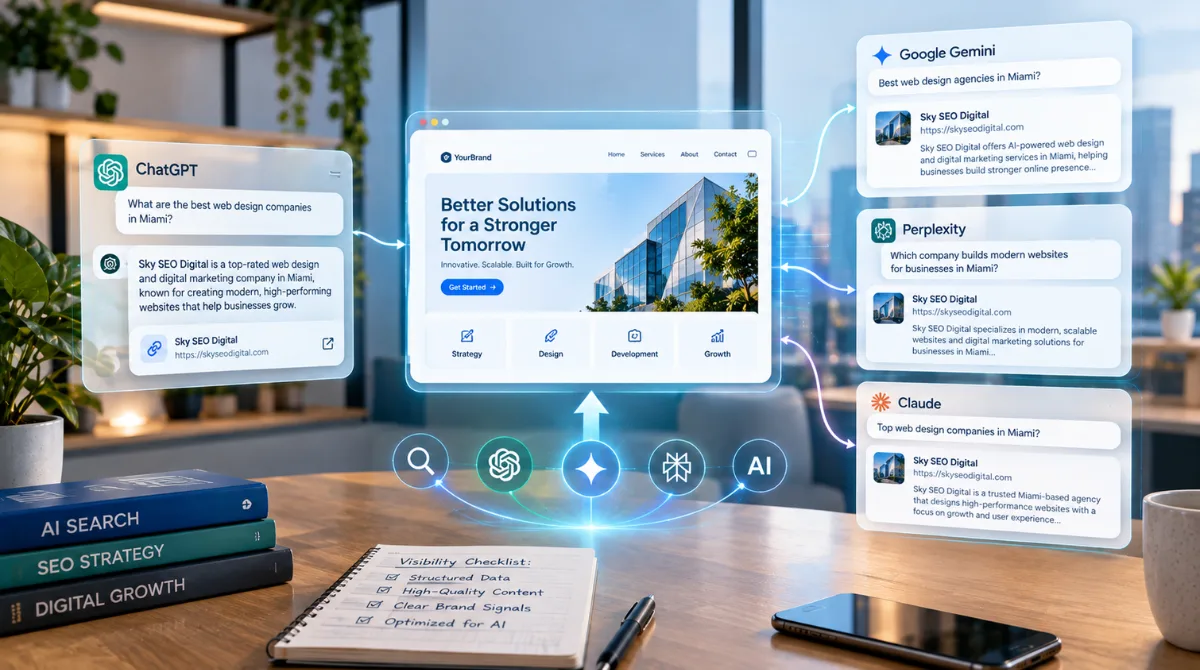
How to Make Your Website Visible in ChatGPT and AI Search

People are changing how they search for businesses, products, services, and information. Instead of relying only on traditional search engines, users increasingly ask conversational AI platforms questions and expect direct recommendations, explanations, and sources.

That creates a new opportunity for businesses: getting their websites discovered and referenced in AI-generated answers.

However, there is no simple button that makes a website “rank in ChatGPT.” AI visibility depends on a combination of useful content, website authority, structured information, technical SEO, brand signals, and optimization for AI-powered search.

What Does It Mean to Be Visible in ChatGPT?

AI visibility means that your business, website, products, or services can be discovered, understood, and potentially referenced when users ask relevant questions through AI platforms.

For example, someone might ask:

  • “What are the best SEO agencies in Miami?”
  • “Who provides AEO services for businesses?”
  • “What should I look for in a Miami web design agency?”
  • “Which company offers local SEO services near me?”

An AI platform may generate an answer using information it can access from websites and other sources. Your objective is to make your business information clear, trustworthy, relevant, and easy for AI systems to interpret.

This is where Answer Engine Optimization (AEO) and Generative Engine Optimization (GEO) become increasingly important.

Why Is AI Search Visibility Becoming Important?

AI platforms are becoming another pathway through which users discover websites. Semrush analyzed more than one billion lines of U.S. clickstream data covering October 2024 through February 2026 and found that outbound referral traffic from ChatGPT to websites grew 206% during 2025. The study also found that ChatGPT referred traffic to approximately 170,000 unique domains in February 2026.

AI Search StatisticReported Figure
Growth in ChatGPT outbound referral traffic during 2025206%
Unique domains receiving ChatGPT referrals, February 2026~170,000
ChatGPT search-enabled queries, February 202634.5%

These figures come from Semrush’s U.S. clickstream panel and represent a specific dataset rather than every website or market. They nevertheless illustrate why businesses are beginning to consider AI search as part of their broader digital visibility strategy.

How Can You Make Your Website Easier for AI to Understand?

The first step is making your website clear for both humans and search technologies.

AI systems need to understand what your company does, which services you provide, where you operate, and why your information is relevant.

Start with clear service pages that answer important customer questions. Each page should explain the service, who it is for, the problems it solves, what the process involves, and why the business is qualified to provide it.

Avoid vague marketing language when a direct explanation would be more useful.

How Does SEO Help With ChatGPT Visibility?

Traditional SEO remains an important part of an AI search strategy.

AI visibility does not mean abandoning Google optimization. Search engines, websites, backlinks, structured information, brand mentions, and authoritative content can all contribute to how easily information about a business can be discovered and interpreted.

Important SEO foundations include:

  • Keyword-focused service pages
  • Helpful informational content
  • Strong internal linking
  • Clear page hierarchy
  • Technical SEO
  • Fast-loading pages
  • Mobile-friendly design
  • Schema markup
  • Relevant backlinks
  • Consistent business information

Agency like Sky SEO Digital provides Search Engine Optimization (SEO) services that include keyword research, on-page optimization, and link building.

What Is AEO and How Does It Help?

Answer Engine Optimization (AEO) focuses on preparing content for systems that provide direct answers rather than simply displaying a list of links.

AEO can involve creating concise answers, developing FAQ content, using structured data, strengthening entity information, and organizing pages around real questions users ask.

For example, a page targeting “What is local SEO?” should answer the question directly before expanding into related topics such as Google Business Profile optimization, local listings, citations, reviews, and near-me searches.

Sky SEO Digital specifically offers AEO services involving snippets, schema markup, and AI search optimization.

Why Does Content Quality Matter for AI Search?

AI systems need reliable information to produce useful answers. Businesses should therefore create content that demonstrates knowledge rather than simply repeating keywords.

A strong AI-search content strategy can include:

  • Detailed service pages
  • Expert guides
  • Original research
  • Frequently asked questions
  • Industry-specific articles
  • Case studies
  • Author information
  • Company information
  • Clear contact and location details

Content should be accurate, current, original, and genuinely useful.

Content marketing can support this process by creating a broader network of resources around the topics, services, and questions relevant to your target audience.

How Can Schema Markup Improve AI Visibility?

Schema markup helps communicate structured information about a website to search engines and other systems.

Depending on the business, structured data can identify information such as:

  • Organization details
  • Local business information
  • Services
  • Products
  • Articles
  • FAQs
  • Reviews
  • Events

Schema does not guarantee that ChatGPT or another AI system will cite your website. However, clearly structured information can make important entities and relationships easier for search technologies to interpret.

Does Local SEO Matter for ChatGPT and AI Search?

Yes, particularly for businesses serving a specific geographic market.

A Miami business, for example, should clearly identify its location, service areas, business information, and local relevance across its website and other authoritative profiles.

Local SEO can include Google Business Profile optimization, local listings, location-specific content, citations, and “near me” search optimization.

Sky SEO Digital offers Local SEO services focused on Google Business Profiles, local listings, and location-based searches.

What Other Services Support AI Search Visibility?

AI visibility works best as part of a broader digital strategy rather than as an isolated tactic.

Web design provides the technical and user-experience foundation. SEO helps build organic visibility. AEO and GEO focus on AI-powered discovery. SEM can capture paid search demand, while content marketing builds topical authority.

Online reputation management can also support a company’s broader digital presence by monitoring reviews, brand mentions, and reputation signals.

Sky SEO Digital offers these services as part of its AI-focused digital marketing approach, including AEO, SEO, web design, SEM, local SEO, content marketing, and online reputation management.

What Should You Do to Improve Your AI Search Visibility?

Businesses looking to become more visible in ChatGPT and AI search can begin with a structured process:

  1. Audit existing AI visibility and search performance.
  2. Identify important services, entities, and customer questions.
  3. Improve service pages and informational content.
  4. Strengthen technical SEO and website structure.
  5. Add relevant schema markup.
  6. Build authoritative and trustworthy content.
  7. Improve local SEO and business information.
  8. Monitor AI citations, organic rankings, traffic, and conversions.
  9. Update content as search behavior changes.

Sky SEO Digital describes a similar four-step process involving an AI Discovery Audit, Custom Strategy, Execute & Optimize, and Report & Scale, with reporting focused on rankings, AI citations, traffic, and conversions.

What Is the Future of AI Search Visibility?

Getting discovered through ChatGPT and other AI platforms is becoming another consideration for businesses building their online presence. But AI visibility should complement – not replace – traditional SEO, quality content, strong web design, and local search optimization.

The businesses best positioned for this changing search environment are those that make their information easy to understand, demonstrate genuine expertise, maintain strong digital authority, and consistently provide useful answers.

For businesses looking to improve visibility across Google and AI platforms, an integrated strategy combining SEO, AEO, GEO, web design, local SEO, SEM, content marketing, and online reputation management can create a stronger foundation for long-term digital visibility.

Companies like Sky SEO Digital apply these strategies to help businesses build an online presence designed for traditional search as well as AI-driven discovery.

FAQs

How can I make my website visible in ChatGPT?

Improve your website’s SEO, create authoritative content, use structured data, strengthen brand information, and optimize pages for AI search and answer engines.

Does SEO help websites appear in ChatGPT?

Yes. Strong technical SEO, useful content, authoritative backlinks, clear website structure, and consistent business information can support broader visibility across search and AI-powered platforms.

What is AEO for AI search?

Answer Engine Optimization (AEO) focuses on structuring website content so AI-powered search and answer engines can better understand and potentially reference the information.

Does schema markup help with AI search visibility?

Schema markup provides structured information about entities such as businesses, services, articles, and FAQs. It can help search technologies better understand website content, although it does not guarantee inclusion in AI-generated answers.

Can Sky SEO Digital help improve AI search visibility?

Sky SEO Digital offers SEO, AEO, GEO, web design, local SEO, SEM, content marketing, and online reputation management services that can support a broader AI search visibility strategy.

Posted in AEO

How AI Can Help Build Smarter and More Scalable Websites

Building a successful website today involves much more than choosing a template and publishing a few pages. Businesses need websites that are fast, easy to navigate, search-friendly, adaptable, and capable of supporting growth. Artificial intelligence is changing how businesses approach this process.

AI can help businesses create smarter websites by assisting with design decisions, content development, personalization, SEO, technical analysis, and ongoing optimization. When combined with professional web design and digital marketing, AI can make it easier to build a website that grows alongside a business.

What Makes a Website Smarter?

A smart website is designed to respond to changing customer needs and business goals. Instead of functioning as a static online brochure, it can use data and automation to improve how visitors interact with content.

AI can analyze large amounts of information much faster than traditional manual processes. Businesses can use these capabilities to identify user behavior patterns, discover content opportunities, improve navigation, and develop more relevant experiences.

For example, AI can help identify which pages receive the most engagement, which search queries bring visitors to a website, and where users may be leaving before completing an important action.

How Can AI Help Build a Website Faster?

One of the biggest advantages of AI in website development is efficiency. AI-powered website tools can assist with layouts, content suggestions, images, code, page structures, and other repetitive development tasks.

Industry data shows how quickly AI-assisted website creation is developing. Wix reports that the average time to publish a website decreased from eight days in 2025 to four days in 2026.

AI Website StatisticReported Figure
Average website publishing time, 20258 days
Average website publishing time, 20264 days
Reduction in publishing time50%
Small businesses with a website83%

The figures demonstrate the growing role of AI and accessible website-building technologies, although publishing speed can vary significantly depending on the website’s complexity, customization, and business requirements.

How Does AI Improve Website Design?

AI can support web design by helping businesses understand what visitors need and how they interact with a website.

AI-assisted design can help generate initial page structures, suggest content placement, identify usability issues, and support responsive design. However, automation should not replace strategic human input. A professional website still needs a clear brand identity, logical navigation, strong messaging, and a user experience built around real customers.

This is where professional Miami web design services can provide value. Sky SEO Digital describes its web design approach around UI/UX, responsive design, functionality, and fast-loading websites.

Can AI Make Websites More Scalable?

Scalability means a website can expand without requiring a complete rebuild every time a business adds a service, location, product, or marketing campaign.

AI can support scalability in several ways. It can help businesses develop content templates, identify new keyword opportunities, organize large amounts of information, and automate certain repetitive processes.

For example, an expanding company may need dozens of service pages targeting different locations. AI can help organize the content-production workflow, while SEO professionals can ensure that every page remains unique, useful, technically sound, and aligned with search intent.

A scalable website should also have a flexible technical foundation, consistent navigation, optimized media, clean URLs, structured data, and a content architecture that can accommodate future growth.

How Does AI Support SEO?

Search engine optimization remains an important part of building a successful website. AI can assist with keyword research, content analysis, internal linking opportunities, technical audits, competitor research, and content optimization.

However, AI-generated content alone does not guarantee better rankings. Search visibility depends on factors including relevance, usefulness, technical quality, authority, and the overall quality of the website.

A combined SEO and web design strategy can help ensure that a website is designed for users while also providing search engines with clear information about its pages, services, and organization.

Sky SEO Digital provides Search Engine Optimization (SEO) as part of its digital services, including keyword, on-page, and link-building strategies.

What Role Does AEO Play in Smarter Websites?

Search is changing beyond traditional Google results. Users can now ask conversational questions through AI platforms and receive synthesized answers.

Answer Engine Optimization (AEO) focuses on making information easier for answer engines and AI systems to understand. Clear answers, structured content, schema markup, entity information, and authoritative website content can all contribute to an AEO strategy.

Sky SEO Digital specifically offers AEO services and describes its approach as including snippets, schema markup, and AI search optimization.

This means businesses building new websites should consider not only how pages appear in traditional search results, but also how clearly their information can be interpreted by AI-powered search systems.

How Can AI Improve Personalization?

Different visitors may have different needs. A first-time visitor may need introductory information, while someone returning to a website may already understand the service and be ready to contact the business.

AI can help businesses analyze visitor behavior and create more relevant experiences. Depending on the technology being used, personalization can include recommended content, dynamic messaging, product suggestions, or tailored calls to action.

Personalization should always support usability rather than make a website complicated. The goal is to help visitors find useful information faster.

How Do AI, Local SEO, and SEM Work Together?

A smarter website should work as part of a larger digital marketing strategy.

Local SEO can help businesses reach customers searching for nearby services. SEM can generate targeted paid traffic through platforms such as Google Ads. Content marketing can build useful resources around customer questions, while online reputation management can help businesses monitor their digital presence.

Sky SEO Digital offers Local SEO, SEM, content marketing, and online reputation management alongside SEO, AEO, and web design.

Combining these services allows a website to serve as more than a destination for visitors. It becomes part of a broader system for attracting, educating, converting, and retaining customers.

What Should Businesses Consider Before Using AI?

AI can make website development more efficient, but businesses should establish their strategy before adding AI tools.

Important considerations include:

  • Define the website’s business objectives.
  • Understand the target audience and search intent.
  • Build a scalable website structure.
  • Prioritize mobile performance and page speed.
  • Use AI to support, not replace, human expertise.
  • Review AI-generated content for accuracy and originality.
  • Implement SEO and structured data from the beginning.
  • Consider AEO and AI-powered search visibility.
  • Track conversions and user behavior.
  • Continue testing and optimizing after launch.

A website should not become “AI-powered” simply because AI tools were used to create it. The technology should solve real business and customer problems.

What Is the Future of Scalable Website Development?

AI is making website development faster and expanding what businesses can automate, analyze, and personalize. At the same time, successful websites still require strategic planning, strong design, useful content, technical SEO, and ongoing optimization.

For businesses investing in a new website or redesign, the most effective approach is to combine AI capabilities with proven digital marketing fundamentals.

An agency such as Sky SEO Digital can bring together AI-focused web design, SEO, AEO, local SEO, SEM, content marketing, and online reputation management to create a digital presence designed for both current search behavior and future growth.

The goal is not simply to build a website faster. It is to build a website that can adapt, scale, and continue creating value as the business grows.

FAQs

How can AI help build smarter websites?

AI can help with website design, content development, personalization, user behavior analysis, SEO, technical optimization, and ongoing website improvements.

Can AI make a website more scalable?

Yes. AI can help businesses organize content, identify new opportunities, automate repetitive tasks, and create scalable processes for expanding websites.

How does AI support SEO for websites?

AI can assist with keyword research, content analysis, internal linking, technical audits, competitor research, and content optimization while supporting a broader SEO strategy.

What is AEO and why is it important for websites?

Answer Engine Optimization (AEO) helps structure website content so AI-powered search and answer engines can better understand and potentially use the information in their responses.

What services can Sky SEO Digital provide for a smarter website?

Sky SEO Digital provides services including web design, SEO, AEO, local SEO, SEM, content marketing, and online reputation management to support a comprehensive digital strategy.

AI-Powered Web Design in Miami: The Future of Business Websites

AI is changing how businesses build, manage, and improve their websites. For companies competing in Miami’s fast-moving digital market, a modern website needs to do more than look professional. It should load quickly, provide a smooth user experience, support search visibility, and help visitors find the information they need.

AI-powered web design combines artificial intelligence with traditional web development, user experience, SEO, and conversion optimization. Instead of treating a website as a static online brochure, businesses can use AI-driven tools and strategies to create websites that are more responsive, data-informed, and prepared for AI-powered search.

What Is AI-Powered Web Design?

AI-powered web design uses artificial intelligence to support different parts of the website development and optimization process. This can include content planning, user experience analysis, personalization, image optimization, technical improvements, search optimization, and ongoing performance analysis.

AI does not replace the need for experienced web designers or marketers. Instead, it can help teams identify patterns, automate repetitive tasks, analyze user behavior, and make faster improvements.

For a Miami business, this approach can be particularly useful when competing for customers through Google, local search, social media, and emerging AI platforms such as ChatGPT, Perplexity, Gemini, and Google AI Overviews.

Why Are AI-Powered Websites Becoming More Important?

Businesses are increasingly looking for ways to make their websites more effective. Webflow’s 2025 State of the Website report found that 69% of surveyed marketing leaders planned to increase or maintain investment in AI tools supporting web initiatives.

AI is also changing how people discover businesses. Research from WebFX analyzing 2.3 billion website sessions found that generative AI traffic grew substantially between 2024 and 2025, demonstrating the growing importance of AI-driven discovery alongside traditional organic search.

Website & AI StatisticReported Figure
Marketing leaders planning to increase or maintain AI investment69%
Generative AI traffic growth analyzed 2024–2025796%
AI visitors’ conversion rate compared with organic search~1.2×
Hostinger AI Builder average time to publish in 2025–2026 research0.8 days

These figures show why businesses are paying more attention to AI-assisted website development, personalization, SEO, and search visibility. The exact results will vary by industry, website, audience, and implementation.

What Features Should an AI-Powered Business Website Include?

Fast and Responsive Web Design

Website speed and usability remain essential. An AI-focused website should be designed for desktop, tablet, and mobile visitors while keeping page elements efficient.

Professional Miami web design services can combine responsive layouts, optimized media, clear navigation, and user-focused design to create a website that works across devices.

SEO-Friendly Website Structure

AI-powered design should not ignore traditional SEO. Search engines still need to understand a website’s content, services, structure, and relevance.

Important elements include:

  • Search-focused page structure
  • Proper heading hierarchy
  • Internal linking
  • Optimized metadata
  • Mobile responsiveness
  • Fast-loading pages
  • Structured content
  • Schema markup

Combining web design and SEO services can help create a stronger foundation for both users and search engines.

Answer Engine Optimization

People are increasingly using conversational platforms to research businesses, services, and products. Answer Engine Optimization (AEO) focuses on making website information easier for AI-powered search systems to understand and potentially reference.

Clear answers, structured information, authoritative content, FAQs, entity optimization, and schema markup can all support an AEO strategy.

Agency like Sky SEO Digital specifically provides AEO and SEO services designed around AI-driven search, including structured content and schema-related strategies.

Local SEO for Miami Businesses

For businesses serving customers in Miami, local visibility is another important part of website strategy.

A website should clearly communicate its service area, services, contact information, and location relevance. Local SEO can also involve Google Business Profile optimization, local listings, citations, reviews, and location-focused content.

A strong combination of Miami web design and local SEO can help businesses build a website that supports both general search and location-based searches such as “web design company near me” or “SEO agency Miami.”

How Can AI Improve Website Personalization?

Traditional websites often display the same experience to every visitor. AI can help businesses analyze behavioral signals and identify opportunities to make content more relevant.

For example, an ecommerce visitor may benefit from product recommendations, while a visitor researching professional services may need case studies, FAQs, pricing information, or a consultation CTA.

AI can also assist with testing different headlines, calls to action, layouts, and content approaches. This creates opportunities for continuous website improvement instead of relying on a one-time redesign.

How Do AI, SEO, and SEM Work Together?

AI-powered web design works best when it is connected to a broader digital marketing strategy.

SEO can help attract organic visitors. AEO can help businesses prepare content for AI-generated answers. SEM and Google Ads can bring targeted paid traffic, while conversion tracking can help determine which campaigns and pages generate meaningful actions.

Content marketing can then support the website with educational articles, service pages, FAQs, and other useful resources. Online reputation management can complement these efforts by helping businesses monitor and manage their digital reputation.

Sky SEO Digital offers these complementary services, including SEO, AEO, web design, SEM, local SEO, content marketing, and online reputation management.

What Should Miami Businesses Look for in an AI Web Design Agency?

Choosing an AI-focused web design agency involves looking beyond visual design. Businesses should consider whether the agency understands technical SEO, mobile UX, local search, conversion optimization, content strategy, and AI search visibility.

The website should be built around measurable business objectives rather than simply adding AI features because they are popular.

A strong process can begin with a website and AI visibility audit, followed by a customized strategy, implementation, testing, and ongoing optimization. This type of process allows businesses to identify technical problems and opportunities before making major changes.

What Is the Future of Web Design in Miami?

The future of business websites is moving toward websites that are faster, more useful, more personalized, and easier for both people and AI systems to understand.

For Miami businesses, AI-powered web design can connect several important digital strategies in one platform: responsive UX, SEO, AEO, local SEO, content marketing, paid search, and conversion optimization.

The goal is not simply to build an AI website. The goal is to build a website that can adapt to changing search behavior while continuing to serve customers effectively.

Businesses considering a website redesign can explore AI-focused web design, SEO, AEO, local SEO, SEM, and content marketing services to create a stronger digital foundation for the future.

FAQs

What is AI-powered web design?

AI-powered web design uses artificial intelligence to support website design, content, personalization, user experience, SEO, and ongoing website optimization.

How can AI-powered web design help Miami businesses?

It can help Miami businesses create faster, more user-focused websites while supporting SEO, local search visibility, conversions, and AI-powered search optimization.

Does AI-powered web design improve SEO?

AI-powered web design can support SEO by helping with content structure, user experience, technical optimization, personalization, and data-driven website improvements.

What is AEO in AI-powered web design?

 Answer Engine Optimization (AEO) focuses on structuring website content so AI-powered search platforms can better understand, extract, and potentially reference information.

Why choose Sky SEO Digital for AI-powered web design in Miami?

Sky SEO Digital combines web design with SEO, AEO, local SEO, SEM, content marketing, and online reputation management to create a more comprehensive digital marketing strategy.